

Robotics Technology – Basic Concepts
Robotics refers to the science and engineering of designing, building, and operating robots. It combines mechanical engineering, electronics, and computer science to develop automated systems that perform tasks with precision, speed, and reliability in diverse environments.
A robot is a programmable machine capable of carrying out tasks autonomously or semi-autonomously. It senses its surroundings, processes information, and performs actions. Robots can work in hazardous, repetitive, or high-accuracy tasks where human efficiency is limited.
a) Sensors
Sensors gather real-time information about the robot’s environment. They measure light, sound, pressure, distance, or motion. This data helps robots make decisions, avoid obstacles, and respond accurately to dynamic surroundings.
b) Actuators
Actuators convert electrical signals into physical movement. They drive wheels, arms, grippers, or tools. Common actuators include electric motors, hydraulic cylinders, and pneumatic systems depending on required force and precision.
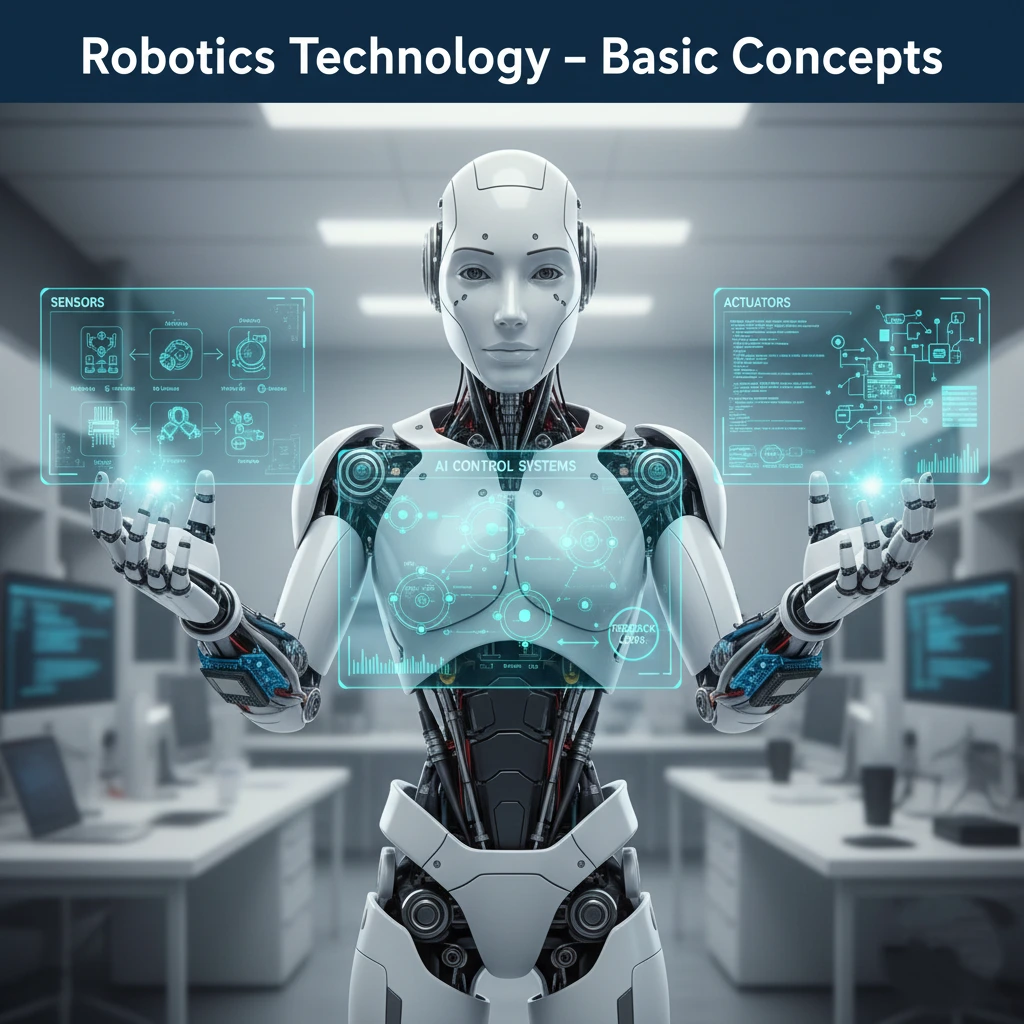
c) Control System
The control system acts as the robot’s brain. It receives sensory inputs, processes commands, and sends signals to actuators. Modern robots use embedded processors and algorithms to manage navigation, balance, and task execution.
d) Power Supply
Power sources provide the energy needed for movement and computation. Robots may use batteries, fuel cells, or wired electric supply. The choice depends on mobility, endurance requirements, and operational environment.
a) Industrial Robots
Used in manufacturing for welding, painting, assembling, and material handling. They deliver high precision and consistency in repetitive tasks. Their adoption is rising due to automation demands and productivity improvements.
b) Service Robots
Designed to assist humans in healthcare, hospitality, logistics, and domestic tasks. Examples include surgical robots, warehouse robots, and cleaning robots. They enhance efficiency and support human capabilities in daily activities.
c) Mobile Robots
These robots move across surfaces to navigate spaces. They include drones, autonomous vehicles, and ground robots. They rely heavily on sensors, mapping technologies, and real-time decision-making algorithms.
d) Humanoid Robots
Humanoids resemble humans in structure or behaviour. They walk, speak, recognize faces, and perform interactions. They are used for research, assistance, and public engagement, contributing to human-robot collaboration studies.
a) Automation
Automation refers to using machines to perform tasks with minimal human intervention. Robotics is a key driver, improving speed, accuracy, and safety, especially in industries where manual processes are slow or risk-prone.
b) Artificial Intelligence Integration
AI enables robots to learn, adapt, and make decisions. Machine vision, speech recognition, and reinforcement learning allow robots to operate in complex environments. AI-enabled robots are crucial for future autonomous systems.
c) Degrees of Freedom
This concept defines how many independent movements a robot can perform. Higher degrees of freedom allow complex actions such as rotating, bending, or grasping objects, essential for advanced manipulation tasks.
Robotics supports defence, space exploration, disaster response, agriculture, and precision healthcare. Future trends include soft robotics, swarm robotics, and human-robot collaboration. Growing AI capabilities will make robots more adaptive, efficient, and safe for real-world deployment.
Why India Must Stay Robotics-Ready?
Overview
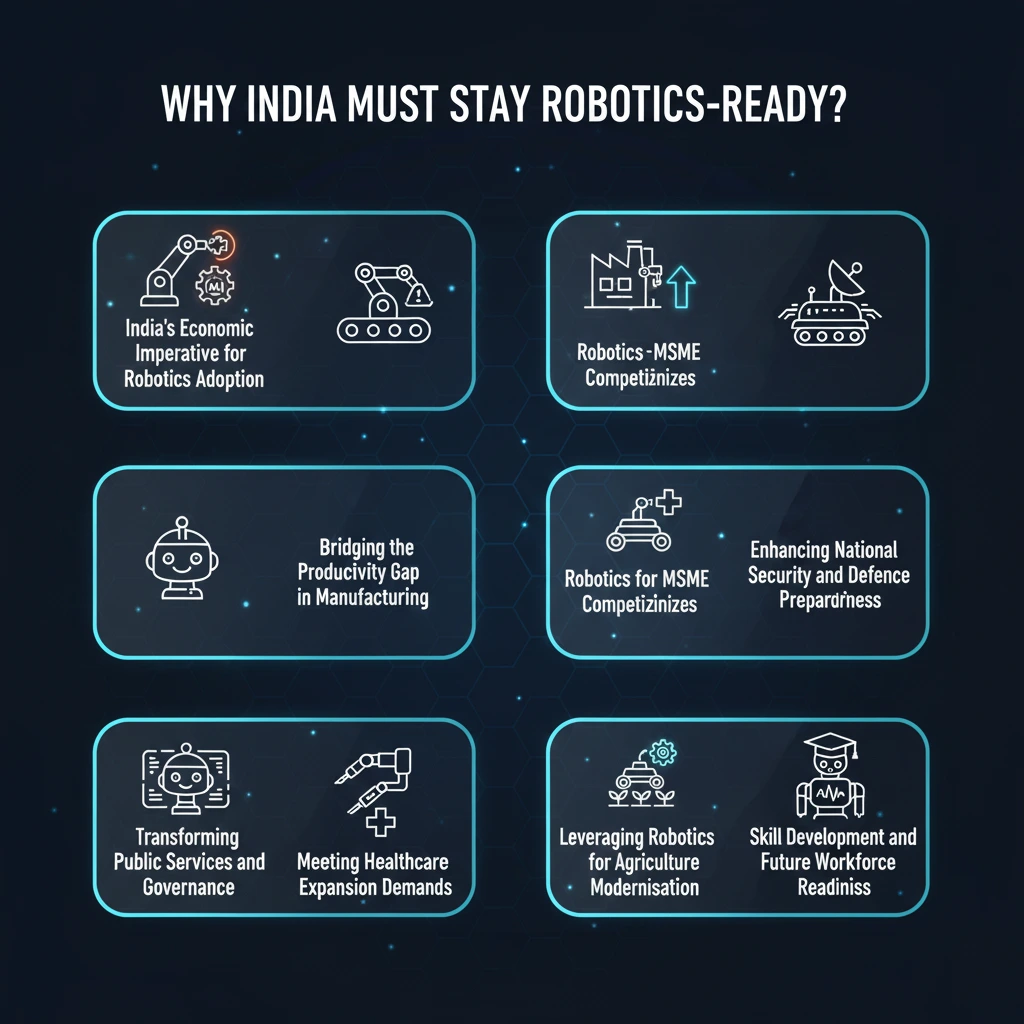
Robotics is rapidly transforming production, services, governance, and security worldwide. As countries adopt automation to boost resilience, India must ensure that its demographic strength, economic ambitions, and global competitiveness remain aligned with emerging robotic technologies.
Strategic Need
Embracing robotics is a critical national strategy to enhance productivity, strengthen defence preparedness, modernise public services, and create a future-ready, high-skill workforce essential for India’s global standing.
Growth & Productivity
India’s growth targets require a sharp rise in productivity. Robotics-enabled automation can strengthen manufacturing quality, reduce defects, and support Make in India ambitions.
Global Standards
It also helps Indian industries match global standards in electronics, automobiles, pharmaceuticals, and precision engineering.
Addressing Bottlenecks
India’s labour-intensive manufacturing faces frequent bottlenecks—skill gaps, inconsistent output, and supply chain delays.
Stable Production
Robotics provides stable, high-speed, low-error production cycles. This helps India compete with technologically advanced economies that already use industrial robots extensively.
Cobots for Small Units
MSMEs struggle with efficiency, quality control, and rising labour costs. Affordable collaborative robots (cobots) can assist small units by performing repetitive, hazardous, or precision-based tasks.
Human Upskilling
This automation allows human workers to focus on creativity, supervision, and high-value roles, transforming the nature of MSME work.
Modern Warfare
Modern warfare increasingly uses unmanned systems, robotic surveillance, automated logistics, and AI-assisted platforms.
Self-Reliance
Staying robotics-ready ensures India develops indigenous capabilities, reduces import dependence, and prepares the armed forces for multi-domain, technology-driven future conflicts.
Emergency and Utilities
Robotics can support India’s governance needs—disaster response, sanitation, health diagnostics, and smart city management.
Hazardous Tasks
Robots can inspect hazardous sites, assist emergency teams, and strengthen urban service delivery where human access is limited or risky.
Accuracy and Workload
Surgical robots, diagnostic automation, and hospital logistics robots enhance accuracy, reduce workloads, and improve patient outcomes.
Shortage Areas
They are especially beneficial in areas facing a shortage of skilled medical professionals, democratising high-tech healthcare.
Precision Farming
Robotic weeders, harvesters, drones, and precision agriculture systems can boost farm productivity, especially in the face of labour shortages.
Sustainability
They help manage labour shortages, reduce chemical usage, and provide real-time crop insights, making agriculture more sustainable and resource-efficient.
Education Focus
As automation increases, India must strengthen STEM education, vocational training, and robotics-driven curricula to prepare its youth.
Job Creation
A robotics-ready workforce ensures employment adaptability, supports innovation ecosystems, and shields youth from job displacement risks through high-skill job creation.
Supportive Frameworks
India’s growing robotics start-ups need supportive policy frameworks, testing zones, R&D incentives, and strong industry-academia linkages to thrive.
Self-Reliance
Indigenous development reduces import bills, enhances self-reliance, and positions India as a global supplier of affordable robotic solutions.
Establishing Standards
Robotics adoption demands strong standards on data privacy, autonomous decision-making, liability, and cybersecurity.
Proactive Regulation
Proactive regulation helps India manage risks while enabling safe experimentation, innovation, and responsible deployment across sectors.
Integration Mandate
To sustain high growth, create skilled jobs, strengthen defence, and modernise governance, India must integrate robotics across education, industry, and public systems.
Future Resilience
Staying robotics-ready is essential for long-term resilience, global competitiveness, and inclusive development, positioning India for the automated future.
Components in Robots
Robots are engineered systems designed to sense, think, and act in controlled or unpredictable environments. Their components work together to accomplish automated, precise, and repeatable tasks. Understanding these elements helps in analysing applications, limitations, and ethical concerns in robotics.
Structure & Stability
The robot’s structure provides shape, stability, and strength. It includes frames, joints, and linkages. Materials like aluminium, carbon fibre, and composites ensure lightweight durability.
Functionality
The mechanical body determines reach, payload capacity, dexterity, and suitability for industrial, medical, or defence uses.
Actuators convert electrical energy into motion. They operate robotic joints and enable linear or rotational movement. Common types include electric motors, hydraulic cylinders, and pneumatic actuators. Choice of actuator affects precision, force output, and response speed in mission-critical tasks.
Sources
Power systems provide the energy needed for sensing, computation, and movement. Robots may use batteries, fuel cells, wired power, or hybrid arrangements.
Considerations
The selection depends on required mobility, power density, endurance, safety, and expected operating conditions.
Sensors allow robots to perceive their environment and internal states. Vision cameras, LIDAR, accelerometers, proximity sensors, and force-torque sensors provide critical inputs. Sensor fusion ensures reliable situational awareness, enabling safe navigation, accurate manipulation, and autonomous decision-making.
Function
Controllers execute algorithms, regulate movement, and coordinate tasks. They interpret sensor data, compute trajectories, and issue commands to actuators.
Technology
Modern controllers use microprocessors, embedded systems, and AI-enabled computing units for precision and adaptive behaviour in dynamic environments.
End effectors are the tools attached to robotic arms for performing specific actions. Grippers, welding torches, surgical instruments, and suction cups are typical examples. Their design influences task accuracy, material compatibility, and the robot’s overall application versatility.
Mobility
Mobile robots use wheels, tracks, or legged mechanisms for movement. Drive systems determine speed, terrain adaptability, and manoeuvrability.
Types
Differential drive, skid steering, and omnidirectional wheels are widely used depending on operational complexity and required motion precision.
Robots require communication channels to interact with humans, networks, and other machines. Wired protocols, wireless connectivity, and IoT-based systems ensure real-time data exchange. Secure and low-latency communication improves coordination, remote control, and multi-robot collaboration.
Integration
Software integrates all hardware components and governs the robot’s behaviour. Operating systems like ROS manage planning, perception, and control.
Autonomy
Algorithms for mapping, localisation, and learning enable autonomous functioning and help scale robots across diverse applications.
Robots incorporate safety sensors, emergency stops, thermal protection, and fault-diagnosis units. These mechanisms prevent accidents, protect hardware, and enhance trust in human-robot interaction. Compliance with global safety standards is essential for industrial deployment.
Application of Robotics
Robotics refers to the design, development and deployment of machines capable of performing tasks autonomously or semi-autonomously. Modern robotics integrates mechanical engineering, electronics, sensors and artificial intelligence to create machines that enhance precision, speed and safety.
Robots are increasingly used across industries due to rising automation demands, labour shortages, cost efficiency and the need for high-quality, repetitive task execution. Their applications influence economic productivity and strategic capabilities.
Industrial Robots
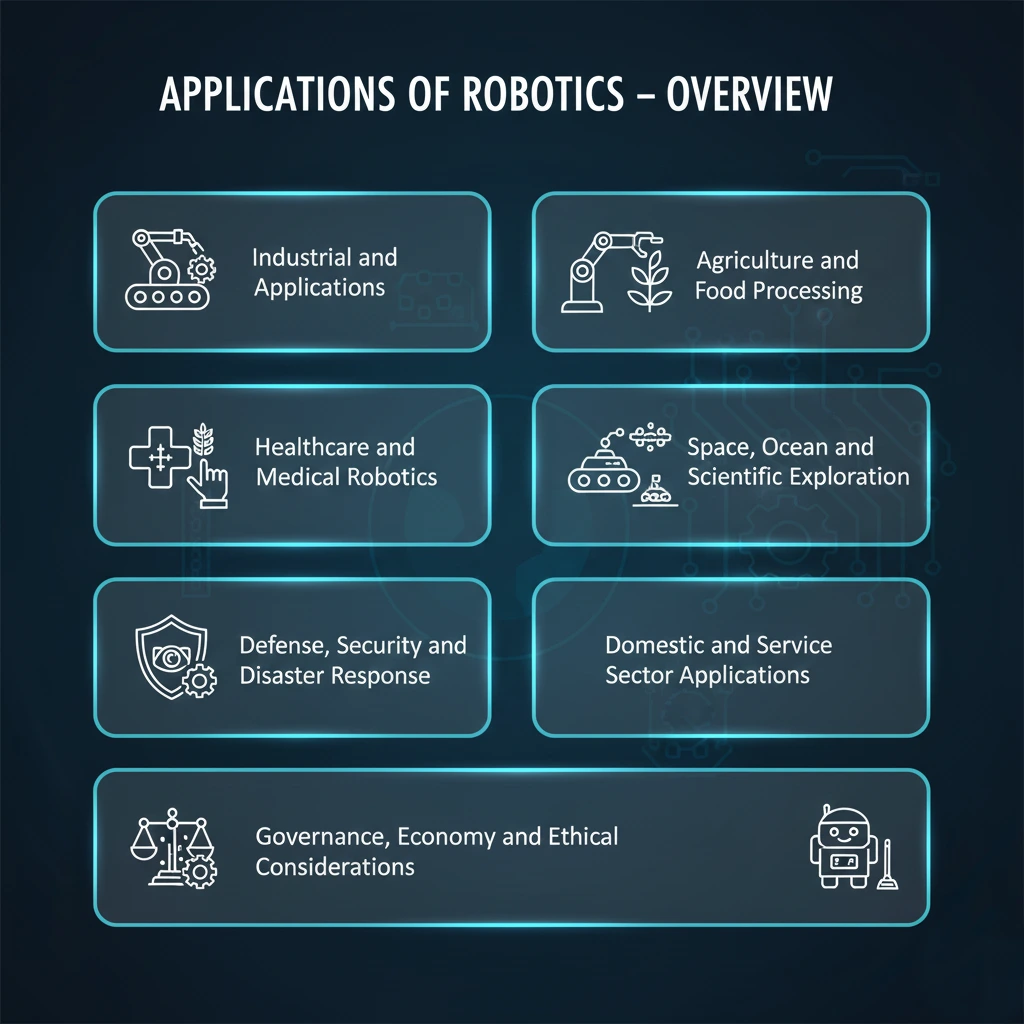
Industrial robots perform tasks such as welding, assembly, packaging and material handling with high accuracy. They reduce human error and ensure uniform product quality, especially in automobile, electronics and heavy-engineering sectors.
Collaborative Robots ("Cobots")
Collaborative robots or “cobots” work alongside humans. They are designed with advanced sensing and safety mechanisms, helping small and medium industries adopt automation without high installation costs.
Surgical Robotics
Surgical robots assist doctors in minimally invasive procedures by offering precision, tremor reduction and remote operation capabilities. This improves patient recovery and reduces complications.
Rehabilitation and Prosthetics
Rehabilitation robots support physiotherapy and assisted movement for patients with neurological injuries. Robotic prosthetics enhance mobility through sensor-based movement replication.
Military and Security
Defence forces employ robots for bomb disposal, surveillance, logistics and unmanned operations in hostile environments. They reduce risk to soldiers and improve mission accuracy.
Disaster Response
Search-and-rescue robots operate in collapsed structures, chemical spills and fire zones. Equipped with cameras and sensors, they identify survivors and map hazardous areas safely.
Precision Farming
Agricultural robots support precision farming through automated sowing, spraying and harvesting. They help optimise input usage, manage labour shortages and improve crop monitoring.
Food Handling and Quality
In food processing, robots ensure hygienic, rapid handling of packaging, sorting and quality checks, reducing contamination risks and supporting large-scale processing.
Space Exploration
Space agencies use rovers and robotic arms for planetary exploration, satellite maintenance and sample collection. Robots perform tasks impossible or unsafe for humans in deep space missions.
Oceanography
Underwater robots assist oceanography by mapping sea floors, inspecting pipelines and monitoring marine biodiversity. They withstand high pressure and low-visibility conditions.
Service Sector
Service robots handle cleaning, delivery, inventory management and customer interaction in hotels, hospitals and airports. They aid human efficiency and reduce operational time.
Domestic Use
Domestic robots like vacuum cleaners, lawn mowers and smart assistants improve household convenience. Their adoption is rising with advancements in sensors and connectivity.
Economic Impact
Robotics boosts productivity, creates new skill demands and transforms employment patterns. Policymakers must balance automation benefits with workforce skilling and inclusive growth.
Ethics and Regulation
Ethical concerns include safety, privacy, accountability and AI-driven decision-making. Clear standards and regulatory frameworks are essential for responsible robotic deployment.
Shaping Tomorrow: India’s Robotics Revolution
India’s robotics revolution is driven by space exploration, healthcare needs, public service efficiency, defence preparedness and industrial automation. Together, these developments strengthen national capacity, reduce human risk and create future-ready governance and economic systems.
Robotics involves designing intelligent machines that sense, analyse and act. In India, robots are increasingly used for hazardous tasks, precision operations, public interaction and mission support. Their growth aligns with the Digital India and Atmanirbhar Bharat visions.
Vyommitra
ISRO’s Vyommitra, a female humanoid robot, will assist the Gaganyaan mission by monitoring modules, simulating human functions and supporting safety checks.
Applications
It represents India’s entry into sophisticated space robotics with applications for long-duration and deep-space missions.
Hospital Deployment
Indian hospitals now deploy robotic surgical systems, telepresence robots and rehabilitation devices. Indigenous innovations aim to reduce costs and widen access.
Benefits
Robotics enhances accuracy, reduces infection risks and provides remote care—critical during pandemics and for rural outreach.
Bandicoot Robot
Bandicoot, developed by Kerala-based Genrobotics, modernised sanitation by replacing manual scavenging. Its latest variants assist in wildlife monitoring and hazardous cleaning operations.
Impact
It highlights how robotics can promote dignity, safety and scientific conservation.
KP-Bot Example
The Kerala Police’s KP-Bot, an AI-enabled robotic receptionist, handles visitor interaction, basic queries and document support.
Governance
Similar deployments across states show the government’s interest in contactless, transparent and citizen-friendly service delivery using robots.
Deployment Areas
Indian defence agencies use bomb-disposal robots, reconnaissance bots and autonomous ground vehicles. DRDO’s systems focus on high-risk operations, border surveillance and disaster tasks.
Strategic Advantage
These robots reduce soldier exposure and strengthen real-time strategic decision-making.
Industry Adoption
Indian industries adopt robots for welding, assembly, packaging and inspection. The growth of micro-robots, collaborative robots (cobots) and low-cost automation helps MSMEs improve quality and compete globally.
Ecosystem
Start-ups and FDI push the ecosystem further by focusing on enhanced productivity and quality control.
Nurturing Skills
Robotics labs under Atal Innovation Mission, university incubators and maker spaces nurture early skills and innovation.
Start-up Focus
India’s start-up ecosystem develops robots for agriculture, logistics, hospitality and retail. Skilling missions emphasise coding, AI integration and machine maintenance.
Key issues include high import dependence for sensors and precision components, limited funding for advanced R&D, skill gaps in robotics engineering, ethical concerns and the need for clear national standards.
Affordable indigenous hardware remains a major bottleneck.
India must promote local manufacturing, support deep-tech start-ups, integrate robotics with AI and 5G, expand mission-based funding and build specialised talent.
Strong regulation and public–private partnerships will accelerate safe, inclusive and scalable robotics adoption.
Institutions Driving the Robotics Revolution — India
India’s robotics ecosystem is expanding rapidly due to government missions, academic R&D, and industry-led innovation. Institutions act as the backbone—funding research, enabling standards, and pushing robotics into manufacturing, healthcare, defence, agriculture, and services.
2.1 Ministry of Electronics and Information Technology (MeitY)
MeitY drives India’s digital manufacturing agenda. It supports robotics through electronics design schemes, AI–robotics integration programs, and Centres of Excellence. It also promotes indigenous components, reducing dependence on imported sensors and actuators.
2.2 NITI Aayog
NITI Aayog promotes frontier technologies through the Atal Innovation Mission. Its initiatives support robotics start-ups, school-level tinkering labs, and nationwide competitions. These programs build early-level skills and create a broad innovation pipeline.
2.3 Department of Science and Technology (DST)
DST funds academic laboratories working on industrial, medical, and social robots. Its Technology Missions support sensor development, autonomous navigation, and robotic arms. DST also anchors collaborations between universities and high-technology industries.
3.1 C-DAC (Centre for Development of Advanced Computing)
C-DAC leads national efforts in high-performance computing and embedded systems. Its robotics work includes control systems, machine vision, and autonomous platforms. C-DAC collaborates with defence and disaster-response agencies for rugged, field-ready robotic systems.
3.2 CSIR Laboratories
Multiple CSIR labs—such as CMERI and CSIO—build indigenous robotic arms, humanoid prototypes, agro-robots, and inspection robots. CSIR focuses on affordable, India-specific solutions suited for harsh climatic and industrial conditions.
3.3 DRDO
DRDO develops defence robotics, bomb-disposal units, unmanned ground vehicles, and autonomous surveillance systems. Emphasis is on ruggedisation, secure communication links, and real-time situational awareness for use in sensitive and high-risk border zones.
4.1 IITs and IISc
IITs and IISc host advanced robotics centres working on locomotion, haptics, drones, and human-robot interaction. These institutes develop low-cost manipulators, modular mobile robots, and AI-driven decision systems. They also supply skilled manpower to industry and government.
4.2 National Robotics Mission Labs
Several institutions host mission-aligned labs working on surgical robotics, warehouse automation, assistive robots, and precision farming. Their outputs support Make in India goals by strengthening domestic intellectual property and translational research.
5.1 Start-ups and Incubators
Incubators such as T-Hub, Atal Incubation Centres, and IIT-linked incubators support robotics start-ups. They provide prototyping support, testing facilities, and investor linkages. Their focus areas include warehouse robots, delivery bots, drones, and AI-enabled automation tools.
5.2 Manufacturing and Industrial Automation Companies
Private industry drives adoption in automotive, electronics, and logistics sectors. Indian firms increasingly integrate collaborative robots, machine-vision systems, and autonomous guided vehicles to enhance productivity and global competitiveness.
6.1 Bureau of Indian Standards (BIS)
BIS develops standards for robotic design, safety, interoperability, and human-machine interaction. Standardisation improves reliability and accelerates industrial adoption, especially in manufacturing and healthcare applications.
6.2 National Programmes
Programmes such as Digital India, Make in India, and SAMARTH-Udyog promote robotics adoption. They catalyse Industry 4.0 readiness by supporting smart factories, skill development, and integration of AI-robotics in MSMEs.
India’s robotics revolution is institution-driven, innovation-focused, and strategically aligned with national developmental goals. Strong government support, academic excellence, and industry momentum position India to become a competitive global hub for advanced robotics.
India’s Roadmap for Transformative Robotics
Robotics is emerging as a key driver of productivity, precision, and safety across sectors. For India, robotics strengthens manufacturing competitiveness, improves service delivery, reduces human risk in hazardous tasks, and enhances national capacity in frontier technologies essential for a $5-trillion digital economy.
India’s robotics landscape is expanding through start-ups, research labs, and domestic automation demand. Applications have grown in automobile plants, logistics, healthcare, agriculture, and defence. However, high costs, low indigenisation, and limited skilled manpower still restrict widespread adoption.
India’s long-term vision aims at developing globally competitive, affordable, and resilient robotic systems. Objectives include boosting indigenous R&D, enabling local manufacturing, expanding applied robotics in public services, and integrating robots into national missions such as Digital India and Make in India.
Policies such as the National Strategy for AI, Make in India, Atmanirbhar Bharat, and PLI schemes indirectly support robotics growth. State-level initiatives and academic-industry collaborations further promote innovation, testbeds, and robotic centres to accelerate real-world applications.
a) Indigenous R&D and Innovation
India seeks to develop core robotics technologies—sensing, actuation, vision systems, and AI-based autonomy. Expanding Centres of Excellence, mission-oriented research, and open-innovation challenges can reduce dependency on imported systems.
b) Scalable Domestic Manufacturing
Boosting local production requires component fabrication, MSME participation, and integration with global value chains. A unified robotics manufacturing cluster could help standardise components, reduce costs, and enhance export readiness.
c) Workforce Upskilling and Human–Robot Collaboration
A future-ready workforce requires skilling in mechatronics, AI, embedded systems, and repair services. Human–robot collaboration must emphasize safety, ethical use, and redesigning workflows to complement human labour instead of replacing it.
d) Robotics for Public Service Delivery
Robotics can enhance efficiency in sanitation, disaster management, mining safety, precision agriculture, healthcare assistance, and public transport. Pilot deployments and urban innovation missions can showcase scalable, cost-effective models for Indian conditions.
e) Robust Regulatory and Ethical Framework
A clear framework is needed for safety standards, data protection, liability, cybersecurity, and ethical deployment. Transparent guidelines will build public trust, protect workers, and encourage responsible innovation.
Manufacturing and MSMEs
Robotics can boost precision, reduce defects, and increase competitiveness in electronics, textiles, and auto components. Low-cost cobots can help MSMEs automate without large capital expenditure.
Healthcare and Assistive Robotics
Robotic surgery, rehabilitation aids, and hospital automation can reduce workload and enhance patient care. Indigenous development can make advanced care affordable for wider populations.
Agriculture and Rural Applications
Robotic sprayers, harvesters, and monitoring drones can address labour shortages and improve crop productivity. Affordable, rugged solutions tailored for small farmers are crucial.
Defence, Space, and Disaster Response
Robots for surveillance, bomb disposal, space exploration, underwater tasks, and disaster relief can reduce human risks and strengthen national security capabilities.
A dedicated mission can unify funding, standards, industry participation, procurement pipelines, and talent development. Multi-stakeholder collaboration will ensure that robotics becomes a transformative pillar of India’s economic growth and technological self-reliance.
Power Source
Power Source in Robots
Robots require a dependable power source to run sensors, actuators, controllers, and communication systems. The choice of power system influences a robot’s mobility, size, load capacity, and operational duration, making it a core design parameter in robotics.
A robot’s performance depends on stable energy delivery. Power systems affect efficiency, safety, autonomy, and environmental impact. UPSC often asks about energy density, battery types, and suitability of power systems in different robotic platforms.
Batteries offer portable, rechargeable energy. They are preferred in service robots, drones, and educational robots due to low noise, easy integration, and high reliability in controlled environments.
Lithium-ion Batteries
These provide high energy density, fast charging, and long cycle life. They support lightweight humanoids, drones, and industrial arms where compactness and efficiency are critical.
Lead-acid Batteries
Older but cost-effective options. Suitable for large ground robots requiring high starting currents, though heavier and slower to recharge compared to modern alternatives.
Offer moderate energy density and safety. Used in mid-range robots needing a balance of cost, weight, and durability, such as mobile service units.
Supercapacitors deliver quick bursts of power and recharge rapidly. They supplement batteries in robots with sudden energy demands, improving peak performance and extending battery life.
Used in heavy-duty outdoor robots requiring long-range operation. They offer high power output but create noise, heat, and emissions, making them unsuitable for indoor or sensitive environments.
Hydraulic Power
Offers high force for industrial robots and exoskeletons, suitable for heavy lifting and demanding tasks.
Pneumatic Systems
Are lightweight and clean, ideal for soft robots needing safe, flexible motion. Both require compressors or pumps for continuous operation.
Fuel cells generate electricity through chemical reactions, providing long-duration power with low emissions. They are promising for field robots, defence applications, and high-end autonomous platforms.
Solar Power Systems
Solar-powered robots use photovoltaic panels to extend mission duration. They are efficient for outdoor, slow-moving robots such as environmental monitoring units.
Wireless Power Transfer (WPT)
WPT enables robots to charge without physical contact through inductive or resonant coupling. It supports continuous operation in warehouses and automated production lines.
Selection depends on mission duration, payload, mobility, operating terrain, safety needs, and energy density. Balancing power, weight, efficiency, and cost is essential for optimal robot design.
Controllers
Controllers in Robotics
A controller is the “brain” of a robot. It receives data from sensors, processes it using programmed logic, and sends commands to actuators. It ensures that the robot performs tasks accurately, safely, and in the desired sequence.
Controllers determine how well a robot understands its surroundings, adjusts its movement, and maintains precision. Without controllers, robots cannot coordinate their limbs, regulate motion, or respond to changes in real time.
A robotic controller performs computation, decision-making, task scheduling, and motion regulation. It translates high-level instructions into low-level motor commands, forming the bridge between human programming and physical robotic action.
Controllers filter, interpret, and convert raw sensor data into meaningful information. This processing enables robots to identify obstacles, measure distances, and maintain balance while executing complex movements.
Controllers compute the speed, direction, and acceleration required for each robotic joint. They ensure smooth trajectories, avoid jerks, and maintain accuracy—crucial for industrial, surgical, and precision-based robotic systems.
Controllers run algorithms, safety rules, and logical sequences. They determine how robots switch tasks, respond to failures, and maintain safe operating boundaries during unpredictable situations.
Programmable Logic Controllers (PLCs)
Widely used in manufacturing robots, PLCs excel in repetitive and time-bound operations. They offer stability, robustness, and easy fault diagnosis, making them suitable for assembly lines and industrial automation.
Microcontroller-Based Controllers
These compact systems are ideal for small robots and educational platforms. They integrate computation and memory on a single chip, delivering cost-efficient and energy-efficient control.
Computer-Based Controllers
Used in advanced robots, these controllers combine CPUs, GPUs, and high-level software. They support artificial intelligence, computer vision, and complex motion planning for autonomous and service robots.
Distributed Controllers
In large or multi-joint robots, control tasks are shared across multiple microprocessors. This reduces latency, improves coordination, and enhances reliability in high-speed robotic applications.
Hardware Component
It includes processors, memory units, communication interfaces, and power modules. These components enable data computation, storage of programs, and real-time command transmission.
Software Component
Software includes operating systems, control algorithms, safety protocols, and user interfaces. It determines how robots learn, adapt, and respond to different working conditions.
AI-enabled controllers integrate machine learning to enable prediction, self-correction, and adaptive behaviour. This reduces human intervention and enhances autonomy in navigation, manipulation, and decision-making.
Sensors
Sensors: As a Component of Robots
Sensors are devices that allow a robot to gather information from its environment. They convert physical inputs—such as light, heat, distance, or pressure—into electrical signals. This makes sensors essential for autonomous decision-making and precise task execution.
Sensors act as the robot’s “sensory organs.” Without them, a robot cannot detect obstacles, measure position, or interact safely with humans. They enable perception, control, and adaptability—three fundamental requirements for intelligent robotic systems across industrial and service sectors.
3. Proximity and Distance Sensors
These sensors help robots detect nearby objects and measure distance for navigation. Common examples include infrared, ultrasonic, and laser distance sensors. They prevent collisions, aid in mapping, and support automated movements in dynamic environments.
4. Vision and Imaging Sensors
Vision sensors capture images or video and enable object recognition. Cameras, LiDARs, and structured-light sensors fall under this category. They support complex tasks such as autonomous driving, quality inspection, and human-robot interaction by providing high-accuracy spatial data.
5. Motion and Position Sensors
Motion sensors measure orientation, acceleration, and rotation through gyroscopes, accelerometers, and IMUs. Position sensors like encoders help track joint movement. These sensors maintain balance, stability, and precision in robotic arms and mobile platforms.
6. Tactile and Force Sensors
Tactile sensors detect touch, pressure, and texture, enabling robots to grasp delicate objects safely. Force-torque sensors measure applied loads at robotic joints. Together, they improve dexterity, support sensitive operations, and reduce chances of accidental damage.
Environmental sensing involves measuring temperature, humidity, gas concentration, and radiation. Robots working in hazardous zones—mines, reactors, or disaster sites—use these sensors for safe operations and to provide real-time situational data to human controllers.
8. Navigation and Mapping
Robots use distance, imaging, and inertial sensors to create maps of unfamiliar spaces. Sensor fusion techniques combine multiple inputs, improving navigation accuracy. This supports applications like warehouse automation, planetary exploration, and disaster-response missions.
9. Control and Feedback Mechanisms
Sensors provide continuous feedback to robot controllers. This enables closed-loop control, ensuring actions adjust to real-time conditions. Such feedback improves performance in tasks requiring accuracy—welding, surgery, or precision assembly.
10. Safety and Human–Robot Collaboration
Sensors detect human presence, monitor workspace conditions, and regulate robot speed. Collaborative robots rely heavily on vision and force sensors to operate safely alongside people. This reduces workplace accidents and enhances acceptance of robotic systems.
Sensor data may suffer from noise, delays, or calibration errors. Integrating multiple sensors increases complexity and cost. Ensuring interoperability, reliability, and environmental robustness remains a major engineering and policy-level challenge in large-scale automation.
Sensors enhance robot intelligence by enabling perception, safety, and precision. As automation expands, understanding sensor technologies becomes essential for UPSC aspirants to link robotics with governance, industry, and emerging-technology policy frameworks.
Actuators
Actuators in Robotics
Meaning of Actuators
Actuators are mechanical components that convert electrical, hydraulic, or pneumatic energy into physical motion. They act as the “muscles” of a robot, enabling controlled movement of joints, wheels, arms, and grippers as per commands from the controller.
Basic Working Principle
Actuators receive a control signal, process energy, and generate motion through mechanical movement. This motion may be linear or rotational. Feedback from sensors helps maintain accuracy, forming a closed-loop system essential for modern intelligent robots.
Why Actuators Matter
Robots cannot perform tasks by sensors and processors alone; they need actuators to translate decisions into motion. The precision, speed, and strength of actuators directly influence a robot’s efficiency, accuracy, and operational capability in industrial and service environments.
Linear Motion
This is motion in a straight line, used in lifting, pushing, or sliding mechanisms in robots, such as in conveyor systems or linear slides for precision positioning.
Rotary Motion
This is circular movement, commonly used in rotating joints, robotic arms, and wheels. It’s fundamental for creating multi-degree-of-freedom manipulators.
Electric Actuators
Use motors powered by electricity (DC, stepper, servo). They offer high precision, easy control, and lower noise. They dominate home robots, humanoids, and autonomous mobile robots due to simplicity and control.
Hydraulic Actuators
Use pressurized fluid to generate high force. They are ideal for heavy-duty robots, construction automation, and robotic arms requiring strong load-bearing capacity, despite risks of leakage and higher maintenance.
Pneumatic Actuators
Rely on compressed air for quick, repetitive motion. They are widely used in assembly lines and light automation tasks. They are inexpensive and fast, but offer lower precision than electric or hydraulic types.
Soft Actuators (Emerging)
Use flexible materials, shape-memory alloys, or polymers to mimic natural muscle movement. They enable safer human–robot interaction and are used in medical robotics, wearable exosuits, and biomimetic robots.
Key Performance Parameters
Important parameters include torque, speed, precision, energy efficiency, payload capacity, and response time. Understanding these characteristics is crucial for designing robots for specific industrial or defence applications.
Actuators vs. Sensors
Sensors gather information from the environment (input), while actuators act on that information (output). Together with controllers, they form the basic functional triad of robotics. Without actuators, robots remain passive systems incapable of performing physical tasks.
Snapshot
Actuators link robotics with manufacturing, defence, health, disaster response, and space technology. Understanding their types and functioning helps in Science & Tech Prelims questions and strengthens Mains answers on automation, Industry 4.0, and AI-driven technologies.
Agriculture
Agriculture – Robotics Application
Robotics in agriculture refers to automated machines designed to perform farming tasks with high precision. It aims to tackle labour shortages, increase productivity, and support climate-resilient cultivation.
Robots in fields help reduce human drudgery and improve efficiency in repetitive agricultural operations.
Agriculture faces skilled labour scarcity, rising input costs, and demand for higher quality produce.
Robotics provides consistent performance, reduces wastage, and supports data-driven decisions.
Precision operations also minimise resource use and enhance sustainability in modern farm management systems.
3. Robotic Weeders
Robotic weeders use sensors and AI vision to identify weeds and mechanically remove them. They reduce dependence on chemical herbicides, lower environmental contamination, and support organic farming practices.
4. Seeding and Planting Robots
Automated seeders perform precision planting at uniform depths and spacing. They optimise seed use, improve germination rates, and maintain crop uniformity. These robots are especially effective in large farms where timely sowing directly influences yield outcomes.
5. Harvesting Robots
Robotic harvesters are increasingly used for fruits, vegetables, and high-value crops. They employ cameras, gripping tools, and AI to pick produce at optimal ripeness. These systems reduce post-harvest losses and ensure continuous harvesting.
6. Crop Monitoring Drones and Rover Robots
Drones capture multispectral images to detect stress, pests, and nutrient deficiencies. Ground robots inspect soil moisture, plant height, and crop health at close range. Together, they provide real-time data for precision agriculture and yield forecasting.
Autonomous sprayers apply fertilisers and pesticides with accurate dosage control. They reduce chemical overuse, ensure uniform coverage, and minimise farmer exposure to toxic substances.
These robots are crucial for integrated pest management and resource-efficient cropping systems.
8. Sensors, AI, and Machine Vision
Robotic agriculture relies on cameras, GPS, LiDAR, and environmental sensors to interpret field conditions. Machine learning improves weed detection, ripeness prediction, and obstacle avoidance.
9. Internet of Things (IoT) Integration
IoT networks allow farm robots to communicate with drones, weather stations, and mobile apps. This integration supports remote monitoring, automated scheduling, and real-time alerts. It promotes coordinated, multi-robot farm management.
Robotic systems remain expensive for small farmers, limiting widespread adoption. Operation and maintenance require technical skills that many rural areas lack.
These constraints create a digital divide in access to smart-farming technologies.
11. Infrastructure and Field Conditions
Irregular field shapes, uneven terrain, and crop diversity reduce robot efficiency. Limited rural connectivity and power supply further restrict deployment.
12. Way Forward
Promoting affordable, locally-manufactured robots, strengthening agri-tech startups, and integrating robotics into government schemes can accelerate adoption. Training extension workers and farmers in digital skills will help mainstream robotics for sustainable agriculture.
Health Care
Health Care – Robotics Application
Robotics in health care combines engineering, automation, and clinical sciences to improve precision, safety, and efficiency. It helps doctors perform complex tasks, supports patients in recovery, and reduces human errors—making it highly relevant for India’s expanding health-care needs.
2.1 Surgical Robots
Surgical robots assist doctors in minimally invasive procedures using precise, computer-guided movements. They enhance dexterity, reduce incision size, and support faster patient recovery, especially in cardiology, oncology, urology, and orthopaedics.
2.2 Rehabilitation Robots
These robots help patients regain movement after injuries, strokes, or neurological disorders. They offer repetitive, controlled training and real-time feedback, improving muscle coordination and therapy accuracy.
2.3 Assistive and Care Robots
Assistive robots support elderly and disabled individuals in daily tasks such as mobility, medication reminders, and monitoring. They help reduce caregiving burden and offer companionship in long-term care settings.
2.4 Diagnostic Robots
Diagnostic robots automate routine tests, imaging support, and sample handling. They improve accuracy, reduce contamination risks, and speed up disease detection, especially in high-volume laboratories.
2.5 Telepresence Robots
These allow doctors to interact with patients remotely using cameras, sensors, and microphones. They strengthen rural health access and reduce exposure risks during infectious disease outbreaks.
3.1 Improving Surgery Outcomes
Robotics enhances precision in critical surgeries such as tumour removal, cardiac bypass, and joint replacement. Indian hospitals increasingly use robotic-assisted systems for difficult procedures once limited by skill shortages.
3.2 Enhancing Primary Health Care Delivery
Telepresence robots and automated kiosks help bridge gaps in remote areas. They support virtual consultations and real-time health assessment, strengthening India’s digital health ecosystem.
3.3 Boosting Medical Research & Training
Robotic simulators provide controlled environments for training surgeons. They reduce learning risks, standardize skills, and help medical colleges modernize curriculum.
3.4 Strengthening Pandemic and Emergency Response
Robots disinfect spaces, deliver supplies, and assist in contact-free patient interaction. They reduce exposure of health workers and support safer quarantine management.
4.1 Higher Accuracy and Reduced Errors
Robots ensure consistent precision in diagnosis, surgery, and sample handling. This reduces human fatigue-related mistakes and improves patient outcomes.
4.2 Minimally Invasive and Faster Recovery
Robotic surgeries cause less blood loss, smaller incisions, and shorter hospital stays, easing pressure on India’s public hospital infrastructure.
4.3 Cost Efficiency in the Long Term
Though initial investment is high, robotics reduces long-term costs through fewer complications, faster throughput, and optimized resource use.
5.1 High Cost and Accessibility Gaps
Robotic systems remain expensive, limiting their use to premium hospitals and widening urban–rural inequalities.
5.2 Skill Shortages
India lacks trained robotic surgeons, technicians, and maintenance specialists, slowing integration into public hospitals.
5.3 Ethical and Safety Issues
Questions remain on accountability, data accuracy, algorithm bias, and machine-patient interaction protocols.
6.1 Promoting Digital Health and Innovation
Policies like the National Digital Health Mission, Make in India, and medical device parks encourage domestic production of health-care robotics.
6.2 Future Path
India needs cost-effective indigenous robots, strong training programs, and safety standards. Integration of AI, IoT, and 5G will further expand applications.
Manufacturing
Manufacturing – Robotics Application
Introduction
Robotics in manufacturing refers to programmable machines that perform repetitive, precision-based, or hazardous tasks. Modern factories integrate robotic arms, mobile robots, and AI-enabled systems to enhance speed, quality, and worker safety across production lines.
Robotics improves productivity, reduces human error, and enables 24×7 operations. It helps maintain standardised quality, lowers long-term costs, and supports flexible production—critical advantages for India’s globally competitive manufacturing ambitions under schemes like “Make in India”.
Articulated and SCARA
Industrial robots include articulated arms for welding and assembly, and SCARA robots for high-speed pick-and-place operations, forming the backbone of automated production lines.
Mobile and Collaborative Robots
Mobile robots are used for material movement, while Collaborative robots (cobots) safely work alongside humans, making automation accessible even for small and medium industries.
Robots handle welding, painting, machining, packaging, quality inspection, and logistics. These tasks demand precision, speed, and repeatability—areas where robots perform better than humans. They also integrate with computer-aided manufacturing systems for seamless production.
Automotive Automation
Automotive plants use robots extensively for body welding, component assembly, painting, and testing. Robotic automation ensures uniform welding strength, consistent finishes, and safer operations. It supports mass production while enabling customisation of vehicle variants.
Electronics Assembly
Electronics manufacturing relies on robots for micro-assembly and soldering. Robots prevent contamination and deliver ultra-precision, essential for high-density circuit boards.
Semiconductor Fabrication
Robots are crucial for clean-room handling and ultra-precision tasks in semiconductor fabrication. Their reliability ensures high yields, reducing rejection rates in sensitive components.
Food and Pharma
Robots are used for packaging, sorting, and quality monitoring, helping maintain hygiene standards, supporting cold-chain operations, and ensuring traceability—key regulatory requirements.
FMCG Logistics
FMCG plants use robots for fast, error-free palletising and dispatch. Automation optimizes end-of-line processes, significantly boosting throughput and efficiency in the supply chain.
Robots combined with 3D-printing systems allow complex prototypes and customised parts. Robotic arms provide larger build volumes and consistent material deposition. This hybrid manufacturing improves efficiency in aerospace, defence, and precision-tool industries.
Global Competitiveness
Robotics strengthens India’s competitiveness by reducing production bottlenecks, improving export quality, and lowering operational risks, helping industries meet global standards.
High-Value Manufacturing
Automation helps manage labour shortages in specialised tasks and supports expansion into high-value manufacturing segments, driving innovation and economic growth.
Economic and Technical Barriers
High initial investment, skill shortages, and technological dependency limit adoption in small industries. Integration issues and maintenance needs are significant technical hurdles.
Policy and Social Concerns
Cybersecurity risks affect deployment. Ensuring inclusive automation without large-scale job displacement remains a key policy challenge that requires careful planning.
Policy Support
National Manufacturing Policy, Production-Linked Incentive (PLI) schemes, and SAMARTH Udyog centres promote smart factories and robotics adoption. Skill India missions train technicians in automation, strengthening India’s robotics ecosystem.
India must expand R&D, promote domestic robot manufacturing, and support MSMEs through incentives. Integrating AI-powered robots, improving connectivity, and strengthening skilling programmes will help India shift toward high-productivity, technology-driven manufacturing.
Space
Space: Robotics Applications
Space robotics refers to automated or semi-autonomous systems used for exploration, maintenance, scientific research, and deep-space missions. These machines operate in harsh environments where human presence is risky, costly, or technologically impractical.
Robots reduce mission risks, lower long-term costs, and enhance precision. They can function without life-support systems, withstand radiation, and perform repetitive or hazardous tasks, enabling continuous space activity beyond human limits.
Space robots primarily include rovers, orbiters, manipulators, humanoids, landers, and autonomous servicing units. Each category addresses specific needs such as surface mobility, telescope maintenance, satellite repair, or assisting astronauts in crewed missions.
Function
Rovers explore planetary surfaces, collect samples, and transmit scientific data. They navigate challenging terrain using sensors and autonomous algorithms.
Examples
NASA’s Perseverance and ISRO’s Pragyan demonstrate how rovers expand knowledge of extraterrestrial geology and habitability.
Capabilities
Robotic arms handle delicate tasks such as docking, repair, and assembly. The Canadarm series on the ISS exemplifies precise orbital operations.
Mission Impact
These manipulators increase mission lifespan by enabling in-orbit servicing without full crew involvement.
Humanoid robots like NASA’s Robonaut assist astronauts in routine tasks. Their human-like structure allows them to use existing tools and interfaces. They support experiments, reduce workload, and act as substitutes during high-risk operations.
Autonomous navigation enables robots to make real-time decisions using sensors, mapping tools, and machine learning. This reduces dependency on Earth-based commands, essential for deep-space missions where communication delays are significant.
Process
Robots collect, store, and transport extraterrestrial samples safely. Technologies in missions like OSIRIS-REx and Chandrayaan-3 ensure contamination-free handling.
Value
Sample return enhances laboratory-based analysis, providing higher accuracy than remote instruments.
Purpose
Robotic servicing extends satellite life through refueling, repairs, and upgrades.
Future
Concepts like NASA’s Restore-L and DARPA’s RSGS show how future satellites may rely on robotic maintenance, reducing space debris and mission costs.
Robots help build large structures such as telescopes, habitats, and solar arrays. On-orbit construction enables deployment of systems impossible to launch in a single rocket. This is crucial for long-term Moon and Mars missions.
ISRO uses robotics in lunar rovers, robotic arms, and upcoming missions like SPADEX for autonomous docking. Technologies developed through Chandrayaan and Gaganyaan program research strengthen India’s capability in advanced space robotics.
Future robotics will feature higher autonomy, advanced AI, swarm robots, and modular repair systems. These innovations aim to support deep-space habitats, asteroid mining, and long-duration human exploration on Mars and beyond.
Defence
Defence: Robotics Applications
Robotics enhances military capability by improving precision, speed and survivability of forces. It helps manage high-risk missions, reduces human casualties, and strengthens modern warfare readiness.
Countries integrate robotics to achieve faster decision-making and battlefield dominance.
Defence robotics includes autonomous or semi-autonomous machines capable of surveillance, combat, logistics and hazardous-zone operations.
These systems combine sensors, AI, communication links and mechanical components to support soldiers or independently undertake mission-critical tasks.
A. Surveillance and Reconnaissance Robots
Robots equipped with cameras, lidar and thermal sensors monitor borders, detect infiltration and map terrain. They provide real-time data in extreme climates with minimal risk to personnel.
B. Unmanned Ground Vehicles (UGVs)
UGVs assist in patrolling, mine detection, riot control and perimeter security. They can access narrow, contaminated or hostile areas where human movement is unsafe or restricted.
C. Unmanned Aerial Vehicles (UAVs)
UAVs support high-altitude surveillance, targeting assistance and rapid response intelligence. They enable strategic monitoring, precision strikes and battlefield communication.
D. Explosive Ordnance Disposal (EOD) Robots
These robots safely diffuse bombs, dispose of IEDs and neutralise hazardous devices. They use robotic arms and specialised tools, significantly lowering risks for bomb squads and infantry units.
E. Logistics and Support Robots
Robots transport ammunition, medical supplies and equipment in forward areas. Autonomous convoys reduce human exposure during resupply missions in high-risk or contested zones.
F. Combat and Armed Robots
Armed robots engage in fire support, perimeter defence and targeted response operations. They deliver precision firepower while keeping troops safe. Advanced versions integrate AI-based threat identification.
A. DRDO and Indigenous Efforts
India develops UGVs, surveillance drones, robotic sentries and bomb-disposal bots. DRDO projects such as Daksh (EOD robot) show progress in reducing risk during hazardous operations.
B. Private-Sector and Start-up Participation
Indian defence start-ups design autonomous drones, swarm systems and AI-enabled robots. Their innovations strengthen Atmanirbhar Bharat and accelerate technology adoption for modern battlefield requirements.
Mission Safety and Efficiency
Robots improve mission safety, reduce human fatigue, enhance accuracy and support continuous operations.
Data and Reliability
They offer superior data collection, faster mobilization and reliable performance under stress, making them essential for future warfare environments.
Technical Challenges
Technical issues include navigation errors, signal jamming, cybersecurity breaches and maintenance demands.
Ethical Concerns
Ethical concerns focus on autonomous weapons, accountability, civilian harm and the need for strict command-control oversight.
Disaster Management
Disaster Management: Robotics Applications
Robotics has become a critical force-multiplier in disaster management. It enhances speed, precision, and safety during rescue and relief operations.
For UPSC, understanding technological capabilities and governance implications is essential to link science, policy, and disaster resilience.
Robots operate in hazardous environments where humans face high risk. They reduce response time, improve situational awareness, and support efficient resource deployment.
Their role aligns with the Sendai Framework’s emphasis on preparedness, risk reduction, and technology-enabled resilience.
3.1 Aerial Robots (Drones)
Aerial drones provide rapid mapping, surveillance, and real-time data during floods, earthquakes, and landslides. Their cost-effectiveness has increased their adoption by NDRF and state disaster agencies.
3.2 Ground Search-and-Rescue Robots
Tracked or wheeled robots enter collapsed structures to detect life, measure toxic gases, and transmit visuals. They use thermal imaging sensors to support urban search-and-rescue operations.
3.3 Marine and Underwater Robots
Autonomous underwater vehicles (AUVs) and remotely operated vehicles (ROVs) identify debris, inspect submerged structures, and support rescue after cyclones or dam failures. They enhance maritime preparedness.
3.4 Medical and Logistics Robots
Medical robots deliver supplies, disinfect contaminated zones, and support casualty evacuation. During pandemics, they reduce human exposure and maintain continuity of essential services through automated operations.
4.1 Early Warning and Risk Assessment
Robotics integrated with sensors, AI, and GIS improves hazard detection. Drones monitor river levels, forest fire patterns, and glacial lake conditions to enhance forecasting accuracy and preparedness.
4.2 Response and Rescue Operations
Robots rapidly access inaccessible zones, identify survivors, and deliver first-aid kits. They significantly reduce “golden-hour” delays when combined with thermal imaging and autonomous navigation.
4.3 Damage Assessment and Recovery
Post-disaster, robots map affected regions and evaluate structural stability. Their precision ensures quicker insurance evaluation, infrastructure planning, and targeted rehabilitation efforts.
Robots enhance safety, speed, accuracy, and reach. They operate continuously without fatigue, especially in extreme conditions.
Their data-driven outputs support evidence-based decision-making and reduce dependency on human manpower during high-risk situations.
High cost, maintenance needs, and a lack of technical expertise limit widespread adoption. Connectivity issues in disaster zones also reduce efficiency.
Ethical concerns include privacy violations, data misuse, and the risk of overreliance on technology without adequate human oversight and backup plans.
NDRF and Institutional Support
NDRF uses drones, ground robots, and sensor-based systems in search-and-rescue. Institutions like ISRO, DRDO, and IITs support indigenous innovation and development of robotic platforms.
Policy and Framework
India’s Disaster Management Act, NDMA guidelines, and Sendai commitments provide the policy context. They emphasise a multi-hazard approach and technology-driven resilience strategies.
Strengthening indigenous manufacturing, public–private partnerships, and field-level training for effective maintenance and operation is essential.
Integrating robotics with AI, 5G, and digital twins can transform disaster management. Ethical frameworks and community awareness will ensure safe, inclusive deployment.
Vyommitra
Vyom Mitra: Space Robot
Vyom Mitra is a semi-humanoid robotic astronaut developed by ISRO for use in the Gaganyaan human-spaceflight mission.
It is designed to simulate human functions, support crew operations, and test onboard systems before actual astronauts undertake the mission.
Origin and Mandate
ISRO’s Vikram Sarabhai Space Centre (VSSC) created Vyom Mitra as part of the precursor missions under Gaganyaan.
Primary Objective
The objective is to validate crew module environments, life-support behaviour, and human–machine interfaces in real mission conditions before sending Indian astronauts.
Human-like Interaction
Vyom Mitra can mimic human gestures, communicate in multiple Indian languages, and operate touchscreens and control panels.
Autonomy and Monitoring
It can respond to commands, issue alerts, and perform limited autonomous decision-making during critical mission phases.
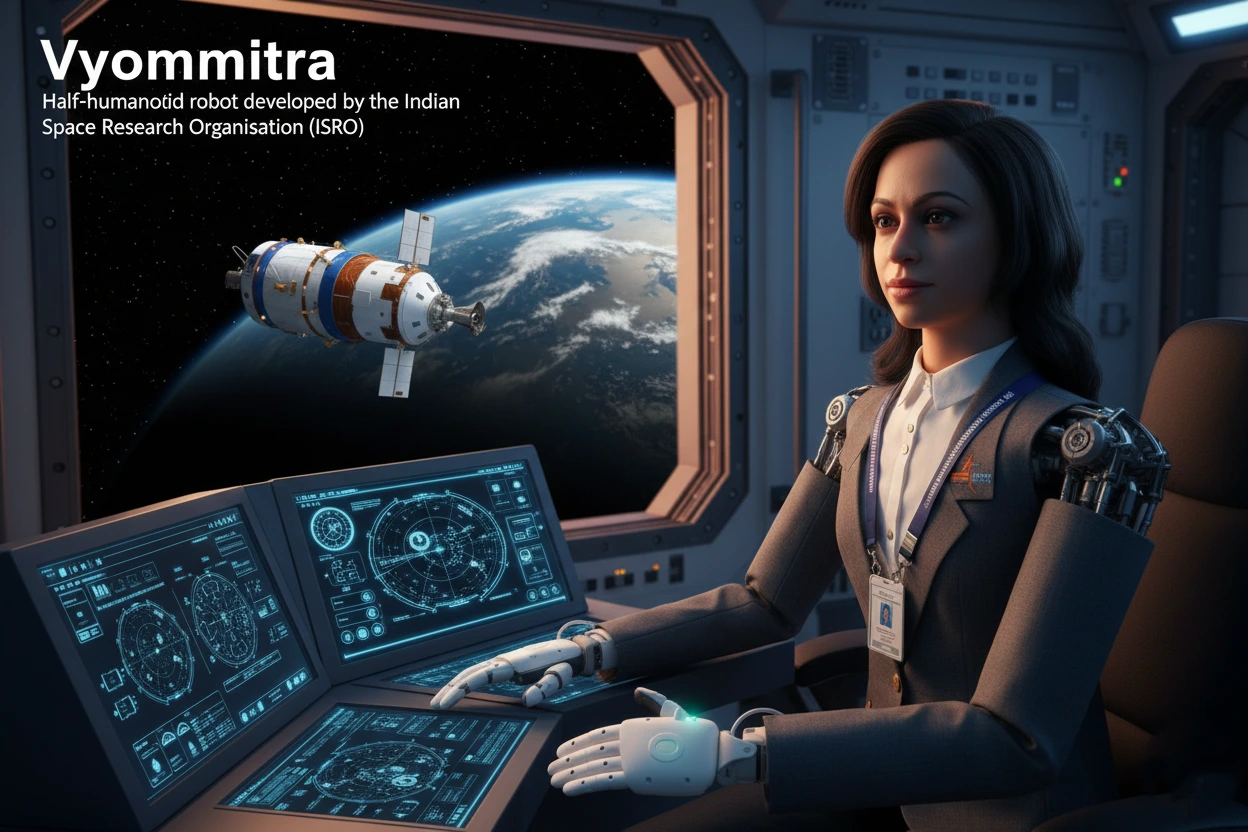
Vyom Mitra helps scientists evaluate micro-gravity effects, thermal loads, and spacecraft habitability, reducing risk for human crew.
Its presence allows continuous testing of life-support systems and human-centric features, strengthening mission safety and enhancing India’s readiness for long-duration space travel.
Pre-Crewed Missions
During uncrewed Gaganyaan missions, Vyom Mitra will occupy the astronaut seat and record physiological-like responses.
Validation
This helps ISRO validate every step—from launch to orbit and recovery—before the first crewed Indian mission.
Vyom Mitra’s technology can support space station maintenance, tele-robotic operations, emergency management, and high-risk experiments in micro-gravity.
Its systems also contribute to future human-robot teams for lunar missions, orbital stations, and deep-space exploration.
Vyom Mitra marks a decisive step in India’s human-spaceflight capability. It demonstrates technological maturity, enhances risk-free experimentation, and strengthens India’s long-term ambition to build indigenous astronaut-support systems for future space programmes.
Bandicoot Robot
Bandicoot Robot
The Bandicoot Robot is a robotic system designed to clean manholes and sewer lines without human entry. It represents a major step towards mechanising sanitation work and eliminating manual scavenging—an important social justice and governance issue.
Developer & Support
Bandicoot was developed by Genrobotics, a Kerala-based robotics startup founded by young engineers. It is supported by the Kerala government and has been adopted by several municipal bodies across India.
Adoption
The robot is adopted under programmes promoting mechanised sewer cleaning, reflecting a commitment to modernizing urban sanitation infrastructure across various states in the country.

The robot uses advanced sensors, articulated robotic arms, and waterproof mechanisms to remove sludge, solid waste, and blockages. It transmits real-time visuals to an operator’s control unit, allowing precise cleaning without human exposure to hazardous gases or pathogens.
Ending Manual Scavenging
Bandicoot directly contributes to ending manual scavenging by replacing dangerous human entry into sewers, fulfilling a critical goal of social justice and human dignity.
Governance & Safety
It enhances worker safety, improves sanitation efficiency, and aligns with constitutional values of dignity, occupational safety, and modern municipal governance.
Municipalities use Bandicoot for sewer cleaning, manhole desilting, and inspection activities. It is increasingly deployed in smart city projects, urban local bodies, and industrial sewage networks where hazardous environments require safe, technology-driven solutions.
Key Acts & Missions
The robot supports the objectives of the Prohibition of Employment as Manual Scavengers Act (2013) and the Swachh Bharat Mission, driving significant urban sanitation reforms.
Technology Integration
It also complements government efforts to introduce robotics and AI for safe, human-centric public service delivery, aligning with national goals for technological advancement in governance.
Manav
Manav: India’s First 3D-Printed Humanoid Robot
Manav is India’s first fully 3D-printed humanoid robot, designed to replicate basic human body movements and interactions. Developed primarily for research, education, and public engagement, it showcases India’s growing capability in robotics and additive manufacturing technologies.
Development Origin
Manav was developed by the A-SET Training & Research Institute, New Delhi, using cost-effective 3D-printing methods.
Core Objective
The institute aimed to create an accessible humanoid platform for students and researchers, enabling hands-on learning in robotics, biomechanics, and artificial intelligence domains.
Design and Components
Manav stands about two feet tall and uses lightweight 3D-printed components. It is equipped with sensors, servomotors, and wireless modules.
Functionality and Architecture
Its capabilities include walking, talking, head movements, and gesture responses. Its open architecture makes it suitable for programming practice and mechanical experimentation.
Robotics Milestone
Manav marks India’s early breakthrough in humanoid robotics, offering an indigenous, low-cost platform for STEM education.
Future Potential
It demonstrates how additive manufacturing can drastically reduce prototyping time. The project also highlights India’s potential to integrate robotics with AI for future industrial and service innovations.
Academic and Research Use
Manav is widely used in academic laboratories for teaching robotics, coding, and control systems. It also supports human–robot interaction research, motion analysis studies, and demonstration projects in science exhibitions.
Experimental Platform
Its modular design helps students test sensors, microcontrollers, and machine-learning algorithms in real time.
DRDO’s Daksh
DRDO Daksh: Remotely Operated Vehicle
About Daksh
Daksh is a remotely operated vehicle (ROV) developed by the Defence Research and Development Organisation (DRDO) for safe handling and neutralisation of hazardous objects, especially improvised explosive devices (IEDs). It enables personnel-free intervention in high-risk environments.
Design and Development
Daksh has been designed and developed by DRDO’s Research and Development Establishment (Engineers) [R&DE(E)], Pune.
Production
It is produced in collaboration with Indian industry partners to support wider induction, maintenance, and upgradation for defence and security forces.
Technology and Capability
Daksh is battery-powered, all-terrain, and equipped with robotic arms, X-ray imaging, cameras, and manipulation tools. Its precision mobility and stable platform enable safe surveillance, lifting, and disposal of suspicious objects without endangering personnel.
Safety and Counter-IED
Daksh enhances India’s counter-IED and bomb-disposal capabilities by reducing human exposure to explosives.
Defence Indigenization
It represents India’s growing indigenous robotics capacity, supporting Atmanirbhar Bharat in defence technology and reducing reliance on imported explosive-handling systems.
Deployment and Role
Daksh is deployed with the Army, paramilitary forces, and specialised bomb disposal units. It supports search operations, vehicle checks, and handling of explosive packages in crowded or sensitive areas.
Hazardous Situations
Daksh assists in disaster situations involving hazardous materials, radiation risks, or chemical leaks.
Emergency Response
Its remote-handling ability helps emergency teams conduct safe rescue and clearance tasks in contaminated or unstable environments.
Mitra Robot
Mitra Robot: Overview
Mitra Robot is an Indian-built humanoid developed by Invento Robotics, designed to enhance customer engagement in public spaces.
It blends AI-driven interaction, autonomous mobility, and a touchscreen interface to provide personalised support, information delivery, and interactive experiences.
Origin
Created by the Bengaluru-based startup Invento Robotics, Mitra emerged as one of India’s earliest humanoid platforms.
Purpose
It was engineered to operate in banks, malls, hospitals, and events, reducing human workload while showcasing India’s progress in service robotics and applied AI.
Interaction
Mitra uses facial and speech recognition, allowing it to greet visitors and identify returning users.
Design
Its fibreglass body, touchscreen chest panel, and LED-based expressions support intuitive interaction.
Operational Time
An 8–10 hour battery enables uninterrupted service in high-footfall areas.
AI Integration
The robot integrates AI for contextual conversations, navigation, and user assistance. Advanced versions now incorporate large language models (LLMs), enabling deeper, human-like responses.
Functionality
It can autonomously move, answer queries, send tweets, capture photos, or even perform as a light entertainer.
Retail & Guidance
In retail environments, Mitra guides customers and explains product or store details.
Banking & Services
In banks, it assists with FAQs and service navigation.
Events & Marketing
At events, it acts as a greeter, selfie companion, or DJ, enhancing brand presence and crowd engagement.
Technological Progress
Mitra represents India’s growing capability in robotics, human–machine interaction, and AI-based service delivery.
Digital Alignment
It demonstrates scalable innovation for sectors like retail, hospitality, smart banking, and public service delivery—aligning with the government’s broader digital transformation goals.
Robocop
KP-BOT (Humanoid Police Robot)
KP-BOT is India’s first humanoid police robot, launched by the Kerala Police in 2019. Designed as a female-bodied AI assistant, it aimed to improve public interaction at police stations and showcase technology-driven governance in basic service delivery.
KP-BOT was developed jointly by the Kerala Police Cyberdome and Asimov Robotics, a Kochi-based startup. The project represented an early attempt to integrate robotics, facial recognition, and automated grievance-handling tools within frontline policing functions.
Reception Duties
The robot performed receptionist duties such as greeting visitors, guiding them to counters, and managing appointments.
First Point of Contact
It served as the first point of contact, recording visitor details and basic complaints, ensuring quicker and more standardized responses for walk-in citizens.
Facial Recognition & Alerts
KP-BOT incorporated facial recognition to identify registered individuals and flag suspicious persons. It was also programmed to issue alerts against bribery attempts.
Proposed Upgrades
Proposed upgrades included metal detection, thermal imaging, and gas sensors to enhance surveillance and situational awareness.
Efficiency and Standardization
The project demonstrated how AI can improve routine police tasks, reduce human error, and minimise discretion in front-office interactions.
Gender Sensitivity
It also highlighted gender sensitivity, with the female design reflecting an effort to symbolise inclusivity and women’s empowerment within the police force.
KP-BOT showcased potential uses in reception management, crowd handling, grievance intake, and basic verification functions.
By automating repetitive duties, such systems can free human officers for investigation, community work, and crisis response, strengthening overall efficiency in policing.
Although KP-BOT received wide publicity during launch, updates on its continued deployment are limited. However, it remains an important case study for AI adoption in Indian policing and a reference for debates on ethics, technology readiness, and human-machine collaboration.
Centre for Artificial Intelligence and Robotics (CAIR)
Centre for Artificial Intelligence and Robotics
The Centre for Artificial Intelligence and Robotics (CAIR) is a key laboratory under DRDO, dedicated to research in AI, robotics, command-and-control systems, and secure communication technologies. It supports India’s strategic, defence, and security needs through indigenous innovations.
Core Objectives
CAIR aims to develop autonomous systems, strengthen decision-support tools, and build cyber-secure communication networks.
Strategic Mandate
Its mandate includes converting advanced research into deployable defence technologies, ensuring India’s long-term technological self-reliance.
CAIR focuses on machine intelligence, multi-agent systems, robotic autonomy, pattern recognition, and cybersecurity tools. It also works on secure operating systems, encryption technologies, and real-time data-fusion systems for battlefield situations.
Key Systems Developed
The lab has developed Combat Management Systems, AI-based surveillance tools, multi-robot coordination technologies, and secure communication frameworks.
Operational Impact
These systems enhance situational awareness, decision-making speed, and mission reliability for India’s armed forces.
CAIR’s technologies are used in unmanned ground vehicles, perimeter protection, threat classification, intrusion detection, and communication security. They support both tactical and strategic operations across land, air, and naval domains.
Self-Reliance
CAIR strengthens India’s Atmanirbhar Bharat goals by reducing dependence on foreign defence technologies.
Future Warfare
It also boosts domestic capability in AI-enabled warfare, essential for modern conflicts involving autonomous platforms and cyber threats.
All India Council for Robotics & Automation (AICRA)
All India Council for Robotics & Automation (AICRA)
The All India Council for Robotics & Automation (AICRA) is a leading industry-driven body promoting research, standards, innovation, and capacity-building in robotics, AI, and automation across India. It works to strengthen the technology ecosystem and support national industrial growth.
Framework Development
AICRA aims to develop a strong robotics and automation framework through policy advocacy, industry partnerships, and workforce upskilling.
Innovation and Adoption
It focuses on creating an innovation-friendly environment and encouraging the use of emerging technologies in education and industry.
AICRA sets technical standards, supports research programs, and promotes indigenous technology solutions. It enables collaboration between institutions, runs capacity-building initiatives, and organizes large-scale events to popularize robotics and automation applications.
Flagship Events
AICRA conducts the India STEM Summit and Robotics League competitions, which provide platforms for showcasing and developing talent.
Skill Development
It runs industry-oriented training programs to build skills among students, foster start-ups, and help institutions adopt global best practices.
AICRA engages with schools, colleges, and technical universities to integrate robotics into learning. It designs curriculum modules, offers certifications, and supports laboratories, enabling youth to gain hands-on exposure to real-world automation challenges.
Sectoral Connect
The organisation connects manufacturing, defence, agriculture, and service sectors with new-age robotic solutions.
Productivity Boost
It helps industries identify automation gaps and adopt advanced technologies that boost productivity and competitiveness.
AICRA strengthens India’s transition toward Industry 4.0 by supporting innovation, skilling, and indigenous R&D. Its work aligns with national goals of self-reliance, technological sovereignty, and modern industrial capacity.
IITs & Premier Academic Institutions
IITs & Premier Academic Institutions: Development of Robotics
Robotics is emerging as a strategic sector for India due to its links with automation, defence, healthcare, manufacturing, and AI. IITs and premier institutes function as key centres driving research, innovation, and talent development in this field.
Since the 1980s, IITs began introductory automation research, gradually shifting towards advanced robotics. Today, almost every IIT hosts specialised robotics labs working on humanoids, intelligent systems, bio-robotics, and swarm robotics.
IIT Delhi
Known for autonomous systems, drone technologies, and medical-assistive robots through dedicated centres like the Robotics Research Center.
IIT Bombay
Focuses on industrial robotics, micro-robotics, and AI-driven machine perception, supported by strong industry collaborations.
IIT Kanpur
One of the earliest leaders in robotics research; works on aerial vehicles, haptics, and defence-oriented platforms.
IISc Bengaluru
Conducts deep-tech robotics research in locomotion, AI-planning, and space applications through the Robert Bosch Centre for Cyber-Physical Systems.
India’s robotics ecosystem is strengthened by National Mission on Interdisciplinary Cyber-Physical Systems (NM-ICPS), Technology Innovation Hubs, and various DRDO-IIT collaborations for autonomous vehicles and robotic soldiers.
Manufacturing & Logistics
Robotics research from IITs now supports manufacturing automation, warehouse logistics, and the development of smart mobility solutions.
Healthcare & Disaster Response
Development includes surgical robotics, medical-assistive robots, and applications for efficient and safe disaster response.
Agriculture & Defence
Focuses on agricultural precision tools and creating defence-oriented platforms like autonomous vehicles and surveillance systems.
National Policy on Electronics
National Policy on Electronics (NPE)
India’s electronics sector is central to digital growth, employment generation, and strategic autonomy. The National Policy on Electronics aims to make India a global Electronics System Design and Manufacturing (ESDM) hub by boosting domestic capabilities and reducing import dependence.
NPE 2012 Foundation
India introduced the first NPE in 2012 to build foundational ESDM capacity, focusing on early-stage manufacturing and policy support.
NPE 2019 Expansion
It was followed by NPE 2019, which expanded targets, strengthened manufacturing incentives, and aligned the sector with Digital India, Make in India, and emerging global supply-chain shifts.

NPE 2019 seeks to reach USD 400 billion in electronics manufacturing, including USD 190 billion in mobile manufacturing. The policy focuses on scaling domestic production, increasing exports, and creating a globally competitive ecosystem for component and semiconductor fabrication.
Electronics Manufacturing Clusters (EMCs)
The policy promotes EMCs with shared infrastructure to reduce costs. These clusters support testing labs, logistics, skill centres, and plug-and-play facilities for electronics manufacturing units.
Semiconductor and Display Fabrication
NPE emphasises attracting investments for semiconductor fabs, ATMP/OSAT units, and display fabs. This is crucial for national security and resilience in global electronics supply chains.
Domestic Component Ecosystem
A major goal is to reduce reliance on imported components by supporting passive, active, and electromechanical component industries through incentives, R&D support, and quality standardisation.
Production Linked Incentive (PLI) for Electronics
PLI offers financial incentives on incremental sales of electronics and components. It has significantly boosted mobile phone assembly and attracted major global manufacturers to India.
Scheme for Promotion of Manufacturing of Electronic Components and Semiconductors (SPECS)
SPECS provides capital subsidies for manufacturing semiconductor components, sensors, PCBs, and specialised materials. It aims to deepen India’s supply chain strength.
Modified Electronics Manufacturing Clusters 2.0 (EMC 2.0)
EMC 2.0 supports new clusters with stronger infrastructure, ensuring manufacturing competitiveness and better integration with global value chains.
Innovation Ecosystem
The policy encourages innovation through incubation centres, design-linked incentives, and academic-industry collaboration.
IP Creation
It supports IP creation in electronics design, embedded systems, and next-generation technologies like AI-hardware and IoT devices.
NPE commits to developing a skilled workforce across manufacturing, design, and service roles. Partnerships with industry and training institutions aim to bridge the talent gap in semiconductor fabrication and electronics assembly.
Import Dependence & Competition
The sector faces high import dependence on semiconductors and intense global competition in advanced manufacturing.
Policy Implementation
Complex regulatory processes, infrastructure bottlenecks, and ensuring consistent policy implementation and stable fiscal incentives remain a key challenge.
Strengthening R&D capabilities, building semiconductor fabs, expanding component manufacturing, and ensuring long-term policy stability will help India capture the shifting global electronics supply chain and achieve NPE’s strategic goals.
National Strategy on Robotics
National Strategy on Robotics
India’s growing manufacturing demands, demographic pressures, and global technology competition make robotics a strategic priority. A national strategy provides direction for research, industry adoption, skilling, and ethical governance, ensuring India leverages robotics for inclusive and sustainable development.
The strategy aims to make India a global hub for affordable, safe, and high-quality robotic solutions. It emphasises innovation, domestic production, human–robot collaboration, and creation of future-ready jobs across agriculture, healthcare, defence, and manufacturing sectors.
Pillar Structure
The strategy generally rests on four pillars: research excellence, domestic manufacturing, large-scale deployment, and a supportive regulatory environment.
Ecosystem Goal
Together, these pillars integrate academia, industry, and government to build a competitive and secure robotics ecosystem.
Priority research areas include autonomous navigation, dexterous manipulation, AI–robot integration, swarm robotics, and human-robot interaction. Public–private research centres and national labs are expected to collaborate to accelerate innovation and reduce dependency on foreign technologies.
Make in India Support
The strategy supports Make in India through incentives for component manufacturing, sensor development, and indigenous controller design.
Scaling Innovation
Special robotics zones, design-linked incentives, and testbeds encourage start-ups and MSMEs to scale affordable, Indian-made robotic systems.
In manufacturing, robots enhance quality and reduce defects in sectors like automobiles, electronics, and textiles. Agriculture applications include precision spraying, automated harvesting, and soil monitoring. Healthcare benefits from surgical robots, rehabilitation devices, and hospital logistics solutions.
Urban Services
Robotics improves urban services such as waste sorting, sewage inspection, and firefighting assistance.
Disaster Management
Disaster management robots support search and rescue, chemical hazard monitoring, and remote operations, reducing risks for frontline personnel.
The strategy encourages indigenous development of unmanned ground vehicles, bomb disposal robots, surveillance drones, and autonomous logistics platforms. Emphasis is placed on cybersecurity, trusted supply chains, and reducing dependence on foreign dual-use technologies.
Training Priorities
A robotics strategy prioritises nationwide training in programming, mechatronics, AI integration, and system maintenance.
Inclusive Growth
It promotes reskilling for workers shifting from repetitive jobs to supervisory, safety, and technical roles, ensuring technology-driven growth remains inclusive.
A national framework focuses on safety standards, liability rules, and ethical guidelines for human-robot collaboration. Transparency, data protection, and bias-free decision-making are emphasised, ensuring responsible deployment without compromising public trust or labour rights.
Entrepreneurship
Incubators, challenge grants, and government-backed procurement programmes encourage deep-tech entrepreneurship.
Market Readiness
Simplified testing rules and shared infrastructure help young innovators convert prototypes into market-ready products, accelerating India’s robotics adoption curve.
The strategy promotes cooperation with global research institutions, technology alliances, and standard-setting bodies. Such partnerships enable knowledge exchange, joint research, and harmonised safety protocols, improving India’s global competitiveness in emerging technologies.
AI & Robotics Technologies Park (ARTPARK)
AI & Robotics Technology Park (ARTPARK)
AI & Robotics Technology Park (ARTPARK) is a not-for-profit foundation created by the Indian Institute of Science (IISc), Bengaluru, with support from the Government of India and the Government of Karnataka. It aims to accelerate frontier innovations in AI and Robotics for societal benefit.
Focus Areas
ARTPARK focuses on solving India-specific challenges in healthcare, education, agriculture, mobility, and security.
Mandate
Its mandate includes building scalable, affordable, and inclusive digital-robotic ecosystems that improve access, efficiency, and quality of services for citizens.
The main facility is located at the Entrepreneurship Building, IISc Bengaluru. Another innovation space, ARTgarage, functions at HMT Estate, Jalahalli. The foundation operates Monday to Friday, with wheelchair-accessible entry and parking, ensuring inclusive participation.
Digital Channels
ARTPARK can be contacted through its official website and dedicated email IDs for general queries, collaborations, and startups.
Engagement
A direct phone line is also available for administrative coordination, enabling seamless stakeholder and industry engagement.
ARTPARK executes large, outcome-driven R&D missions addressing India’s socio-economic needs. These projects integrate AI, robotics, IoT, and data systems to improve public service delivery, rural productivity, linguistic accessibility, and citizen safety through scalable technological solutions.
Project Vaani
A major initiative, Project Vaani, builds real-time speech datasets in diverse Indian languages.
BhashaSetu
Through BhashaSetu, it supports live translation and speech-to-speech communication, reducing linguistic barriers and enabling inclusive digital governance.
ARTPARK’s DataSetu initiative develops privacy-preserving frameworks for secure data exchange. It enables federated learning, regulated data access, and transparent governance, supporting India’s broader digital public infrastructure efforts through trust-enhancing technologies.
Incubation Focus
Startup@ARTPARK provides deep-tech incubation for entrepreneurs working in AI and robotics.
Support Offered
It offers mentorship, prototyping support, funding access, and industry collaboration to convert research ideas into market-ready technologies.
ARTPARK houses advanced robotics laboratories for building, testing, and validating robotic systems. These include fabrication units, sensor-integration platforms, autonomous navigation tools, and collaborative robotics environments that help innovators create deployable solutions.
Drone Facilities
The centre features specialized drone testing spaces, including indoor arenas and a wind-shaping facility.
Mobility Tracks
Additional mini and large-scale test tracks allow real-world trials of autonomous and connected vehicles, supporting safe experimentation and regulatory readiness.
ARTgarage is an open, flexible workspace supporting students, researchers, and deep-tech startups. It facilitates rapid prototyping, peer collaboration, and hardware experimentation, creating a vibrant innovation culture aligned with India’s emerging robotics ecosystem.
Training Initiatives
ARTPARK runs structured skilling initiatives like UG/PG Fellowships, educator-training programs, and hands-on workshops.
Capacity Building
These programs strengthen India’s AI-robotics talent pipeline and promote capacity building for students, teachers, and professionals.
Operating in a public–private partnership model, ARTPARK collaborates with DST, Government of Karnataka, IISc, industry players like NVIDIA, and global academic networks. These collaborations enhance research depth, technology translation, and long-term sustainability.
Atal Tinkering Labs
Atal Tinkering Labs (ATL)
Atal Tinkering Labs are innovation workspaces established by the Government of India under the Atal Innovation Mission (AIM), NITI Aayog to promote creativity, problem-solving, and hands-on STEM learning among school students of Classes 6–12.
ATLs aim to build a culture of scientific temper, design thinking, and early-stage innovation. They help students develop curiosity, computational skills, and real-world problem-solving abilities through guided experimentation.
Modern Toolset
Each ATL provides modern tools such as robotics kits, 3D printers, sensors, IoT modules, and DIY materials.
Financial Support
Schools receive financial support for establishment and operational expenses to ensure accessibility and continuity of innovation activities.
The program encourages students to work on mini-projects, community challenges, and prototype development.
Mentorship from industry experts, teachers, and volunteers strengthens applied learning and bridges classroom concepts with practical solutions.
Selection and Grants
NITI Aayog selects schools based on infrastructure and outreach potential. Approved schools receive grants in phases and must run regular tinkering activities.
Training and Support
ATL handbooks, training modules, and teacher orientation sessions support smooth implementation and ensure quality education.
ATLs have widened innovation access beyond metropolitan schools, promoting inclusive scientific education.
They have improved students’ confidence, teamwork, and design-thinking capabilities.
Many ATL students participate in national innovation challenges and develop prototypes addressing local developmental issues.
AI & Robotics Mission
AI & Robotics Mission – India
India’s AI & Robotics Mission aims to accelerate innovation, scale domestic research, and apply intelligent systems across governance, defence, health, agriculture, and industry. It positions India to harness emerging technologies for economic growth and strategic capability.
India faces rising demand for automation, skilled labour shortages, and global competition in digital technologies. The mission seeks to bridge gaps in R&D, ensure ethical use, and promote indigenous AI solutions suited to India’s developmental context and diverse population needs.
The mission targets three goals: boosting high-end research, enabling large-scale deployment of AI tools, and nurturing a talent ecosystem. It emphasises inclusive growth, safe AI adoption, and innovation-friendly policies to strengthen India’s future-ready digital economy.
4.1 Research Ecosystem
It proposes national AI research centres, robotics innovation hubs, and collaborative platforms connecting academia, industry, and government. The focus remains on fundamental research, real-world prototypes, and solving India-specific problems through affordable, scalable technology.
4.2 Computing Infrastructure
The mission plans a shared AI compute grid with secure cloud facilities, high-performance computing clusters, and open-source tools. This supports start-ups and researchers lacking access to expensive AI hardware, reducing barriers to experimentation and deployment.
4.3 Standards, Ethics, and Safety
It stresses transparent algorithms, bias reduction, data protection, and responsible autonomous systems. Ethical principles guide applications in sensitive sectors like policing, healthcare, and finance to prevent misuse and strengthen citizen trust.
4.4 Skilled Workforce Development
Training programmes aim to build expertise in AI engineering, robotics design, data science, cybersecurity, and embedded systems. Curricula upgrades, online courses, and industry partnerships help create a large workforce capable of driving innovation.
5.1 Agriculture
Smart irrigation, crop monitoring, robotic harvesters, and AI-based advisories can reduce input costs and boost productivity. These tools support small farmers through precise decision-making and early detection of pests and diseases.
5.2 Healthcare
AI algorithms for diagnostics, robotic surgery, telemedicine platforms, and predictive models enhance access, affordability, and early intervention. Such solutions help reduce workload on medical professionals while improving patient outcomes.
5.3 Governance
AI-driven grievance systems, automated document processing, and digital public services improve efficiency and transparency. Robotics can support disaster management, urban sanitation, and infrastructure maintenance.
5.4 Industry and MSMEs
Predictive maintenance, automated quality checks, and warehouse robotics help reduce costs and increase competitiveness. MSMEs gain from AI toolkits that simplify adoption and reduce dependence on foreign technologies.
6.1 Data Gaps and Fragmentation
India lacks high-quality datasets, especially in local languages. Fragmented data slows research and limits accuracy of AI models across regions.
6.2 Funding and R&D Shortages
Investment in advanced robotics and core AI research remains limited. Many start-ups struggle to scale due to hardware costs and uncertain market demand.
6.3 Regulatory and Ethical Issues
Balancing innovation with safety requires clear guidelines. Concerns include algorithmic bias, accountability of autonomous systems, and privacy protection.
A successful mission demands strong public–private partnerships, sustained R&D funding, and regional innovation clusters. India must promote open-data frameworks, expand skilled training, and encourage global collaboration to build secure, inclusive, and competitive AI-robotics capabilities.
No comments:
Post a Comment