

Nuclear Technology – An Overview
Nuclear technology refers to the controlled use of nuclear reactions for energy, research, medicine, industry, and strategic applications. It operates primarily through fission, fusion, and radioactive decay, each offering unique advantages and challenges for civilian and defence sectors.
Nuclear Fission & Fusion
Nuclear fission involves splitting heavy nuclei like uranium-235 to release heat and neutrons for sustained energy production. Fusion fuses light nuclei such as hydrogen isotopes, offering cleaner and abundant energy, though still technologically difficult for commercial deployment.
Radioactivity
Radioactivity refers to spontaneous decay of unstable nuclei, emitting alpha, beta, or gamma radiation. These emissions enable applications in medical diagnostics, industrial testing, and scientific instrumentation, besides posing safety challenges requiring strict regulatory frameworks.
India follows a three-stage nuclear power programme focused on energy security and resource optimisation. It sequentially uses uranium reactors, plutonium-based fast breeder reactors, and thorium reactors, aiming long-term sustainability using India’s vast thorium reserves.
Key institutions include the Department of Atomic Energy, Bhabha Atomic Research Centre and Nuclear Power Corporation of India Ltd. India maintains strict civilian–strategic separation while expanding nuclear cooperation under international safeguards and supply agreements.
Power Systems
Nuclear power plants convert fission heat to electricity using pressurised heavy water reactors, light-water reactors and emerging fast breeder reactors. These systems ensure high energy density, low greenhouse emissions and reliable base-load power essential for long-term energy planning.
Safety and Regulation
Safety is maintained through multiple barriers, emergency cooling systems and passive safety features. International frameworks like IAEA safety standards and national regulators such as AERB ensure risk-minimisation, periodic inspections and transparent reporting of operational status.
Nuclear technology supports diverse civilian uses including cancer treatment through radiotherapy, diagnostic imaging using radioisotopes and sterilisation of medical equipment. These applications significantly improve healthcare access, precision and treatment outcomes across India.
Industrial uses include non-destructive testing of infrastructure, food irradiation for shelf-life enhancement and agricultural mutation breeding to develop high-yield varieties. Research reactors also support isotope production and neutron-based material studies.
Strategic Doctrine
Nuclear technology underpins India’s credible minimum deterrence doctrine, supported by command-and-control systems and delivery platforms. India adheres to strong export-control norms and participates in global non-proliferation efforts while safeguarding autonomous strategic capability.
Nuclear Security
Nuclear security focuses on preventing theft, sabotage or misuse of radioactive materials. Measures include physical protection systems, personnel reliability checks and regulatory audits consistent with international best practices and evolving threat assessments.
Major challenges include high project costs, public concerns, waste management and dependence on imported reactor components. Developing domestic manufacturing capacity and advancing thorium-based technologies remain long-term priorities for energy independence.
Future prospects lie in small modular reactors, fusion research, advanced fuel cycles and international collaboration. These innovations aim to enhance safety, reduce waste and expand nuclear energy’s role in India’s clean-energy transition.
Why India Must Stay Nuclear-Ready?
India’s nuclear capability acts as a long-term security shield in an uncertain neighbourhood. It ensures deterrence, strengthens diplomatic leverage, and safeguards national interests against both conventional and nuclear threats. Maintaining readiness is therefore essential for strategic autonomy.
India’s security environment includes two nuclear-armed neighbours with unresolved borders and evolving weapons programmes. This creates a persistent risk spectrum, making sustained nuclear preparedness vital for credible deterrence and preventing coercive diplomacy during strategic crises.
India follows the doctrine of Credible Minimum Deterrence supported by a No First Use policy. Nuclear readiness ensures that CMD remains operationally effective, technologically updated, and strategically believable, preventing adversaries from doubting India’s retaliatory capability.
China’s growing nuclear stockpile, advanced delivery systems, and integrated missile-defence architecture alter regional power balances. India must remain nuclear-ready to maintain strategic parity, reduce vulnerability, and ensure its deterrence posture stays stable and reliable.
5. Pakistan Factor: First-Use Posture and Tactical Weapons
Pakistan’s reliance on nuclear weapons for conventional parity and its development of tactical nuclear systems increase escalation risks. A ready and resilient Indian nuclear posture ensures escalation control and prevents miscalculations during high-tension military situations.
6. Enhancing Second-Strike Capability
A strong second-strike capability is the backbone of India’s nuclear doctrine. Maintaining survivable assets—such as ballistic missile submarines and hardened command structures—ensures retaliation capacity even after an adversary’s first strike, reinforcing deterrence credibility.
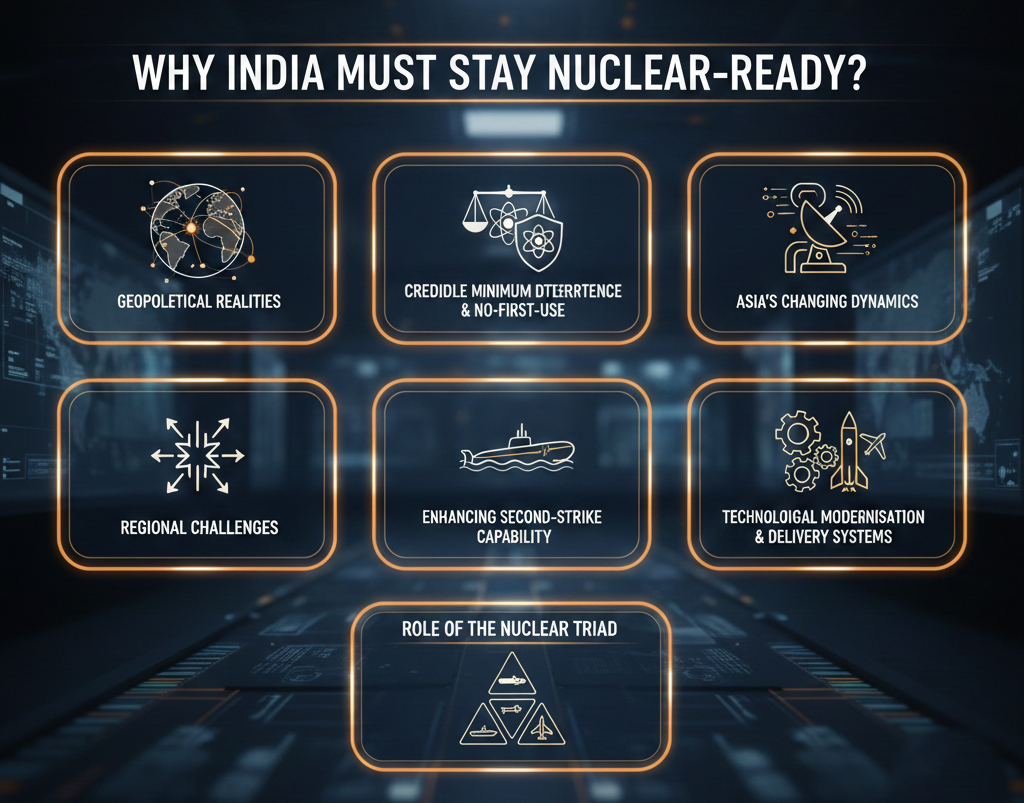
Nuclear readiness requires continuous improvement of missiles, early-warning sensors, and secure communication networks. Modernisation helps India counter evolving threats, reduce response time, and ensure that its nuclear arsenal remains secure, accurate, and reliable under all conditions.
India’s nuclear triad—land, air, and sea-based delivery systems—provides operational flexibility and survivability. Maintaining readiness across all three legs ensures dispersed capabilities, reduces vulnerability to pre-emptive strikes, and strengthens overall strategic stability.
Global shifts toward missile-defence shields and hypersonic glide vehicles challenge traditional deterrence models. India must stay technologically aligned to avoid strategic disadvantages and ensure that its deterrence remains effective against advanced offensive and defensive systems.
A credible nuclear posture enhances India’s negotiating power in multilateral forums, strengthens great-power engagement, and supports aspirations for a permanent UNSC seat. Nuclear readiness signals responsibility, capability, and strategic maturity on global security issues.
India’s nuclear readiness is not aggression but strategic prudence. It ensures national security, stabilises deterrence, and protects sovereign decision-making. In a complex regional environment, sustained readiness remains essential for long-term peace and strategic stability.
India’s Rise as a Nuclear Power
India’s nuclear journey reflects a balance between scientific aspiration, national security needs, and global strategic positioning. Over time, India has transformed from a technology-seeking nation to an autonomous nuclear power with credible capabilities in energy, defence, and space applications.
Initial Focus
India’s post-Independence leadership prioritised peaceful atomic research.
Key Structures
Under Homi J. Bhabha, institutional structures such as the Atomic Energy Commission and BARC were established, laying scientific groundwork for indigenous fuel cycles and reactor design.
India’s nuclear policy has consistently aimed at reducing external dependence. Restrictions after the 1974 nuclear test pushed the country towards self-reliance. Despite global technology denial regimes, India expanded indigenous research, reprocessing, and enrichment capabilities to pursue independent nuclear choices.
Key Tests
The 1974 test demonstrated India’s scientific potential, but the 1998 Pokhran-II series formally declared India a nuclear weapons state.
Impact
These tests validated weapon design, boosted deterrence credibility, and marked India’s arrival as a responsible nuclear actor with defined strategic goals.
India follows credible minimum deterrence, emphasising no-first-use and non-use against non-nuclear states. The doctrine supports a triad-based force structure, ensuring secure second-strike capability. This framework aims to maintain stability and project restraint in South Asia.
Role of Nuclear Energy
Nuclear energy supports India’s long-term low-carbon goals and energy security.
Indigenous Technology
Pressurised heavy-water reactors (PHWRs) dominate the civilian sector, while fast-breeder and thorium-based programmes aim to use domestic resources for capacity expansion.
India’s three-stage plan links natural uranium, plutonium, and thorium utilisation. Stage-I PHWRs produce plutonium, Stage-II fast-breeder reactors multiply fuel, and Stage-III aims for advanced thorium reactors. This model promises sustainable energy security with reduced reliance on imported uranium.
Stance on Treaties
Though outside the NPT, India supports non-proliferation values and acts as a responsible nuclear state.
Global Integration
The 2008 NSG waiver and civil nuclear agreements strengthened international trust and integrated India into global nuclear markets.
India has developed land-, sea-, and air-based delivery platforms, forming a nuclear triad. Agni missiles, strategic aircraft, and Arihant-class submarines enhance deterrence flexibility. Indigenous advancements improve survivability, command-and-control, and long-term strategic preparedness.
India’s rise as a nuclear power reflects decades of scientific resilience, policy consistency, and strategic maturity. Balancing energy needs and national security, India has evolved into a responsible nuclear state shaping regional stability and contributing to global strategic dialogues.
Powering India: The Nuclear Revolution – Overview
India’s nuclear sector represents a strategic blend of energy security, technological strength, and geopolitical autonomy. As fossil fuel limitations deepen and climate goals tighten, nuclear power emerges as a stable, low-carbon pillar supporting India’s long-term development trajectory.
2. India’s Energy Challenge
Growing population, industrial expansion, and rising electricity demand strain India’s conventional energy systems. Renewable sources are vital but intermittent. Nuclear power offers continuous, high-output electricity, reducing dependence on imported fuels and supporting grid stability.
3. Evolution of India’s Nuclear Journey
India’s nuclear programme evolved through indigenous research, strategic autonomy, and global partnerships. From early reactors in the 1960s to present advanced designs, the sector reflects long-term planning, self-reliance, and consistent policy support.
India’s three-stage plan aims to utilise limited uranium and vast thorium reserves effectively. The stages progress from PHWRs (Stage I) to fast breeder reactors (Stage II) and eventually thorium-based systems (Stage III), ensuring a sustainable and indigenous fuel cycle in the long run.
5. Current Nuclear Power Capacity
India operates numerous Pressurised Heavy Water Reactors (PHWRs) across several states. These reactors contribute a modest share to the energy mix but remain central to long-term low-carbon expansion plans due to reliability and technological maturity.
6. Advanced Reactor Technologies
India is developing fast breeder reactors, light-water reactors, and experimental thorium systems. These technologies promise higher fuel efficiency, reduced waste, and greater safety, positioning India among the few countries pursuing next-generation nuclear solutions.
7. Safety Framework and Regulation
Nuclear operations follow strict safety norms under the Atomic Energy Regulatory Board (AERB). India adopts multi-layered safety systems, international best practices, and periodic audits, ensuring minimal risk across design, construction, operation, and waste management.
8. International Cooperation
Civil nuclear agreements with countries like the U.S., Russia, and France enabled technology access and reactor collaborations. India’s unique position outside the NPT yet accepted by global regimes highlights strategic diplomacy and trust in its safeguards.
Nuclear power supports India’s climate commitments by providing low-carbon baseload electricity. Unlike renewables, nuclear plants operate continuously, making them essential for balancing the grid and reducing long-term emissions.
10. Economic and Industrial Impact
Domestic reactor design, fuel fabrication, and heavy-engineering capabilities strengthen India’s manufacturing base. Nuclear power creates skilled jobs and drives advanced research, contributing to economic resilience and technological leadership.
11. Challenges to Expansion
High capital costs, land acquisition hurdles, public perception issues, and long construction timelines slow nuclear growth. Fuel supply constraints and delays in fast breeder deployment also affect planned capacity additions.
India aims to rapidly scale reactors through indigenous PHWRs, imported LWRs, and future thorium-based systems. Streamlined regulations, technological innovation, and public engagement will be crucial to unlocking the full potential of nuclear energy.
Applications of Nuclear Technology
Nuclear technology uses controlled nuclear reactions—primarily fission and, emergingly, fusion—to generate energy or produce useful isotopes. Its importance lies in high energy density, precise scientific applications, and wide relevance to sectors like health, agriculture, industry, and national security.
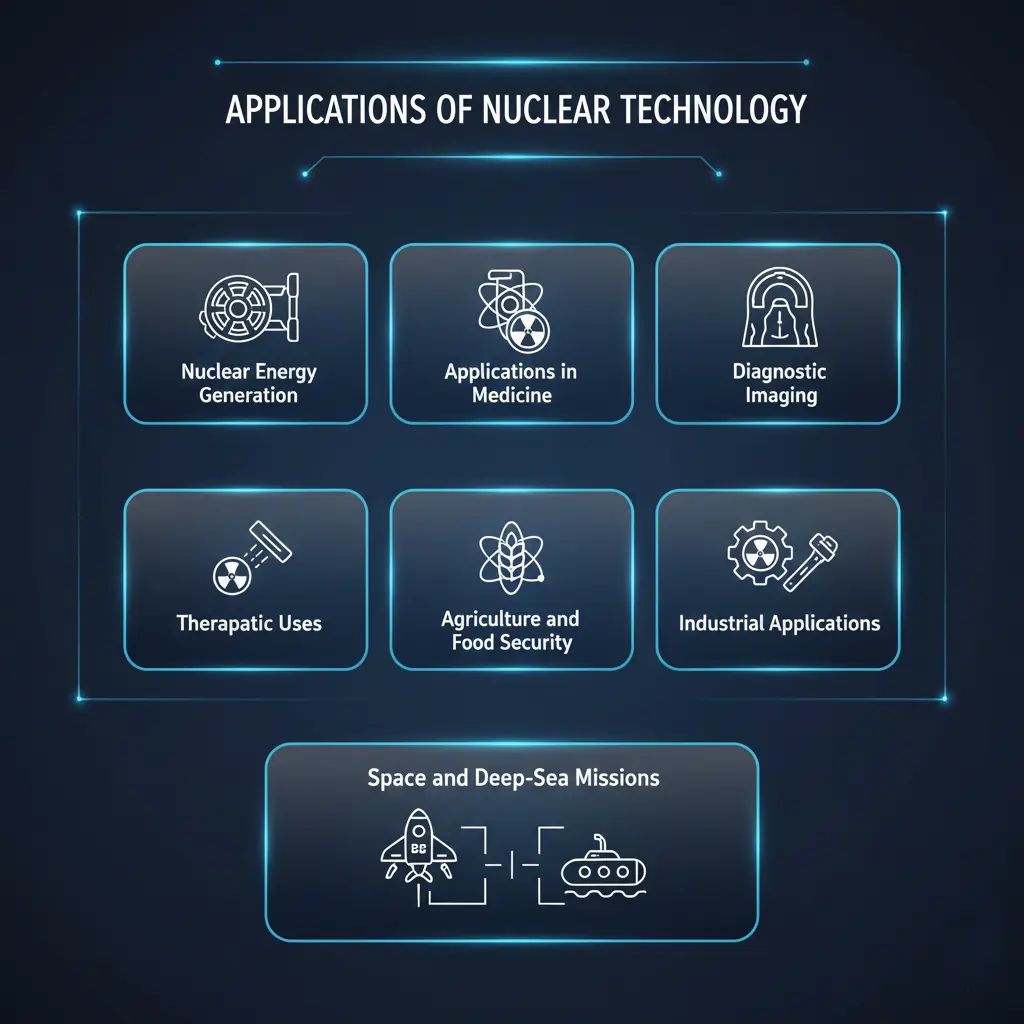
Nuclear power plants use fission of uranium or thorium to produce heat, which drives turbines for electricity. This offers stable baseload power, low carbon emissions, and reduced dependence on fossil fuels, making it vital for India’s long-term energy security.
Nuclear medicine employs radioisotopes for diagnosis and treatment. Technologies like PET, SPECT, and targeted radiotherapy enable detection of cancers, cardiovascular disorders, and organ dysfunctions with high accuracy, supporting both public health and advanced clinical research.
4. Diagnostic Imaging
Radioisotopes injected into the body emit gamma rays captured by scanners. This reveals metabolic activity, tumour locations, and physiological abnormalities. The strength of nuclear imaging lies in showing functional changes earlier than structural imaging like CT or MRI.
5. Therapeutic Uses
Radioisotopes such as I-131 and Lu-177 deliver focused radiation to destroy cancerous cells. Modern techniques minimise damage to surrounding tissues. This targeted approach is central to modern oncology and has become an important area of nuclear technology innovation.
Nuclear techniques support mutation breeding, pest control, and food preservation. Induced mutations create disease-resistant crop varieties. Radiation-based Sterile Insect Techniques reduce pest populations, while food irradiation enhances shelf life and safety without altering nutritional quality.
7. Industrial Applications
Industries use nuclear technology for non-destructive testing, thickness gauging, and material inspection. Gamma radiography detects structural flaws in pipelines, aircraft parts, and machinery. These applications enhance reliability, ensure safety, and reduce maintenance costs across industrial sectors.
8. Water Resource Management
Isotope hydrology uses stable and radioactive isotopes to trace groundwater movement, recharge rates, and contamination sources. This helps governments design sustainable water-use strategies, identify over-exploitation zones, and manage aquifers in drought-prone regions efficiently.
Radioisotopes monitor air and water pollution, soil erosion, and sediment transport. Nuclear analytical techniques provide precise measurements of pollutants, enabling evidence-based policy decisions. They also support climate studies by analysing atmospheric and oceanic processes over long periods.
10. Space and Deep-Sea Missions
Radioisotope thermoelectric generators (RTGs) power spacecraft operating far from the Sun. They convert decay energy into electricity, ensuring long-duration missions. Similar systems support deep-sea sensors where solar or conventional batteries cannot function reliably.
11. Public Safety and Security
Nuclear technology aids border security, cargo scanning, and radiation detection. Devices using neutron and gamma interrogation identify explosives, illicit materials, and nuclear contraband. These systems strengthen national security while improving disaster preparedness and emergency response.
Fusion research, small modular reactors (SMRs), and medical isotope production are expanding nuclear technology’s future scope. These developments promise safer reactors, cleaner energy, and improved global supply of critical isotopes for therapy and diagnostics.
Nuclear Power: Humanity’s Hidden Curse — Overview
Nuclear power has long been promoted as a clean, efficient, and reliable energy source. Yet its hidden risks—ranging from radioactive pollution to strategic vulnerabilities—raise fundamental questions about sustainability, safety, and long-term human welfare.
Nuclear Fission
Nuclear power is generated through controlled fission of heavy isotopes like Uranium-235. This process releases vast energy but also produces hazardous radioactive by-products.
Global Challenge
Managing these by-products remains one of the most complex global technological challenges, requiring sophisticated storage and monitoring for geological timescales.
Nuclear plants can produce large quantities of electricity from minimal fuel. Their low greenhouse-gas emissions make them an attractive choice for countries aiming to meet climate commitments while reducing dependence on fossil fuels and fluctuating global energy markets.
Long-Term Threat
Radioactive waste disposal poses a long-term threat as it remains hazardous for thousands of years, creating intergenerational environmental liabilities.
Contamination Risk
Safe geological storage options are limited, and leakages can contaminate soil, water, and ecosystems, demanding extreme and continuous long-term caution.
Events like Chernobyl and Fukushima exposed the devastating consequences of nuclear accidents. Even with advanced engineering, human error, natural disasters, or system failures can trigger radiation release, causing long-lasting health and ecological damage.
Dual-Use Potential
Civilian nuclear technology carries dual-use potential. Materials used for power generation can also be diverted for weapon development, raising geopolitical tensions.
Proliferation Risk
This creates global monitoring burdens and proliferation risks, especially in unstable regions where oversight is weak or political conditions are volatile.
Nuclear reactors require vast capital investment, strict safety systems, and long construction timelines. Many projects worldwide suffer cost overruns and delays, making nuclear energy less competitive than rapidly advancing renewable technologies.
Disposal Dilemma
No country has yet perfected a universally accepted method for long-term nuclear waste disposal. This problem continues to hinder its long-term viability.
Continuous Surveillance
High-level waste remains intensely radioactive, and temporary storage solutions demand continuous surveillance, adding significantly to long-term national liabilities.
While nuclear power reduces carbon emissions, climate change itself increases nuclear risks. Rising sea levels, extreme weather, and heatwaves can threaten reactor safety, cooling systems, and coastal plant infrastructure, making nuclear resilience a critical concern.
International Standards
International bodies like the IAEA enforce safety norms and non-proliferation standards, aiming to mitigate global nuclear risk.
Uneven Implementation
However, varying national capacities and political interests often lead to uneven implementation, highlighting gaps in global nuclear risk management and governance.
India relies on nuclear energy to diversify energy sources and support sustainable growth. Yet challenges such as technology dependence, waste disposal, and public safety concerns continue to shape the pace and direction of its nuclear expansion.
Nuclear power embodies a complex paradox—offering clean energy while imposing profound long-term risks. For policymakers, the challenge lies in balancing immediate energy needs with environmental security, technological capacity, and intergenerational responsibility.
Public Sector Enterprises in India: Nuclear Sector
India’s nuclear sector operates through strategic Public Sector Enterprises (PSUs) working under the Department of Atomic Energy (DAE). These PSUs support nuclear power generation, fuel cycle management, research, and indigenous technology development crucial for strategic and civilian energy needs.
Nuclear PSUs strengthen national energy security, ensure domestic production of critical materials, support Make-in-India reactor components, and promote self-reliance in nuclear fuel supply. They function as nodal institutions bridging research, industry, and national strategic programmes.
3.1 Overview
IREL, a DAE-owned PSU, specializes in mining, processing, and refining rare earth minerals. It supports the nuclear programme by supplying strategic minerals essential for reactor materials, radiation shielding, and advanced technological applications.
3.2 Key Functions
IREL extracts beach sand minerals such as monazite, ilmenite, and zircon. These minerals serve as sources of thorium and titanium-based materials, enabling India’s long-term three-stage nuclear programme and advanced fuel cycle initiatives.
3.3 Strategic Significance
By securing rare earth supply chains, IREL reduces import dependence and enhances India’s technological autonomy. Its production capabilities strengthen both civilian nuclear power and high-technology sectors like electronics, aerospace, and defence.
4.1 Overview
NPCIL is the primary operator of nuclear power reactors in India. Established under the Companies Act and controlled by DAE, it manages the design, construction, and operation of nuclear power plants across the country.
4.2 Key Functions
NPCIL runs Pressurised Heavy Water Reactors (PHWRs) and Light Water Reactors (LWRs). It ensures safe operations, adheres to IAEA standards, and implements new reactor projects under India’s nuclear expansion and climate-mitigation strategy.
4.3 Strategic Significance
NPCIL is central to India’s low-carbon energy transition. It supports indigenous reactor development, fosters global civil-nuclear cooperation, and drives long-term energy security through reliable baseload power.
5.1 Overview
ECIL is a technology-driven PSU under DAE engaged in developing electronic systems for nuclear industries. It focuses on automation, instrumentation, cyber-security, and control systems essential for reactor safety.
5.2 Key Functions
The PSU designs radiation monitoring devices, control-room electronics, reactor data systems, and secure communication solutions. It also supports India’s strategic installations through high-reliability electronic components.
5.3 Strategic Significance
ECIL boosts indigenous capability in sensitive technologies. Its systems ensure operational safety, real-time monitoring, and secure communication across nuclear and national security establishments.
6.1 Overview
UCIL is responsible for uranium mining and processing in India. As a critical DAE PSU, it provides raw material for nuclear fuel fabrication required in India’s civilian reactors.
6.2 Key Functions
UCIL operates uranium mines and mills at Jaduguda, Turamdih, and other locations. It manages ore extraction, processing, and purification to supply uranium concentrate used by the Nuclear Fuel Complex.
6.3 Strategic Significance
By ensuring domestic uranium availability, UCIL supports uninterrupted reactor fuel supply, stabilises nuclear generation capacity, and reduces external dependence in a strategically sensitive domain.
India’s nuclear PSUs form an integrated ecosystem supporting power generation, fuel security, technological innovation, and strategic autonomy. Their coordinated functions ensure that the civilian nuclear programme progresses safely, sustainably, and self-reliantly.
Research Establishments in India’s Nuclear Sector
Introduction to the DAE Ecosystem
India’s nuclear research ecosystem is anchored by specialised institutions operating under the Department of Atomic Energy (DAE). These bodies conduct fundamental research, technology development, fuel fabrication, reactor design, and isotope production to support India’s civilian nuclear programme.
Role and Mandate
BARC is India’s premier multidisciplinary nuclear research centre responsible for advanced reactor systems, fuel cycle technologies, radiation applications, and nuclear safety research. It supports both strategic and civilian programmes through innovation in nuclear science and engineering.
Key Activities
It engages in R&D on nuclear reactors, fuel reprocessing, waste management, accelerator technologies, and radiation-based applications in healthcare and agriculture. BARC also develops indigenous reactors and supports critical national missions.
Fast Breeder Reactor Research Hub
IGCAR focuses on research related to sodium-cooled fast breeder reactors, essential for India’s long-term three-stage nuclear programme. It leads the development of advanced materials, design codes, and safety systems for fast reactors.
Major Facilities
Important facilities include the Fast Breeder Test Reactor (FBTR), hot cells for post-irradiation studies, and laboratories for sodium technology, corrosion testing, and reactor instrumentation, enabling advanced fuel cycle research.
Implementation Agency
BHAVINI is a public sector enterprise responsible for constructing and operating fast breeder reactors. It converts IGCAR’s research into functional power reactors, integrating technology, construction, and fuel management expertise.
Flagship Project
Its key project is the 500 MWe Prototype Fast Breeder Reactor (PFBR) at Kalpakkam. The reactor is designed to enhance fuel sustainability by breeding more fissile material than it consumes.
Fuel Fabrication Centre
NFC manufactures nuclear fuel assemblies for India’s Pressurised Heavy Water Reactors (PHWRs) and other systems. It also produces structural materials, zirconium alloys, and critical components essential for reactor operations.
Additional Functions
The complex contributes to fuel cycle security by supplying seamless tubes, fuel bundles, and special materials. It supports reactor fleet expansion through consistent fuel quality and fabrication capacity.
Accelerator-Based Research
VECC is a major centre for accelerator technology, nuclear physics, and materials research. Its cyclotrons enable experiments on nuclear structure, high-energy particle interactions, and isotope production for medical applications.
Collaborative Programmes
It works with institutions like CERN on accelerator development and participates in large-scale international research projects involving particle detectors and superconducting magnet technology.
Heavy Water Board (HWB)
HWB oversees the production, supply, and research of heavy water, crucial for PHWR operations. It also manages specialty chemicals, hydrogen production technologies, and industrial-scale separation processes supporting reactor sustainability.
Board of Radiation & Isotope Technology (BRIT)
The Board promotes radiation technologies, medical isotopes, radiopharmaceuticals, sterilisation services, and industrial irradiators. It enables widespread societal applications of nuclear science, particularly in healthcare and agriculture.
Strategic Importance
Together, these institutions strengthen India’s nuclear independence, fuel security, and advanced reactor development. Their integrated roles support national energy goals, strategic capabilities, and innovation in peaceful applications of atomic energy.
India’s Role in Global Nuclear Platforms
India’s nuclear policy balances national security, strategic autonomy, and global non-proliferation norms. Over the years, India has expanded its role in nuclear governance while retaining an independent stance rooted in peaceful technological growth.
What is NSG?
NSG is a 48-nation export-control cartel that regulates nuclear materials and technology trade. It aims to prevent proliferation by setting guidelines for responsible nuclear commerce among member states.
India’s Position in NSG
India is not yet a member but enjoys a special waiver since 2008. This waiver allows access to global nuclear markets despite India not being a signatory to the NPT.
Challenges to India’s Entry
China’s opposition and the group’s insistence on NPT adherence delay India’s membership. India argues that its strong non-proliferation record justifies a criteria-based rather than treaty-based approach.
Role of IAEA
IAEA promotes safe, secure and peaceful nuclear use. It undertakes inspections, sets safety standards and assists nations in nuclear technology development.
India–IAEA Engagement
India has signed multiple safeguards agreements covering civilian reactors. Post-2008, India placed several reactors under IAEA oversight, strengthening global confidence in its nuclear governance.
NPT Overview
The NPT divides nations into Nuclear Weapon States and Non-Nuclear Weapon States. India rejects this imbalance and remains a non-signatory, citing discriminatory provisions.
CTBT Overview
CTBT bans all explosive nuclear testing. India supports the test-ban norm but has not signed, linking its position to national security considerations and the need for strategic deterrence flexibility.
World Association of Nuclear Operators (WANO) ensures global nuclear plant safety through peer reviews and performance standards. India actively participates, enhancing reliability and operational excellence of domestic reactors.
Significance of the Deal
The deal ended India's nuclear isolation by enabling civil nuclear trade despite non-NPT status. It recognised India as a responsible nuclear power and facilitated strategic technology access.
Impact on Nuclear Sector
The agreement opened prospects for foreign reactors, uranium imports and global partnerships. It also strengthened India’s energy security and international legitimacy.
Civil Nuclear Cooperation
Russia is India’s most reliable nuclear partner, supporting reactors at Kudankulam and future projects under the “strategic vision” for nuclear energy.
Strategic Importance
Russia provides long-term fuel supply, technology transfer and reactor assistance, strengthening India’s energy diversification and strategic autonomy.
India’s nuclear engagement reflects a mix of strategic necessity and global responsibility. Through active participation in major platforms, India emphasizes peaceful nuclear development while safeguarding national interests and strengthening non-proliferation norms.
Department of Atomic Energy
Department of Atomic Energy (DAE)
The Department of Atomic Energy (DAE) is a key strategic wing of the Union Government under the direct charge of the Prime Minister. It drives India’s nuclear power programme, atomic research, fuel-cycle activities, and strategic technologies essential for national security.
DAE was established in 1954 under the Atomic Energy Act to advance peaceful uses of nuclear energy. It evolved with India’s three-stage nuclear power programme, supporting critical infrastructure such as reactors, fuel plants, heavy-water units, and key scientific missions across the country.
DAE functions as an independent department reporting directly to the Prime Minister. It operates through research centres, public-sector undertakings, aided institutions, and service organisations that together manage nuclear power generation, fuel management, and advanced research initiatives.
BARC, IGCAR, RRCAT
Prominent research centres include BARC (nuclear research and reactors), IGCAR (fast-reactor technologies), and RRCAT (accelerators and lasers).
Core Functions
These institutions develop technologies for nuclear safety, material sciences, health applications, and high-end engineering for national missions.
Major PSUs
NPCIL operates civilian nuclear power plants, while BHAVINI handles fast-breeder reactors. ECIL and NFC support electronics, fuel fabrication, and strategic systems.
Contribution
These PSUs contribute to energy security, indigenous technology, and Atmanirbhar Bharat in nuclear engineering.
The programme includes Pressurised Heavy Water Reactors (PHWRs), Fast Breeder Reactors (FBRs), and Thorium-based reactors for long-term sustainability. DAE manages technology development, reactor design, and infrastructure for ensuring self-reliance in future thorium utilisation.
DAE oversees mining, milling, fuel fabrication, heavy water production, spent-fuel reprocessing, and waste management. This closed-fuel-cycle strategy maximises resource efficiency, reduces import dependence, and supports both civilian reactors and strategic programmes requiring uninterrupted nuclear material.
DAE's Role
DAE supports India’s strategic nuclear capabilities through research, material development, high-precision engineering, and secure fuel supply.
National Security
These functions operate under strict confidentiality to strengthen deterrence, national security, and India’s doctrine of credible minimum deterrence.
Safety and Preparedness
While the AERB regulates safety, DAE plays a major role in designing robust safety systems, emergency preparedness, and radiological protection.
Global Standards
Research centres continually upgrade reactor safety codes and disaster-response frameworks to maintain global-standard nuclear security.
DAE contributes to agriculture, healthcare, food preservation, and industrial testing. Radiation technologies enable crop improvement, cancer treatment, sterilisation, and material inspection. These applications enhance socio-economic development and expand peaceful uses of atomic science.
DAE engages with IAEA, ITER, and bilateral partners to access advanced technology, fusion research, nuclear safety methods, and uranium supplies. International collaboration also strengthens India’s global credibility as a responsible nuclear power.
Resource & Cost
Major challenges include limited uranium availability, high capital costs, and slow reactor deployment.
Projects & Perception
Other issues include public safety concerns and delays in upcoming FBR and thorium projects. Addressing these is vital for scaling nuclear power capacity.
DAE remains central to India’s strategic autonomy, energy security, and scientific leadership. Its integrated role in nuclear power, research, and defence strengthens India’s long-term technological capability and supports future growth in clean, reliable energy.
Atomic Energy Commission
Atomic Energy Commission (AEC)
The AEC is the apex policy-making body responsible for India’s nuclear energy programme. It supervises research, development, and peaceful uses of atomic energy, ensuring strategic autonomy and scientific advancement. Its decisions shape long-term nuclear policy and technology growth.
Historical Background & Formation
The AEC was established in August 1948 on the recommendation of post-Independence scientific planners. It emerged to institutionalise India’s nuclear efforts, coordinate research, and maintain strong scientific direction in sensitive technologies essential for national development and security.
First Chairman
The first Chairman was Dr. Homi Jehangir Bhabha, considered the architect of India’s nuclear programme. His leadership laid the foundation for nuclear research, reactor development, and indigenous capability building, enabling India to pursue atomic energy with strategic confidence and scientific precision.
Administrative Ministry
The AEC functions under the Department of Atomic Energy (DAE), which is directly under the Prime Minister. This arrangement ensures high-level autonomy, quick decision-making, and strategic oversight in areas such as nuclear power, research reactors, radiation technology, and atomic minerals exploration.
Composition of the Commission
The AEC includes a Chairman, Secretary of DAE, and distinguished scientists from key institutions. Members represent fields such as reactor physics, radiation safety, nuclear fuel, and strategic systems. This expert-driven structure strengthens scientific rigor and long-term policy continuity.
Policy Formulation
The AEC frames national policy for atomic energy, covering reactor development, technology partnerships, radiation applications, and long-term research priorities. It ensures alignment between scientific goals, energy security needs, and national strategy.
Supervision of Nuclear Institutions
It oversees major institutions like BARC, NPCIL, IGCAR, and research centres. The Commission reviews progress, approves major projects, and ensures technological advancement in reactors, fuel cycle facilities, and nuclear materials management.
Approving R&D Programmes
The AEC sanctions research projects on nuclear fuel, waste management, radiation technologies, fusion research, and advanced reactors. It evaluates scientific potential, safety implications, and national relevance before granting approval.
International Cooperation
It examines proposals for global nuclear partnerships, safeguards agreements, and cooperation with IAEA. It ensures India participates in beneficial collaborations while protecting strategic autonomy and indigenous technology interests.
Key Findings & Contributions
The AEC consistently emphasised self-reliance, leading to the development of PHWRs, fuel cycle capabilities, and fast breeder reactors. It supported major scientific breakthroughs, improved radiation technologies for agriculture, medicine, and industry, and guided India’s robust nuclear energy roadmap.
Role in Policy Making
The Commission plays a crucial role in shaping nuclear power expansion, reactor choices, waste management frameworks, and safety standards. It coordinates with NPCIL, AERB, and strategic agencies to ensure sustainable growth, public safety, and adherence to national energy goals.
Atomic Energy Regulatory Board
Atomic Energy Regulatory Board (AERB)
The Atomic Energy Regulatory Board (AERB) is India’s apex nuclear safety authority responsible for regulating the use of ionising radiation and nuclear materials. Its role is to ensure that nuclear and radiation facilities operate safely, protecting workers, the public, and the environment.
AERB functions under the Department of Atomic Energy (DAE), Government of India. Though administratively linked to the DAE, it is mandated to operate independently in its regulatory decisions to maintain objectivity and safety integrity.
Atomic Energy Act, 1962
AERB derives authority from the Atomic Energy Act, 1962, which empowers the central government to enforce radiation safety measures.
Environmental Protection Act, 1986
Additional backing comes from the Environmental Protection Act, 1986, strengthening regulatory control over radioactive waste management.
AERB’s mandate is to protect people and the environment from unnecessary radiation hazards. It ensures that nuclear installations meet prescribed safety standards throughout their lifecycle—design, construction, commissioning, operation, and decommissioning.
Chairman & Members
AERB consists of a full-time Chairman and Member functions, who manage the day-to-day regulatory operations.
Multi-Tier Committee System
These committees evaluate safety assessments, review technical proposals, and advise on regulatory actions, ensuring specialised oversight across domains.
AERB sets and enforces nuclear safety standards, conducts licensing of nuclear plants, and approves siting, design, and operational procedures. It also carries out safety reviews, regulatory inspections, and independent assessments of nuclear and radiation facilities.
Oversight Beyond Power Plants
AERB regulates medical, industrial, and research radiation sources. It ensures that radiology departments, cancer therapy units, and industrial radiography operations comply with strict radiation protection guidelines.
Emergency Preparedness & Response
AERB oversees on-site emergency plans and coordination with district/national-level agencies. It verifies radiation monitoring systems and mandates free-flowing public communication during any emergency.
AERB annually publishes safety status reports. Its findings highlight strong operational safety culture but identify gaps such as ageing equipment, procedural lapses, and the need for enhanced human reliability mechanisms.
AERB prepares codes, safety guides, and regulatory frameworks aligning with IAEA norms. It advises the government on nuclear safety policies, radioactive waste rules, and technological upgradation in regulatory practices.
AERB engages with global bodies like the International Atomic Energy Agency (IAEA) for peer reviews, knowledge exchange, and adherence to global best practices. This sustains India’s compliance with evolving international safety expectations.
Key Challenges
Challenges include limited autonomy (due to DAE linkage), an expanding radiation sector, and the sheer technological complexity of modern nuclear facilities.
Way Forward
Essential reforms include strengthening legislative independence, upgrading regulatory capacity, and adopting risk-informed regulation for future readiness.
Three Stage Nuclear Program
India’s Three-Stage Nuclear Programme
Introduction
India’s Three-Stage Nuclear Programme, conceived by Dr. Homi Bhabha, aims to achieve long-term energy security using limited uranium and abundant thorium. It strategically transitions from natural uranium to self-sustaining thorium-based reactors, ensuring sustainable, indigenous nuclear power development.
Background and Rationale
India has modest uranium reserves but one of the world’s largest thorium deposits. The programme was designed to overcome fuel scarcity, reduce dependence on imports, and establish a closed nuclear fuel cycle to ensure long-term energy independence.
Stage I: Simple Overview
Fuel: Natural Uranium
Reactor Type: PHWR
Purpose: Produce electricity and Plutonium-239 for Stage II.
Stage II: Simple Overview
Fuel: Plutonium-239 & Uranium-238
Reactor Type: Fast Breeder Reactor (FBR)
Purpose: Produce more Plutonium and Uranium-233 from Thorium.
Stage III: Simple Overview
Fuel: Thorium & Uranium-233
Reactor Type: Advanced Heavy Water Reactor (AHWR)
Purpose: Self-sustaining, long-term energy security using abundant domestic Thorium.

Core Idea
Stage I uses natural uranium as fuel and heavy water as moderator. The reactors generate electricity while producing plutonium-239 as a by-product. This plutonium becomes the essential driver for Stage II’s fast breeder systems.
Operational Status
India operates multiple PHWRs—forming the backbone of current nuclear capacity. Indigenously developed 220 MW and 540 MW units demonstrate technological maturity and support fuel recycling through established reprocessing facilities.
Output and Significance
PHWRs provide reliable base-load power and generate the plutonium required for breeder reactors. The stage establishes the foundation of the closed fuel cycle, making India self-reliant in nuclear fuel technology.
Core Idea
Fast Breeder Reactors use plutonium-239 as primary fuel and “breed” more fuel than they consume by converting fertile uranium-238 into additional plutonium. This dramatically enhances fuel efficiency and resource utilisation.
Prototype Fast Breeder Reactor
India’s Prototype Fast Breeder Reactor (PFBR) at Kalpakkam is a key milestone. It uses mixed oxide fuel, sodium coolant, and aims to produce surplus plutonium. Once commercially operational, it will unlock the programme’s second stage.
Role in Transition
Stage II is critical for producing uranium-233 from thorium. The surplus plutonium enables construction of future breeder systems and supports the eventual shift towards thorium-based reactors in Stage III.
Core Idea
Stage III aims to deploy reactors using thorium as fuel. Thorium itself is not fissile, but breeder reactors convert it into fissile uranium-233, which becomes the primary fuel for an advanced, sustainable nuclear cycle.
Advanced Heavy Water Reactor (AHWR)
The AHWR is designed to utilise thorium efficiently while ensuring high safety standards. It incorporates passive safety systems, making it environmentally sound and suited for India’s abundant thorium reserves.
Long-Term Significance
Stage III ensures energy security by using domestic thorium, reducing fuel imports, and creating a virtually inexhaustible nuclear resource base. It positions India as a global leader in next-generation nuclear technology.
India’s Three-Stage Nuclear Programme is a long-term strategic vision to harness limited uranium and abundant thorium for sustainable power. With PHWRs operational, FBRs nearing deployment, and thorium research advancing, the programme remains central to India’s nuclear future.
Small Modular Reactors
Bharat Small Modular Reactors (SMRs)
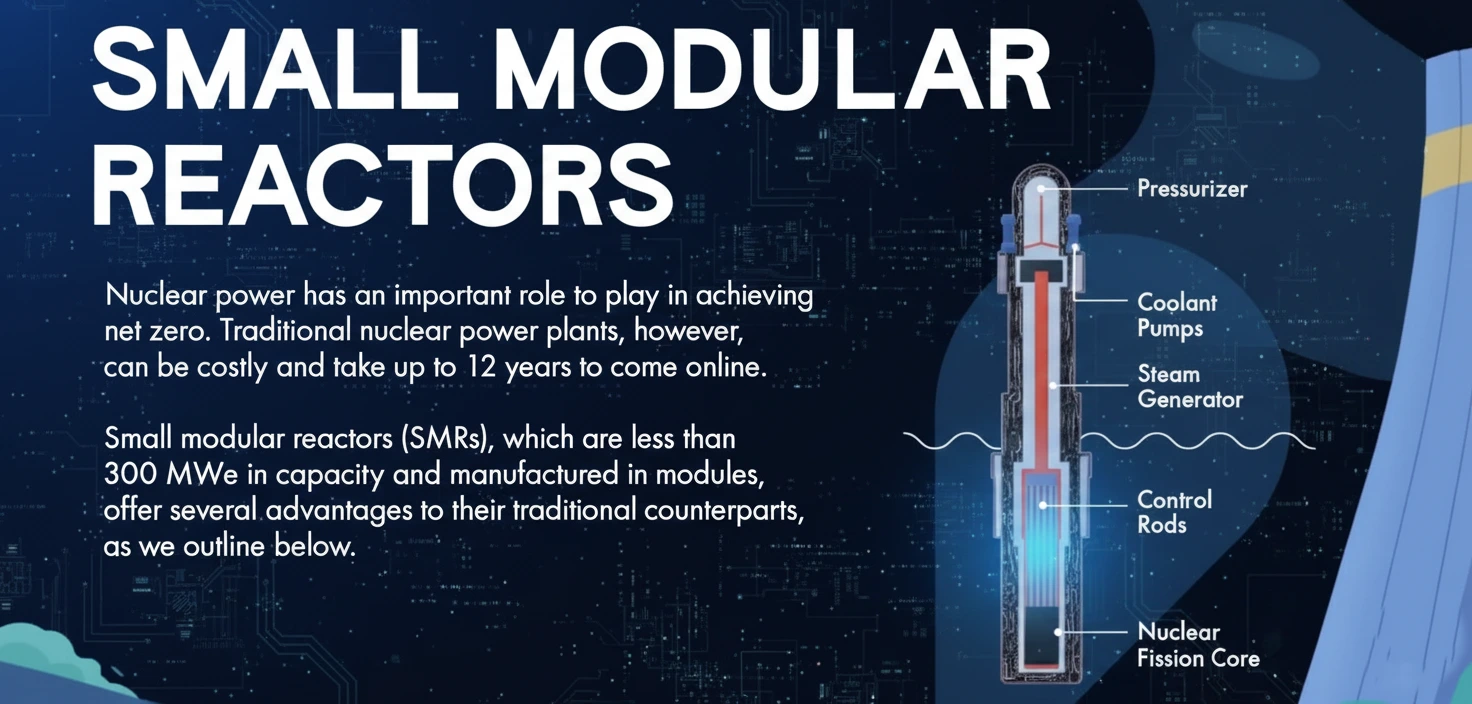
Small Modular Reactors are compact nuclear reactors designed with lower power output, modular construction, and enhanced safety. They aim to provide flexible, scalable, and cost-efficient clean-energy options aligned with India’s long-term energy security and climate goals.
Rationale for SMRs in India
India faces rising electricity demand, urbanisation pressure, and decarbonisation commitments. SMRs offer a reliable, baseload clean-energy source that complements renewable energy. Their smaller size makes them particularly suitable for remote regions, industrial clusters, and grid-constrained areas.
SMRs typically generate 50 MW to 300 MW per unit, depending on the design. This lower rating allows faster manufacturing, easier transport, and flexible deployment. India is exploring scalable units to reach multi-GW capacity through clustering of several SMRs on a single site.
Compact Core and Fuel
SMRs use compact reactor cores with high-efficiency fuel assemblies. Designs generally include simplified coolant channels and integrated steam generators.
Thermal Output and Control
Lower thermal output reduces reactor size while maintaining stable fission reactions, improving control, reliability, and operational predictability.
SMRs are manufactured as prefabricated modules in factories and transported to the site. This reduces construction delays, cost overruns, and regulatory complexities. Modular deployment ensures that additional units can be added based on future energy needs.
Passive Cooling
Most SMRs rely on passive cooling systems using natural circulation of coolant without pumps, simplifying operations and reducing dependence on active safety systems.
Safety Features
Smaller reactor cores and reduced heat flux lower the risk of overheating. Safety features include automatic shutdown, double containment, and long-duration decay-heat removal systems.
SMRs primarily use low-enriched uranium similar to conventional reactors but in more compact assemblies. Some designs propose long refuelling cycles of 3–7 years, reducing downtime and enhancing operational efficiency, especially in remote or industrial locations.
Reactor Types
India is exploring Light Water SMRs, Heavy Water SMRs, and eventually high-temperature reactors for specialised applications.
Energy Integration
Technologies aim to integrate thermal energy storage and district heating, supporting industrial decarbonisation alongside electricity generation, particularly for hydrogen production.
SMRs have a smaller land footprint, lower water requirement, and reduced construction waste. Their modularity enables step-by-step investment, reducing upfront financial risk. Passive safety reduces insurance and regulatory compliance costs, improving long-term viability.
Policy and Finance
India must update nuclear regulations, financing models, and public-sector-led reactor ownership rules to support private participation.
Logistics and Security
Waste management, cybersecurity, and global supply-chain dependencies are critical issues requiring comprehensive policy frameworks.
SMRs support India’s net-zero commitments, enhance energy sovereignty, and strengthen Atmanirbhar Bharat goals. Their integration with renewables and hydrogen ecosystems can significantly transform industrial decarbonisation and strengthen India’s global position in clean-energy innovation.
R&D Initiatives in India
Bharat Small Modular Reactors (SMRs): India’s R&D Push
Small Modular Reactors (SMRs) represent compact, factory-built nuclear reactors designed for flexible deployment. For India, they promise clean baseload power, grid stability, industrial heat applications, and strategic energy security aligned with net-zero commitments by 2070.
R&D Allocation
The Union Budget 2025 proposed a ₹20,000 crore R&D fund to accelerate indigenous SMR development, signaling a major government commitment.
Target
The aim is to build at least five India-designed SMRs by 2033, strengthening domestic innovation, manufacturing capability, and regulatory experience.
India is expanding international nuclear cooperation around SMRs. NTPC is in advanced discussions with Russia’s Rosatom for technology transfer, manufacturing partnerships, and potential deployment models suited to Indian grid and industrial requirements.
Flagship Project
BARC is developing a fully Indian-designed 100 MW Bharat SMR with enhanced safety and modularity for civilian power generation.
Parallel Designs
It is also pursuing three parallel reactor designs—a 200 MW PWR, a 55 MW PWR, and a 5 MW gas-cooled unit for niche industrial uses.
India’s proven Pressurized Heavy Water Reactor (PHWR) expertise is being re-engineered for modular deployment. DAE and Tata Consulting Engineers plan to develop 40–50 standardised Bharat SMRs by redesigning PHWR systems to achieve cost efficiency and mass-manufacturing capability.
Grid Complementarity
SMRs can complement renewable expansion by offering stable, zero-carbon baseload power, essential for grid balancing.
Deployment Flexibility
Their smaller footprint enables installation near load centres, refineries, or remote regions, reducing transmission losses and improving grid resilience.
The government is considering amendments to the Atomic Energy Act and Civil Liability for Nuclear Damage Act. The objective is to allow private sector participation in SMR construction, financing, and operation while ensuring strict regulatory safeguards.
France Joint Declaration
India and France signed a Joint Declaration on SMR Collaboration in February 2025, expanding cooperation on design, safety, and supply chains.
Broader Cooperation
This builds upon broader energy partnerships with the US, Russia, Canada, and the strategic Quad frameworks.
Bharat SMRs can serve multiple sectors—desalination, district heating, green hydrogen production, and synthetic fuels. For defence and space facilities, SMRs offer compact, secure, and reliable power sources with minimal logistical disruption.
Key Challenges
Key challenges include financing models, complex licensing processes, liability clarity, and ensuring public acceptance.
Future Strategy
India must streamline regulations, build supply chains, create skilled manpower, and ensure SMR costs become competitive with renewables and battery storage.
Nuclear Energy Mission
Nuclear Energy Mission (2025–47)
Mission Overview
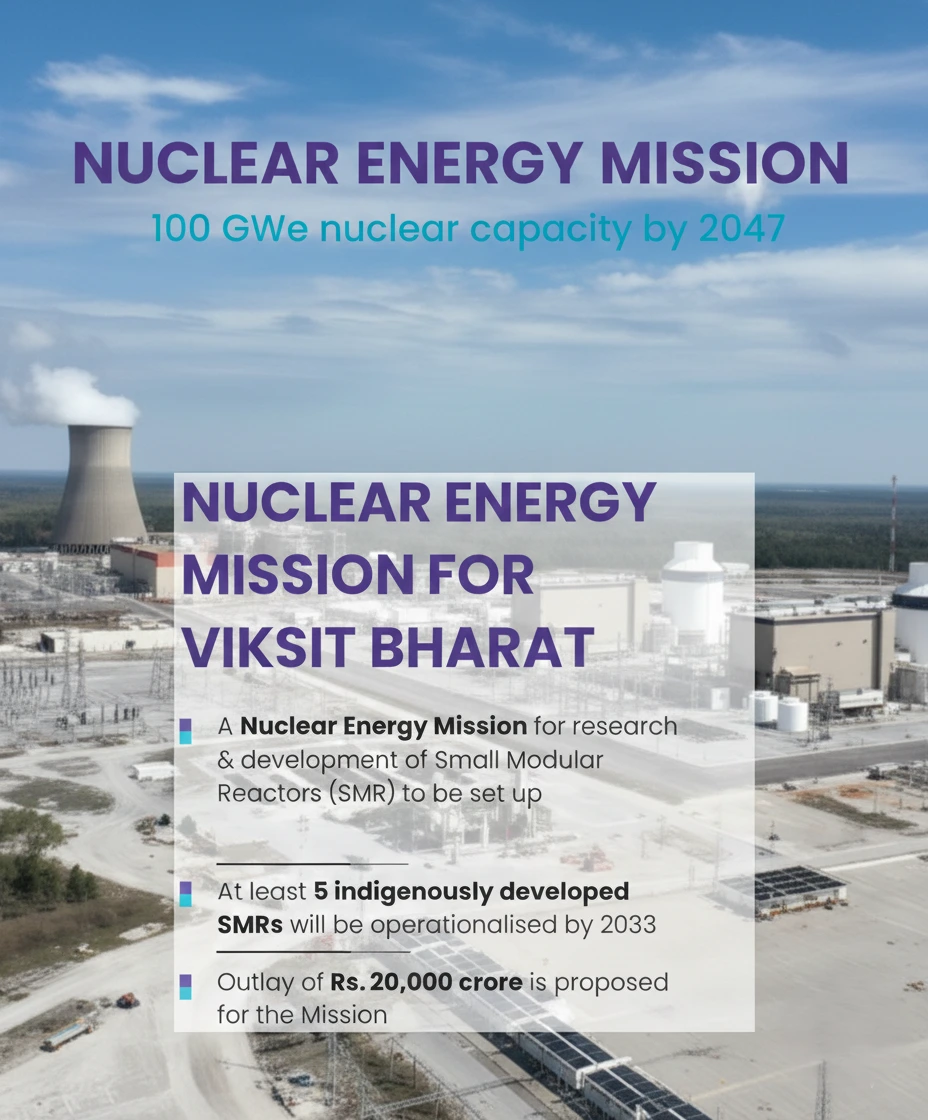
India’s Nuclear Energy Mission is a major clean-energy initiative announced in the 2025–26 Union Budget to accelerate nuclear deployment and achieve 100 GWe capacity by 2047. It aligns nuclear expansion with India’s Net Zero 2070 commitments and promotes indigenous technology, private participation, and modern reactor designs.
India currently has about 8.18 GWe nuclear capacity (early 2025), which is insufficient for long-term baseload needs.
Growing electricity demand, climate goals, and the need to reduce fossil fuel dependence make nuclear energy essential for a stable, low-carbon energy mix.
a) Capacity Expansion Target
The Mission aims to reach 100 GWe nuclear capacity by 2047, drastically scaling up from existing levels. This target is central to strengthening India’s baseload power availability for a high-renewable grid.
b) Net Zero Alignment
Nuclear energy is positioned as a non-intermittent, clean source crucial for India’s Net Zero 2070 transition. It supports grid stability and reduces dependence on thermal plants.
c) Stronger Energy Mix
By expanding nuclear share in the power basket, India reduces fossil fuel reliance. Nuclear’s high load factor makes it suitable for round-the-clock supply, supporting industries and metro-city clusters.
d) Indigenous Technology Push
The Mission prioritizes domestic Pressurized Heavy Water Reactors (PHWRs) and development of advanced Small Modular Reactors (SMRs). This reduces import dependence and builds long-term technological sovereignty.
a) Large Reactor Deployment
India continues constructing 700 MWe PHWRs at multiple sites and plans larger imported reactors. These plants will anchor high-capacity zones for industrial regions and urban corridors.
b) Small Modular Reactors (SMRs)
SMRs are central to the Mission. Designs include BSMR-200 (200 MWe) and SMR-55 (55 MWe). They suit remote regions, industrial clusters, and repurposed coal-plant sites due to smaller footprint and flexible operation.
c) Private Sector Participation
The Mission proposes amendments to the Atomic Energy Act (1962) and the Civil Liability for Nuclear Damage Act (2010). These changes aim to permit PPP models, enabling private firms to enter R&D, financing, manufacturing, and plant operation.
d) R&D Funding Support
A dedicated ₹20,000 crore allocation supports SMR design, safety validation, prototype building, and eventual commercial deployment. This marks India’s largest nuclear R&D investment to date.
a) Clean Energy Transition
Increased nuclear output helps cut carbon emissions and reduces pressure on coal-based generation, enabling sustainable economic growth.
b) Energy Security
Nuclear power ensures reliable baseload supply, complementing variable renewable energy and enhancing national grid stability.
c) Economic Growth & Innovation
The Mission boosts the domestic nuclear value chain, creates high-skilled jobs, promotes localization, and deepens India’s advanced-manufacturing capability.
Key reforms include amending the Atomic Energy Act to allow broader participation beyond public sector entities and updating the CLNDA (Civil Liability for Nuclear Damage Act) to create workable liability norms.
These steps aim to unlock capital, strengthen safety compliance, and accelerate project timelines for nuclear expansion.
Electricity Generation
Electricity Generation: Nuclear Power Plants
Nuclear power plants generate electricity using heat released from controlled nuclear fission reactions. The process produces large, continuous, and low-carbon energy, making it an important component of India’s long-term energy security and climate commitments.
Nuclear fission occurs when heavy atoms like Uranium-235 split after absorbing a neutron. This splitting releases huge heat energy and additional neutrons. Reactors use moderators and control rods to regulate these reactions safely and maintain steady power output.
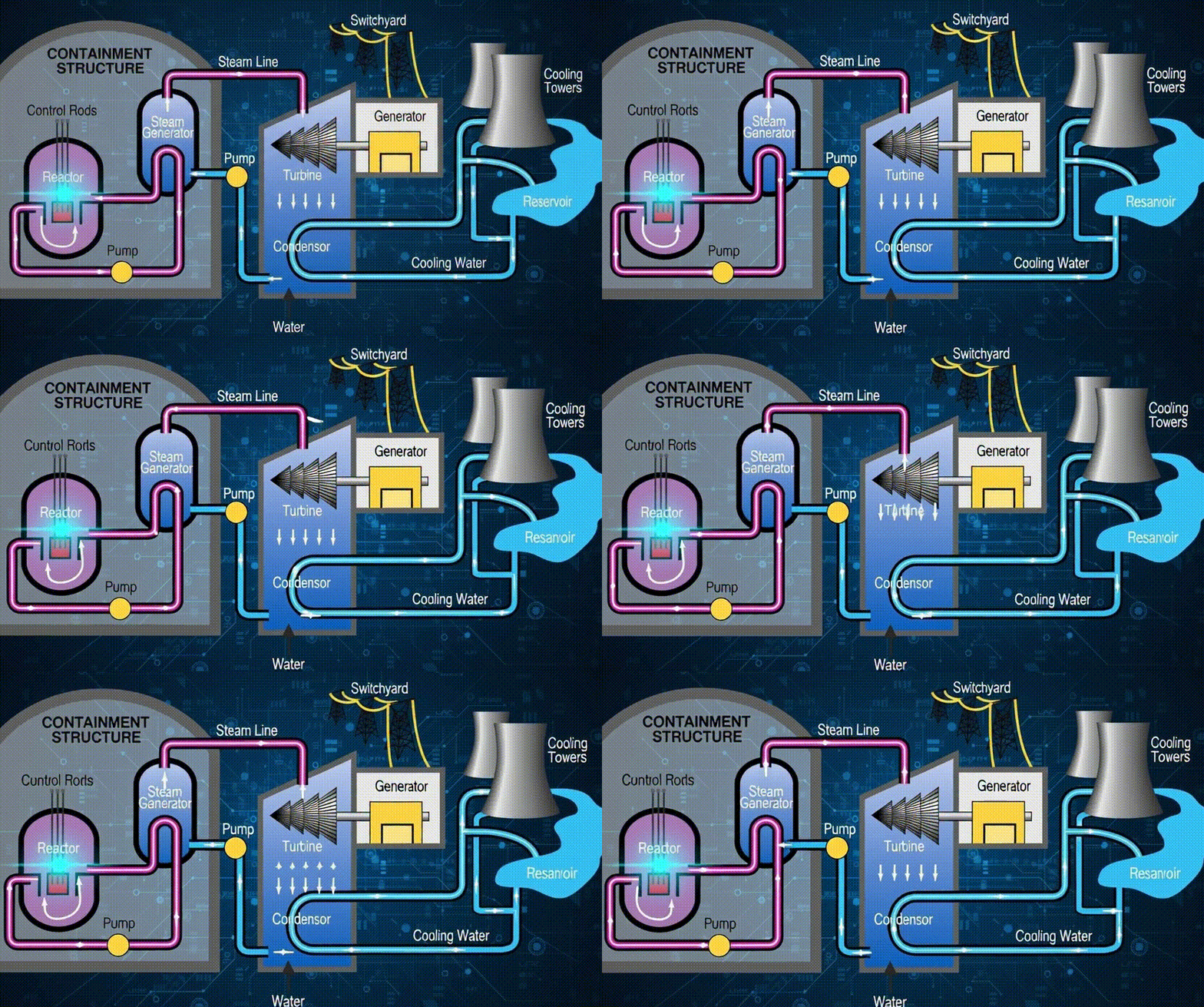
A typical nuclear reactor includes the reactor core, fuel rods, control rods, moderator, coolant, pressure vessel, and containment structures. Together, they enable safe fission, efficient heat transfer, and multi-layer protection against radiation leakage or sudden accidents.
Step 1: Fuel Preparation and Assembly
Enriched uranium is shaped into ceramic fuel pellets and arranged in long fuel rods. These rods are bundled into fuel assemblies. This compact configuration ensures optimum neutron interactions, predictable heat generation, and stable reactor operation over long cycles.
Step 2: Initiating the Fission Chain Reaction
When the reactor starts, control rods are gradually withdrawn to allow neutrons to strike uranium nuclei. A self-sustaining chain reaction begins. Moderators like heavy water or light water slow neutrons, improving fission efficiency and stabilising reactor behaviour.
Step 3: Heat Generation in the Reactor Core
As millions of fission events occur each second, the reactor core becomes extremely hot. Coolant—usually water, heavy water, or gas—absorbs this heat. Efficient heat removal prevents fuel damage and maintains constant thermal conditions inside the core.
Step 4: Heat Transfer to Steam Generator
The heated coolant circulates to a steam generator. Here, it transfers heat to a secondary water circuit without mixing. This isolation enhances safety by preventing radioactive contamination and maintaining thermal efficiency in steam production.
Step 5: Steam Production and Turbine Rotation
In the steam generator, high-pressure steam is produced. This powerful steam jet rotates large turbines connected to electrical generators. Turbine efficiency determines the final electricity output and influences overall reactor performance and cost.
Step 6: Electricity Generation in the Generator
The rotating turbine shaft spins the generator’s magnetic rotor. This movement induces electrical current in surrounding coils based on electromagnetic induction. Generated power is then stabilised, stepped-up, and supplied to the transmission grid.
Step 7: Cooling and Condensation
After rotating the turbine, steam enters a condenser. Here, cool water absorbs heat and converts steam back into liquid. This closed-loop system enables continuous reuse of water, reduces wastage, and improves plant thermal efficiency.
Step 8: Spent Fuel Handling and Storage
Used fuel assemblies are removed periodically and placed in water-filled pools for cooling and radiation shielding. Later, they shift to dry cask storage or reprocessing facilities. Effective spent fuel management ensures long-term environmental and public safety.
Nuclear power plants convert atomic energy into electricity through a controlled, stepwise thermal cycle. Their high energy density, reliability, and low emissions make them vital for India’s baseload capacity and strategic energy diversification in the coming decades.
Nuclear Power Plants in India
Nuclear Power Plants in India
India’s nuclear energy sector forms a crucial pillar of its clean, reliable, and long-term power strategy. Operated mainly by the Nuclear Power Corporation of India Ltd. (NPCIL), nuclear plants currently contribute around 3% of national electricity, with major expansion planned by 2031–32.
Role of NPCIL & DAE
NPCIL, under the Department of Atomic Energy (DAE), oversees construction, operation, and safety of civilian nuclear reactors. This integrated institutional mechanism ensures indigenous reactor development, regulatory compliance, and strategic fuel management aligned with India’s three-stage nuclear programme.
Reactor Types in India
India predominantly uses Pressurized Heavy Water Reactors (PHWRs) due to indigenous capability, lower operational complexity, and efficient fuel use. Light Water Reactors (LWRs), such as Russian VVER units at Kudankulam, supplement capacity through international collaboration.
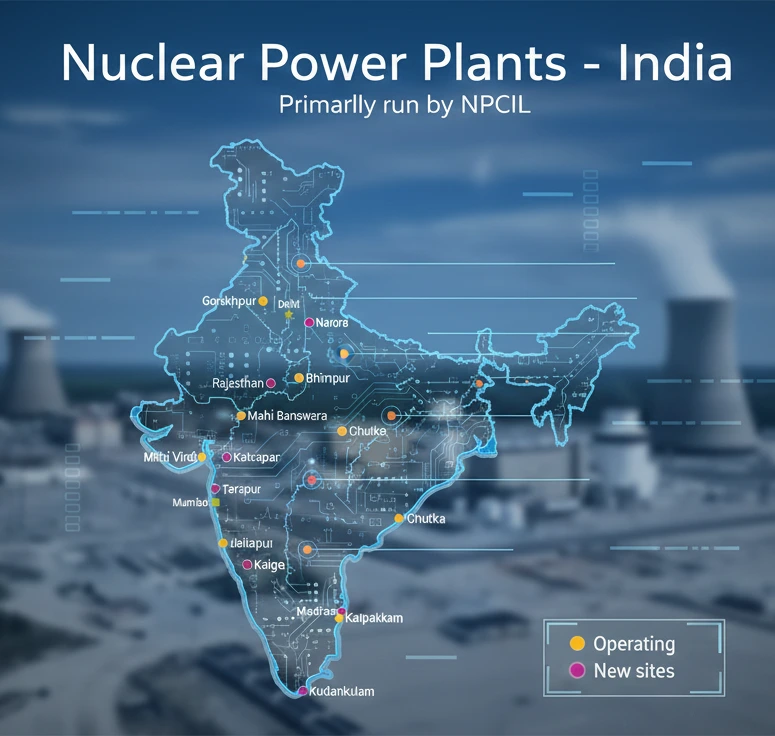
Tarapur Atomic Power Station (Maharashtra)
India’s first nuclear plant, Tarapur began operations in 1969. It includes BWR and PHWR units, symbolizing the early Indo-US collaboration and later indigenous adaptation. Tarapur remains a major contributor to western grid stability.
Rajasthan Atomic Power Station (Rawatbhata, Rajasthan)
RAPS represents India’s early self-reliance in PHWR design. Its multiple units have consistently supported North-Western power needs. The plant also serves as a training hub for reactor operations and safety engineering.
Madras Atomic Power Station (Kalpakkam, Tamil Nadu)
MAPS hosts PHWR units and supports advanced research at the Kalpakkam nuclear complex. It is central to fast-breeder reactor development and fuel cycle research, strengthening India’s long-term nuclear sustainability goals.
Narora Atomic Power Station (Uttar Pradesh)
NAPS operates standardized PHWR units and supplies power to northern states. It is known for strong safety culture reforms introduced after early operational challenges, becoming a benchmark for reactor reliability.
Kakrapar Atomic Power Station (Gujarat)
KAPS includes indigenous 700 MW PHWR units, showcasing advanced Indian reactor technology. The recent criticality achievements mark a significant step toward higher-capacity, safer, and more efficient domestic nuclear designs.
Kaiga Generating Station (Karnataka)
Located in the Western Ghats, KGS is known for high plant load factors and operational efficiency. Its PHWR units demonstrate India’s capability to run reactors safely even in ecologically sensitive regions.
Kudankulam Nuclear Power Plant (Tamil Nadu)
India’s largest nuclear power station hosts Russian VVER LWRs. Kudankulam enhances southern grid strength and represents major Indo-Russian collaboration in nuclear technology, safety systems, and fuel supply assurance.
Why Nuclear Matters
Nuclear energy provides continuous, low-carbon baseload power essential for industrial growth. Unlike solar and wind, reactors offer stable generation, making them key to India’s climate commitments and long-term energy security.
Future Expansion (2031–32 Outlook)
India is constructing several new PHWRs and LWRs, aiming for a substantial capacity increase by 2031–32. Indigenous 700 MW PHWRs, additional Kudankulam units, and pre-project sites highlight an ambitious nuclear growth roadmap.
Nuclear power remains a strategic, clean, and expanding pillar of India’s energy mix. With indigenous technology advancements, international cooperation, and strong institutional frameworks, India is steadily enhancing its nuclear capacity to meet future energy demands.
Nuclear Medicine
Nuclear Medicine; Overview
Nuclear Medicine involves the medical use of radioactive substances (radiopharmaceuticals) to diagnose, monitor, and treat diseases. It focuses on studying organ function rather than structure, making it a critical tool in modern healthcare and precision-based treatment.
The technique relies on detecting radiation emitted by administered radioisotopes. When these isotopes accumulate in specific organs or tissues, scanners capture their signals, creating functional images. This helps identify abnormalities before structural changes become visible.
Radiopharmaceuticals are compounds combining a radioactive isotope with a biologically active molecule. They selectively target organs like the thyroid, bone, or heart. Their short half-life ensures minimal exposure while enabling accurate physiological assessment essential for early disease detection.
PET (Positron Emission Tomography)
PET uses positron-emitting isotopes to study metabolic and biochemical processes. It is widely used in oncology to detect tumors, monitor response to therapy, and differentiate benign from malignant tissues with high precision and sensitivity.
SPECT (Single Photon Emission Computed Tomography)
SPECT captures gamma photons to create three-dimensional functional images. It is routinely employed for assessing cardiac perfusion, brain disorders, and bone lesions. Its cost-effectiveness and availability make it a widely used diagnostic tool in India.
Nuclear Medicine plays a major role in targeted therapy. Radioisotopes like Iodine-131 treat hyperthyroidism and thyroid cancer effectively. Newer methods such as peptide receptor radionuclide therapy (PRRT) enable precise destruction of tumor cells while sparing healthy tissues significantly.
Nuclear techniques detect disease at an early functional stage, often before structural damage appears on CT or MRI. They provide organ-specific information, guide individualized treatment plans, and improve prognosis. Their accuracy makes them crucial in modern evidence-based medicine.
Radiation doses used are low and carefully regulated. Proper shielding, controlled handling, and trained personnel ensure patient and worker safety. In India, the Atomic Energy Regulatory Board (AERB) oversees licensing, usage, and disposal of radioactive materials to ensure compliance.
India has a strong institutional base through BARC, AIIMS, and regional cancer centres. Indigenous production of radioisotopes strengthens accessibility. Growing PET-CT facilities and trained nuclear medicine physicians help expand diagnostic reach to semi-urban and rural regions.
High equipment cost, limited cyclotrons, and shortage of trained technologists constrain expansion. Logistical issues in transporting short half-life isotopes affect timely availability. Ensuring uniform quality across public and private facilities remains a continuing regulatory concern.
Is Nuclear Power Humanity’s Hidden Curse?
Is Nuclear Power Humanity’s Hidden Curse?
Nuclear power represents a paradox—capable of delivering massive clean energy, yet burdened with risks that can devastate generations. Its promise of stability contrasts sharply with concerns of safety, waste, weapons linkage, and global inequality in access.
2.1 High Energy Density
Nuclear fuel produces extremely high output from small quantities, enabling sustained electricity generation. This makes nuclear power ideal for countries seeking long-term, reliable baseload energy independent of seasonal or climatic variations.
2.2 Low Carbon Emissions
Unlike coal and gas plants, nuclear reactors emit negligible greenhouse gases during operation. This makes them crucial for climate-mitigation goals, particularly for nations balancing development with Paris Agreement commitments.
3.1 Catastrophic Accident Risks
Accidents such as Chernobyl and Fukushima highlight nuclear energy’s long-term social, health, and environmental impacts. Even rare failures create irreversible contamination, large-scale displacement, and multi-decadal ecological damage.
3.2 The Problem of Nuclear Waste
Radioactive waste remains hazardous for thousands of years. Permanent disposal solutions are limited, politically contested, and technologically complex. Many countries rely on temporary storage, increasing vulnerability to leaks, attacks, or future mismanagement.
3.3 Nuclear Proliferation Concerns
Civil nuclear programs can indirectly support military capabilities through enrichment and reprocessing technologies. This dual-use nature contributes to geopolitical tensions and raises fears of weapons-grade material diversion.
4.1 Intergenerational Burden
Future generations bear responsibility for managing hazardous waste and decommissioned reactors. This raises moral concerns about imposing long-term risks on societies that did not benefit from the energy produced.
4.2 Environmental Justice
Nuclear facilities are often located near marginalised communities. These populations face disproportionate exposure to radiation risks, land displacement, and health uncertainties, raising issues of fairness and informed consent.
5.1 Strategic Need and Energy Security
India relies on nuclear energy to reduce import dependence, diversify energy sources, and maintain strategic autonomy. Indigenous technologies like PHWRs and thorium-based research support long-term national energy resilience.
5.2 Safety Regulations and Global Engagement
India maintains a multi-tier safety framework under the AERB. Cooperation through the IAEA and civil nuclear agreements enhances technology access, but also increases accountability and global scrutiny.
Strengthening reactor safety, expanding renewable-nuclear hybrid models, and accelerating research in small modular reactors can reduce risks.
Transparent governance and robust waste-management systems are essential to make nuclear energy socially acceptable and future-ready.
Nuclear power is neither purely a boon nor a curse. It is a high-stakes technology demanding mature governance, public trust, and global cooperation. For humanity, the central challenge lies in maximising benefits while responsibly managing its irreversible risks.
Chernobyl – A Nuclear Disaster Case Study
Chernobyl – A Nuclear Disaster Case Study
The Chernobyl disaster, occurring on 26 April 1986 in the USSR (present-day Ukraine), remains the world’s worst nuclear accident. It offers critical lessons in nuclear safety, governance failure, risk communication, disaster management, and environmental recovery—key themes relevant for UPSC preparation.
The plant used the RBMK-1000 reactor, designed for high output but containing major safety weaknesses. The graphite-moderated structure, positive void coefficient, and inadequate containment made it vulnerable under unstable operating conditions, especially during low-power testing.
During a safety test, operators disabled crucial emergency systems and attempted to run the reactor at unstable low power. Poor coordination, lack of protocol adherence, and flawed design triggered uncontrollable power surges that caused explosions and reactor core rupture.
Core Explosion
The reactor’s graphite core caught fire, releasing large quantities of radioactive materials into the atmosphere. The initial blast killed two workers immediately.
First Responders
Firefighters, unaware of radiation levels, responded without protection. Many suffered acute radiation doses, highlighting the severity and unknown nature of the initial threat.
Massive radioactive clouds containing iodine-131, cesium-137, and strontium-90 dispersed over Ukraine, Belarus, Russia, and parts of Europe. Weather patterns accelerated transboundary spread, making Chernobyl a global environmental crisis instead of a localized industrial accident.
Delayed Evacuation
Pripyat, the nearest city, was evacuated almost 36 hours later due to delayed official acknowledgment. Over 1,00,000 people were ultimately relocated.
Governance Lesson
The slow response highlighted systemic secrecy in Soviet governance and poor public risk communication—a major lesson in disaster ethics and transparency.
Acute radiation syndrome affected plant staff and firefighters. Long-term consequences included thyroid cancers, psychological trauma, and socioeconomic displacement. Although exact death figures vary, global organizations recognize Chernobyl as a long-lasting public health emergency.
Radiation contaminated soil, water bodies, and surrounding forests. The “Exclusion Zone” became a large testing ground for radioactive decay impacts. Some wildlife populations unexpectedly rebounded due to human absence, showing complex interactions between ecology and abandoned landscapes.
Safety and Oversight
Chernobyl exposed weak safety culture and inadequate regulatory oversight. It emphasized the need for independent nuclear regulators and strong safety protocols.
Transparency
The disaster underscored the critical need for lack of transparency and immediate information disclosure during technological disasters to maintain public trust.
Global Reforms
Worldwide reforms included the Convention on Nuclear Safety and enhanced, inherently safer reactor designs.
India's Focus
For India, it strengthened focus on NPCIL standards, AERB independence debates, emergency preparedness, and the importance of public trust in nuclear governance.
A massive “New Safe Confinement” structure now covers the destroyed reactor to prevent further leakage. The area remains uninhabitable, serving as a living laboratory for radiation studies and long-term disaster-monitoring strategies.
Nuclear Power Corporation of India Limited
Nuclear Power Corporation of India Limited (NPCIL)
NPCIL is a public sector enterprise responsible for the design, construction, commissioning, and operation of India’s nuclear power reactors. It plays a central role in India’s civilian nuclear energy programme and supports long-term energy security through clean, reliable baseload power.
NPCIL functions under the Department of Atomic Energy (DAE), Government of India. DAE provides policy direction, project approvals, and regulatory oversight.
NPCIL ensures implementation of India’s nuclear power strategy by coordinating technology, safety systems, and operational standards across all nuclear sites.
NPCIL was created under the Companies Act, 1956 as a wholly owned Government enterprise.
Its activities are governed by the Atomic Energy Act, 1962, which empowers the Central Government to develop, control, and operate nuclear installations for peaceful uses.
NPCIL is mandated to build and operate nuclear power plants across India. It manages reactor design, fuel handling, radiation safety, and station operations.
It also collaborates with research institutions to integrate indigenous technologies and enhance nuclear generation capacity.
NPCIL plans new nuclear projects, secures regulatory clearances, and executes construction.
It ensures safe reactor operations, emergency preparedness, and constant monitoring of radiation levels.
The corporation also undertakes public outreach and environmental stewardship around nuclear sites.
NPCIL primarily operates Pressurised Heavy Water Reactors (PHWRs), India’s indigenous technology. It also runs Boiling Water Reactors (BWRs).
It is expanding towards Light Water Reactors (LWRs) through international cooperation. Reactor diversification supports higher efficiency and global technology integration.
The Atomic Energy Regulatory Board (AERB) oversees nuclear safety. NPCIL adheres to strict protocols on design, seismic safety, radiation limits, and waste management.
Regular audits, peer reviews, and emergency readiness drills strengthen public confidence and operational credibility.
NPCIL contributes significantly to India’s clean-energy mix by supplying stable, non-carbon baseload power.
Nuclear energy provides grid stability, reduces dependence on fossil fuels, and aligns with India’s long-term climate commitments.
Current expansion focuses on the fleet-mode construction of 700 MW PHWRs to accelerate capacity addition.
Upcoming sites include Gorakhpur (Haryana), Mahi Banswara (Rajasthan), and Chutka (Madhya Pradesh), enhancing regional power availability and technological self-reliance.
India is progressing with Kudankulam Units 3–6 using Russian VVER technology. Construction of new PHWRs under fleet mode has begun.
NPCIL also reported record nuclear generation, improved plant availability, and advances in indigenous reactor components to reduce imports.
Electronics Corporation of India Limited
Electronics Corporation of India Limited (ECIL)
Overview and Establishment
Electronics Corporation of India Limited (ECIL) is a leading public-sector enterprise under the Department of Atomic Energy (DAE). It was established in 1967 to achieve self-reliance in advanced electronics crucial for national security, strategic sectors, and technological sovereignty.
Departmental Position & Governance
ECIL functions under the Department of Atomic Energy (DAE), giving it strategic importance in India’s nuclear and defence ecosystem. Being a government-owned enterprise, it is headed by a Board of Directors, ensuring accountability, financial oversight, and alignment with national security priorities.
Statutory Backing
ECIL is registered under the Companies Act, 1956, giving it a corporate legal framework. It does not have a separate statute but derives authority through DAE, enabling it to support sensitive sectors with strategic autonomy.
Vision & Self-Reliance
ECIL was established to develop indigenous electronics for defence, nuclear energy, space, and industrial control systems. Its mandate includes designing secure, self-reliant technologies that reduce foreign dependence and strengthen national technological capabilities.
Core Functional Areas
ECIL works across multiple sectors including defence electronics, nuclear instrumentation, communication systems, and cybersecurity. It develops high-reliability equipment used in missiles, aerospace, atomic research, and secure communication networks.
Major Products & Technologies
The corporation produces electronic voting machines (EVMs), nuclear reactor control systems, radiation monitoring devices, secure radios, and missile-support electronics. Its technologies are often customized to meet classified or mission-critical requirements of strategic agencies.
EVM & VVPAT Manufacturing
ECIL, along with BEL, manufactures Electronic Voting Machines and VVPATs for the Election Commission. It maintains strict quality protocols, secure manufacturing processes, and periodic technology upgrades to ensure reliability and transparency in India's electoral system.
Support to Strategic Agencies
ECIL supports DRDO, ISRO, NPCIL, and armed forces with mission-critical electronics. It provides command-control systems, telemetry units, cyber-secure communication tools, and radiation detection systems, strengthening India’s indigenous defence ecosystem.
Infrastructure & R&D Capacity
ECIL has strong in-house R&D centres focusing on embedded systems, secure communication, cyber protection, and precision electronics. Its manufacturing units in Hyderabad enable large-scale production with strict quality assurance for strategic applications.
Specialized Workforce
ECIL develops specialized human resources through training centres and collaboration with premier institutes. Its workforce includes engineers, scientists, and technicians trained in high-reliability electronics essential for national security projects.
Modernization and New Systems
Recent developments include modernization of EVM/VVPAT production lines, new secure communication systems for defence forces, digital radiation monitoring upgrades for nuclear facilities, and expanded cyber-secure infrastructure solutions for government agencies.
Uranium Corporation of India Limited
Uranium Corporation of India Limited (UCIL)
Uranium Corporation of India Limited (UCIL) is a central public sector enterprise responsible for mining and processing uranium ore in India. It plays a critical role in ensuring fuel supply for the country’s nuclear energy programme operated by the Department of Atomic Energy (DAE).
UCIL functions under the Department of Atomic Energy (DAE), which reports directly to the Prime Minister. This makes UCIL part of India’s strategic nuclear infrastructure, aligned with national energy security and nuclear development priorities.
UCIL was incorporated in 1967 under the Companies Act, 1956, giving it corporate legal status. Its operations draw additional authority from the Atomic Energy Act, 1962, which governs the mining, handling and processing of radioactive minerals in India.
Mandate and Core Functions
UCIL is mandated to locate, mine, process and produce uranium concentrates. Its work supports the fuel cycle of nuclear reactors operated by NPCIL. It also undertakes exploration, environmental safety measures and tailings management around its mining sites.
Major Mining and Processing Sites
UCIL operates key facilities in Jharkhand, mainly around Jaduguda, Bhatin, Turamdih and Narwapahar. Newer projects include Tummalapalle (Andhra Pradesh) and Gogi (Karnataka). These sites collectively sustain India’s domestic uranium availability.
Importance for India’s Nuclear Programme
India’s nuclear power reactors rely heavily on natural uranium fuel. UCIL’s output directly affects reactor load factors and energy generation. Indigenous uranium mining reduces dependence on imports, improving strategic autonomy and resource security.
Environmental and Safety Regulation
UCIL must follow safety standards set by the Atomic Energy Regulatory Board (AERB). Regular monitoring ensures radiation protection, tailings disposal, groundwater safety and community health. Environmental clearances are mandatory for all new projects.
Uranium deposits in India are often low-grade, requiring extensive processing. Local resistance due to environmental concerns, land acquisition issues and regulatory delays also slow project expansion. Technology upgradation is needed for deeper mining operations.
Recent years have seen expansions at the Jaduguda-Turamdih belt and operationalisation of the Tummalapalle mill. The government is pushing for new exploration blocks to boost domestic uranium supply, supporting India’s growing nuclear power capacity.
IREL (India) Limited
IREL (India) Limited
IREL (India) Limited is a Central Public Sector Enterprise (CPSE) under the Department of Atomic Energy (DAE). Established in 1950, it plays a key role in India’s strategic mineral security, especially in producing and processing beach sand minerals vital for nuclear and industrial applications.
Administrative Ministry
IREL operates under the Department of Atomic Energy (DAE), which oversees nuclear energy, strategic minerals, and related research. The ministry provides policy direction, ensures security regulations, and aligns IREL’s operations with India’s long-term atomic and strategic resource priorities.
Legal & Statutory Status
IREL is registered as a Schedule-A Miniratna Category-I CPSE under the Companies Act, 1956 (now governed by Companies Act, 2013). Though not a statutory body, it functions under DAE’s regulatory framework and India’s Atomic Energy Act for handling strategic minerals.
IREL’s mandate includes mining, processing, and refining of rare earth elements, titanium-bearing minerals, and beach sand minerals. Its activities ensure domestic availability of strategic materials essential for nuclear fuel cycles, defence technologies, clean energy systems, and high-end manufacturing.
Key Minerals Handled
The company processes ilmenite, rutile, zircon, monazite, sillimanite, and garnet. These minerals yield products like rare earth oxides, titanium dioxide, and thorium-bearing compounds, forming the backbone of sectors such as electronics, aerospace, metallurgy, and nuclear research.
Strategic Importance to India
IREL supports India’s three-stage nuclear programme by supplying thorium-rich monazite and rare earth elements. Its work strengthens import substitution, safeguards critical mineral supply chains, and reduces dependence on global suppliers for high-value strategic materials.
IREL operates major units in Kerala (Chavara), Odisha (Chatrapur), and Tamil Nadu (Manavalakurichi). These units undertake mining, processing, separation, and value addition. The Rare Earths Division (RED) in Odisha ensures downstream production aligned with global technology standards.
Research & Innovation Role
The IREL R&D unit develops advanced extraction, separation, and purification technologies. It collaborates with BARC, IGCAR, and academic institutions to strengthen rare-earth processing capabilities, improve mineral recovery, and develop new materials for strategic and industrial use.
Environmental & Regulatory Compliance
IREL follows coastal regulation norms, atomic minerals handling protocols, and strict radiation safety standards. It adopts eco-friendly mining, rehabilitation of mined areas, and waste-reduction approaches consistent with national environmental and atomic energy regulations.
In recent years, IREL has expanded rare-earth production, modernised processing plants, and initiated new value-addition projects.
Bhabha Atomic Research Centre
Bhabha Atomic Research Centre (BARC)
Bhabha Atomic Research Centre (BARC) is India’s premier nuclear research organisation under the Department of Atomic Energy (DAE). It leads the country’s programme in nuclear science, engineering, fuel cycle technologies, and strategic applications essential for national development and security.
Administrative Location
BARC functions directly under the Department of Atomic Energy (DAE), which reports to the Prime Minister. This unique placement ensures autonomy, strategic confidentiality, and seamless coordination for sensitive nuclear and energy-related research and development activities.
India’s atomic energy framework is governed by the Atomic Energy Act, 1962. BARC operates under the powers, mandates, and regulatory mechanisms established by this Act, enabling research, development, and control of nuclear materials, fuel cycles, and radiation technologies.
Mandate & Vision
BARC’s vision is to advance nuclear science and engineering for peaceful purposes. Its mandate spans power generation technologies, reactor design, isotope applications, national security initiatives, and scientific innovation with broad societal benefits.
a. Nuclear Reactor Development
BARC designs and develops reactors such as PHWRs, FBRs, and AHWRs. Its research supports India’s three-stage nuclear power programme for long-term energy security.
b. Nuclear Fuel Cycle Management
It manages the entire fuel cycle—fuel fabrication, reprocessing, waste management, and thorium utilisation research—ensuring sustainability and reduced energy dependence.
c. Strategic and Defence Applications
BARC contributes to strategic systems, radiation technologies, and materials crucial for national defence. It ensures secure handling and advancement of high-end nuclear capabilities.
d. Research in Basic & Applied Sciences
The centre conducts multidisciplinary research in physics, chemistry, biosciences, engineering, and advanced materials contributing to national innovation and scientific leadership.
e. Societal Applications
BARC develops radiopharmaceuticals, medical isotopes, water purification technologies, and irradiation facilities supporting agriculture, health, and environmental protection.
Structure & Facilities
BARC operates through specialised groups such as Reactor Engineering, Radiation Technology, Nuclear Recycle, and Bioscience Divisions. Its facilities include laboratories, pilot plants, research reactors, and advanced testing centres across India.
a. BARC’s AHWR & Thorium Research
BARC’s progress on the Advanced Heavy Water Reactor (AHWR) supports India’s long-term thorium utilisation strategy, a key component of the three-stage nuclear programme.
b. Isotope Production for Healthcare
Recent expansion in radiopharmaceutical production boosts cancer diagnosis and therapy capabilities across regional medical centres.
c. Indigenous Technologies
BARC has advanced indigenous reactor components, safety systems, and fuel fabrication methods under “Atmanirbhar Bharat” for reducing foreign dependence.
d. Waste Management Innovations
New vitrification and waste minimisation techniques enhance nuclear safety and environmental protection measures.
IGCAR
Indira Gandhi Centre for Atomic Research (IGCAR)
IGCAR is one of India’s premier nuclear research centres under the Department of Atomic Energy (DAE). It leads advanced research in fast breeder reactor (FBR) technology and materials science, strengthening India’s long-term energy security and strategic nuclear capabilities.
Location & Establishment
Established in 1971 at Kalpakkam (Tamil Nadu), IGCAR was earlier called the Reactor Research Centre.
Renaming
It was later renamed in honour of Indira Gandhi, acknowledging its role in advancing self-reliant nuclear technology and indigenous reactor development.
IGCAR functions directly under the Department of Atomic Energy (DAE), which reports to the Prime Minister. The Centre works within DAE’s strategic mandate of nuclear power generation, research, and technological self-sufficiency.
Authority
IGCAR does not have a separate statutory Act.
Legal Basis
It derives authority from the Atomic Energy Act, 1962, which empowers DAE to oversee nuclear research, development, safety, and regulation.
IGCAR aims to develop fast reactor technology, enhance fuel cycle efficiency, design advanced materials, and support India’s three-stage nuclear programme. It focuses on innovation, safety, and indigenisation to reduce external dependence in strategic sectors.
R&D Focus
IGCAR conducts R&D on fast breeder reactors, plutonium-based fuels, reactor instrumentation, safety systems, and waste management.
Advanced Development
It also develops reprocessing technologies, corrosion-resistant materials, and computational reactor models for long-term nuclear sustainability.
One of IGCAR’s landmark achievements is operating the FBTR, a sodium-cooled experimental reactor. It validates indigenous fuel design, materials behaviour, and safety mechanisms, forming the scientific foundation for India’s commercial fast breeder programme.
Support Role
Although the PFBR is implemented by BHAVINI, IGCAR provides essential design inputs, material testing, safety analysis, and commissioning support.
Key Collaboration
This collaboration is central to scaling fast-breeder technology for commercial power production.
IGCAR works extensively on metallic and mixed-oxide (MOX) fuels, high-temperature alloys, and radiation-resistant components. Its research enhances reactor life, safety margins, and fuel efficiency, supporting long-term nuclear sustainability.
Safety Studies
The Centre undertakes advanced studies on reactor safety codes, probabilistic assessments, thermal–hydraulic modelling, and spent-fuel reprocessing.
Waste Management
It supports safe waste immobilisation, reducing environmental risk and ensuring compliance with national safety norms.
IGCAR runs training schools, fellowship programmes, and high-end research facilities. It collaborates with IITs, IISc, and international agencies, strengthening India’s scientific manpower and global nuclear research standing.
Technology Progress
Recent developments include progress on metallic fuel fabrication, enhanced sodium-cooled reactor testing, new materials for Gen-IV reactors, and digital reactor monitoring.
PFBR Status
There is increasing support activities for PFBR commissioning at Kalpakkam.
Raja Ramanna Centre for Advanced Technology
Raja Ramanna Centre for Advanced Technology (RRCAT)
RRCAT is a premier research institute under the Department of Atomic Energy (DAE), Government of India. Located in Indore, it focuses on advanced research in lasers, particle accelerators, and related high-technology applications, supporting both strategic and civilian sectors.
RRCAT functions directly under the Department of Atomic Energy (DAE), which reports to the Prime Minister. The Centre’s activities align with India’s atomic energy programme, high-end physics research, national security applications, and emerging accelerator-based technologies.
RRCAT does not have an independent statutory act. It operates under the overarching legal framework of the Atomic Energy Act, 1962, empowering DAE institutions to engage in research, development, and deployment of nuclear and allied advanced technologies.
RRCAT is mandated to develop cutting-edge technologies in lasers and accelerators. Its functions include R&D, technology development, training, and collaboration for national missions. The Centre supports India’s strategic capabilities, healthcare sectors, materials science, and industrial applications.
4.1 Laser Technology
The Centre develops high-power, industrial, medical, and scientific lasers. These include solid-state lasers, fiber lasers, and specialized systems for precision manufacturing, defence uses, and advanced diagnostics. RRCAT contributes significantly to India’s indigenous laser ecosystem.
4.2 Particle Accelerators
RRCAT is India’s nodal centre for accelerator development. It leads work on synchrotron sources, free-electron lasers, and accelerator subsystems. The Centre contributes to electron accelerators used in research, radiation processing, and advanced materials characterization.
4.3 Indus Synchrotron Facilities
The Indus-1 and Indus-2 synchrotron radiation sources are major national facilities built and operated by RRCAT. They support frontier research in physics, chemistry, biology, and engineering, strengthening India’s self-reliance in advanced photon science.
4.4 Cryogenics and Advanced Instrumentation
To support accelerator development, RRCAT develops cryogenic systems, vacuum technologies, and precision instrumentation. These technologies are vital for superconducting accelerators, ultra-low temperature materials research, and high-energy physics experiments.
The Centre runs training programmes for scientists, engineers, and technicians under DAE schemes. It supports national missions through knowledge exchange, internships, and specialized courses on lasers, accelerator physics, and materials science.
RRCAT collaborates with national laboratories, IITs, IISERs, and global research facilities. Participation in accelerator-driven projects, medical radiation initiatives, and science outreach programmes enhances India’s global footprint in frontier technologies.
RRCAT recently advanced work on superconducting radio-frequency (SRF) technology for next-generation accelerators. Upgrades to Indus-2 beamlines, progress in free-electron laser R&D, and deployment of advanced industrial laser systems are key current updates.
RRCAT strengthens strategic autonomy in high-technology sectors. Its innovations enhance defence readiness, expand India’s materials research capabilities, support medical radiation technologies, and contribute to Make in India through indigenous scientific infrastructure.
Variable Energy Cyclotron Centre
Variable Energy Cyclotron Centre (VECC)
VECC is a premier research and development unit under the Department of Atomic Energy (DAE). It plays a central role in India’s accelerator-based research, nuclear physics experiments, and development of advanced radiation technologies for strategic and civilian applications.
Location
VECC operates from Kolkata with an additional campus at Rajarhat, facilitating advanced scientific activities and expansion.
Governance
It functions directly under the administrative control of the Department of Atomic Energy (DAE), ensuring alignment with India’s nuclear science roadmap and technology missions.
VECC draws authority from the Atomic Energy Act, 1962, which empowers DAE to manage nuclear research, build accelerators, and promote atomic energy applications. This statutory framework enables VECC to conduct high-energy accelerator activities with national security and safety oversight.
Primary Focus
The centre aims to conduct frontier-level nuclear physics research through particle accelerators.
Key Activities
It supports experimental studies involving heavy ions, rare isotopes, high-energy beams, and advanced detector technologies essential for understanding nuclear structure and fundamental interactions.
VECC hosts the K-130 Cyclotron and K-500 Superconducting Cyclotron, enabling variable-energy particle beams. These accelerators are essential for radiation therapy research, isotope production, materials studies, and precision experiments involving ion-induced reactions.
Key Partners
VECC works with BARC, RRCAT, TIFR, and IUAC to strengthen India’s accelerator ecosystem.
Focus Areas
These collaborations support development of new beamlines, joint experiments, detector design, cryogenics, and accelerator physics training for scientists and engineers.
VECC is a major partner in the Facility for Antiproton and Ion Research (FAIR) project in Germany. India contributes accelerator components, cryogenic systems, and detector technologies, improving its global standing in next-generation high-energy physics infrastructure development.
Medical
Supports radioisotope production, radiation chemistry studies, and accelerator technology for medical imaging and cancer therapy.
Industrial
Enables advances in material modification, ion implantation, and radiation-hard components used across strategic industries.
VECC’s functions include accelerator development, nuclear physics experiments, detector fabrication, cryogenic research, and production of specialized isotopes. It also provides training, supports university research, and develops technologies for national accelerator missions.
FAIR Progress
VECC has progressed on the India-FAIR accelerator modules and cryogenic systems deliveries, contributing to the international project.
Cyclotron Upgrades
Upgrades to the K-500 cyclotron aim to enhance beam stability, precision, and experimental capacity, alongside expansion of beamline infrastructure at Rajarhat for medical applications.
VECC strengthens India’s strategic scientific capacity in particle accelerator technology. It supports Atmanirbhar Bharat goals by localising high-energy accelerator components, advancing nuclear research capabilities, and enabling world-class experiments across physics and materials sciences.
Atomic Minerals Directorate
Atomic Minerals Directorate for Exploration and Research (AMD)
The Atomic Minerals Directorate for Exploration and Research (AMD) is India’s premier agency responsible for locating, evaluating, and establishing resources of atomic minerals. It plays a foundational role in strengthening India’s nuclear energy programme by ensuring a secure domestic supply of strategic minerals.
AMD functions under the Department of Atomic Energy (DAE), Government of India. As an attached office, it receives policy guidance, budgetary support, and strategic direction from the DAE, aligning its activities with national nuclear energy priorities and long-term resource security planning.
Established in 1948, AMD is one of India’s earliest scientific exploration bodies. It began as the ‘Rare Minerals Survey Unit’ and gradually expanded into a multidisciplinary directorate, reflecting India’s evolving nuclear ambitions and the need for indigenous mineral resource assessment.
AMD’s functioning derives authority mainly from the Atomic Energy Act, 1962. The Act empowers the Central Government to control, regulate, and develop atomic energy and associated minerals. It also mandates confidentiality, licensing, and exclusive government ownership over specified atomic minerals.
Key Minerals
Atomic minerals include uranium, thorium, zirconium, beryllium, niobium, tantalum, lithium-bearing minerals, and rare earth elements associated with monazite.
Strategic Importance
These minerals are vital for nuclear fuel fabrication, reactor components, and advanced strategic technologies such as space, defence, and electronics.
AMD conducts airborne surveys, ground radiometric mapping, geochemical sampling, drilling, and resource estimation for uranium and thorium. It also assesses beach sand heavy minerals, validates private exploration proposals, and supports reactor fuel-cycle planning through reliable geological data generation.
Advanced Techniques
AMD has developed advanced geophysical, geochemical, and radiometric techniques suited to Indian geology for precise exploration outcomes.
Modern Tools
The directorate uses drones, GIS platforms, and high-resolution spectrometry in its laboratories for rock analysis and isotopic studies.
Major uranium provinces include Singhbhum (Jharkhand), Tummalapalle (Andhra Pradesh), Mahadek Basin (Meghalaya), and Bhima Basin (Karnataka). Thorium-rich deposits are concentrated along Kerala, Tamil Nadu, and Odisha coasts. These regions form the backbone of India’s long-term nuclear resource planning.
Fuel Security
AMD ensures fuel security for the first stage based on natural uranium and simultaneously maps thorium resources essential for the third stage.
Long-Range Planning
By providing reliable reserves data, AMD enables reactor design, fuel strategy, and long-range nuclear expansion necessary for the three-stage plan.
Recent updates include expanded uranium exploration in Rajasthan’s Aravalli belt, resource augmentation at Tummalapalle, and intensified mapping of lithium and rare earth elements. AMD is also collaborating with ISRO and IITs for geospatial analytics and advanced mineral characterisation.
AMD strengthens India’s energy independence by reducing reliance on imported nuclear fuel. Its discoveries enhance national security, support clean-energy goals, and enable future reactor technologies. The directorate remains central to India’s aim of achieving a robust, diversified nuclear fuel base.
Nuclear Fuel Complex
Nuclear Fuel Complex (NFC)
Introduction to NFC
The Nuclear Fuel Complex (NFC) is a key industrial arm of India’s atomic energy programme. It manufactures nuclear fuel assemblies and specialised components essential for operating India’s Pressurised Heavy Water Reactors (PHWRs) and Boiling Water Reactors (BWRs), ensuring self-reliance in fuel supply.
Administrative Location
NFC operates under the Department of Atomic Energy (DAE), an executive department directly under the Prime Minister of India. This positioning enables strategic oversight, faster decision-making, and alignment of fuel manufacturing with national nuclear energy priorities and security requirements.
Statutory and Legal Backing
DAE’s mandate, including NFC’s functioning, stems from the Atomic Energy Act, 1962. This Act empowers the Union government to regulate nuclear materials, establish supporting institutions, control fuel cycle operations, and oversee safety protocols across the civilian nuclear sector.
Evolution and Establishment
NFC was established in 1971 at Hyderabad as a centralised industrial complex to produce fuel for PHWRs. The goal was to create an integrated back-end and front-end manufacturing ecosystem covering fuel fabrication, zirconium production, and reactor-grade material processing.
Core Functions of NFC
NFC fabricates fuel assemblies for PHWRs, BWRs, and research reactors. It manufactures zirconium alloy cladding tubes, reactor components, and structural materials. NFC also contributes to heavy-water reactor development by supplying high-purity, high-strength nuclear-grade components.
Role in India’s Three-Stage Nuclear Programme
NFC supports Stage-I PHWRs by producing natural uranium fuel assemblies. Its material technologies aid fast-breeder reactor systems under Stage-II. The complex enables the long-term transition to the thorium-based Stage-III cycle by developing advanced material processing capabilities.
Fuel Fabrication Process (Simplified)
Fuel fabrication involves converting uranium concentrates into nuclear-grade fuel. NFC undertakes pelletisation, sintering, tube fabrication, assembly loading, and rigorous non-destructive testing to ensure high safety standards suitable for long reactor life.
Safety and Quality Framework
NFC follows stringent safety norms under the Atomic Energy Regulatory Board (AERB). It uses multi-layered quality checks, radiation protection systems, and automated inspection technologies to maintain safety of workers and reactor-grade products.
Recent Developments
NFC achieved record fuel production for PHWRs in recent years, supporting India’s expanding reactor fleet. A new fuel fabrication facility at Kota, Rajasthan, improved redundancy and capacity. Upgrades in zirconium alloy technology enhanced fuel efficiency and reactor performance.
Strategic Importance
NFC reduces dependence on external suppliers and strengthens India’s nuclear autonomy. Its indigenisation efforts help maintain stable reactor operations, expand clean-energy generation, and support strategic programmes requiring specialised nuclear materials.
Board of Radiation and Isotope Technology
Board of Radiation and Isotope Technology (BRIT)
The Board of Radiation and Isotope Technology (BRIT) is an important unit under India’s nuclear technology framework. It plays a crucial role in producing, supplying, and promoting radiation-based products, services, and isotope technologies for peaceful applications across multiple sectors.
BRIT functions under the Department of Atomic Energy (DAE), Government of India. It operates from Mumbai and works closely with other DAE institutions such as the Bhabha Atomic Research Centre (BARC) to ensure reliable radiation and isotope-related services nationwide.
Nature of Organisation
BRIT is not a statutory body created by an Act of Parliament. Instead, it is an autonomous commercial entity under DAE. Its mandate focuses on commercial operations, technology transfer, and supply of radioisotope-based solutions to government and private users.
Objective and Vision
The organisation aims to popularise radiation and isotope technologies for societal benefits. Its core vision includes improving healthcare, agriculture, industry, and research through reliable supply, safety assurance, and innovation-driven isotope applications.
BRIT produces radioisotopes, radiopharmaceuticals, and radiation-processing products. It also provides services such as gamma sterilisation, calibration, quality assurance, and technical consultancy. These offerings support medical diagnosis, therapy, industrial operations, and agricultural quality enhancement.
Radiopharmaceutical Production
A significant function of BRIT is the production and supply of radiopharmaceuticals used in nuclear medicine. These include diagnostic isotopes for imaging and therapeutic isotopes for cancer treatment, ensuring uninterrupted delivery to hospitals nationwide.
Industrial Applications
BRIT offers industrial irradiation services through gamma processing facilities. These services help in sterilising medical products, food preservation, polymer modification, and ensuring quality control using radiation-based inspection technologies.
BRIT supports agriculture through radiation-based disinfestation, shelf-life enhancement, and mutation breeding. Its technologies enable safer storage, export-grade quality, and reduced post-harvest losses in various crops, fruits, and food products.
Quality Assurance and Calibration
The organisation ensures radiation safety by providing dosimetry, calibration, and standardisation services. These functions strengthen regulatory compliance for radiation facilities and help maintain accuracy in industrial and medical instruments.
Technology Transfer Initiatives
BRIT actively transfers radiation-processing technologies to private entrepreneurs. Through partnerships and licensing, it promotes wider adoption of isotope technologies, enabling new irradiation plants and expanding commercial applications across India.
The board conducts training programs for radiation professionals, industry personnel, and researchers. These programs enhance awareness of safety norms, operational practices, and emerging radiation technologies aligned with DAE standards.
Recent Updates
Recent developments include expansion of gamma irradiation facilities, improved radiopharmaceutical supply chains, and collaborations with hospitals for advanced therapeutic isotopes. BRIT is also adopting digital tracking and quality management systems for transparent and efficient deliveries.
Significance for India
BRIT strengthens India’s self-reliance in nuclear medicine, food safety, and industrial quality. Its low-cost and reliable services enhance public health, export competitiveness, and technological innovation, making it vital for India’s peaceful nuclear application ecosystem.
Heavy Water Board
Heavy Water Board (HWB)
Heavy Water Board (HWB) is a key industrial unit under India’s atomic energy framework responsible for producing heavy water (D₂O), critical for Pressurised Heavy Water Reactors (PHWRs). It supports India’s strategic, energy, and research requirements through specialised chemical and engineering capabilities.
HWB functions under the Department of Atomic Energy (DAE), Government of India. It operates as an industrial entity with nationwide plants and facilities, ensuring secure and reliable supply of heavy water, rare materials, and allied products for the nuclear programme.
HWB draws authority from the Atomic Energy Act, 1962, which empowers the Central Government to control nuclear materials and related technologies.
The Board is not a statutory body by itself but operates with full legal mandate under DAE’s executive authority.
Heavy water contains deuterium atoms and acts as a neutron moderator and coolant in PHWRs. Its non-absorption of neutrons helps sustain nuclear fission with natural uranium, reducing dependence on enriched fuel and supporting indigenous energy security.
India’s major heavy-water plants are located at Kota, Baroda, Manuguru, Talcher, Thal, and Tuticorin.
Many plants have diversified into advanced solvents, catalysts, and specialty chemicals, enhancing India’s self-reliance in strategic materials.
HWB ensures production, storage, and supply of heavy water for reactors. It also develops technologies for deuterium-based products, special chemicals, and industrial isotopes.
Additional functions include engineering design, process optimisation, and supporting national nuclear infrastructure.
HWB undertakes R&D in energy-efficient separation technologies, hydrogen-deuterium exchange processes, and heavy-water upgradation systems.
Its innovations reduce import dependence, improve safety standards, and contribute to India’s long-term nuclear sustainability.
HWB manufactures catalysts, solvents, speciality chemicals, and high-purity materials for industries such as pharmaceuticals, electronics, and petrochemicals.
These products strengthen India’s industrial ecosystem and generate revenue for strategic expansion.
India has emerged as a global supplier of high-quality heavy water, recognised for reliability and purity.
HWB’s exports to friendly countries showcase India’s technological maturity while adhering to strict international safeguards and regulatory requirements.
All HWB operations follow DAE safety regulations, AERB oversight, and rigorous quality standards.
Plants maintain environmental safeguards, radiation protection measures, and continuous monitoring to ensure sustainable and safe operations.
HWB has advanced efficiency upgrades in Manuguru and Kota plants and expanded production of deuterium-based chemicals.
Recent diversification includes high-value catalysts and nuclear-grade materials supporting India’s expanding PHWR fleet and upcoming 700-MW reactor series.
Nuclear Supplier Group
Nuclear Suppliers Group (NSG)
Introduction to NSG
The Nuclear Suppliers Group (NSG) is a 48-member export-control regime that regulates global nuclear commerce. It aims to prevent nuclear proliferation by controlling the transfer of materials, equipment, and technology that can support civilian or military nuclear programmes.
Formation History
The NSG was formed in 1974 after India’s peaceful nuclear explosion raised concerns over dual-use technologies. Member countries agreed that nuclear trade needed uniform rules, transparency, and safeguards to prevent diversion for weapons development.
Type of Grouping
NSG is an informal, voluntary, rule-based export-control arrangement. It has no legal treaty status but its guidelines influence global nuclear trade. Decisions are made through consensus, giving equal weight to every participating government.
Key Declarations & Guidelines
NSG operates on two main guidelines: (a) Part I covers items directly related to nuclear material, reactors, and fuel cycle technologies. (b) Part II covers dual-use items that can assist both civilian and military applications. Both stress safeguards, responsible transfers, and non-proliferation commitments.
Core Objectives
The NSG seeks to ensure that international nuclear cooperation does not assist nuclear weapon programmes. It promotes safe, secure, and peaceful use of nuclear energy while strengthening global non-proliferation architecture through uniform, predictable export procedures.
Membership Criteria
Key criteria include: Strong non-proliferation record, Compliance with IAEA safeguards, National export-control laws, Support to global non-proliferation treaties, and Ability to supply nuclear-related items responsibly. These criteria, though not legally binding, guide consensus-based admission.
Current Members
Currently, 48 countries are members, including the US, Russia, China, France, UK, Germany, Japan, South Korea, Canada, Australia, and most EU members. China remains a key player influencing membership decisions, especially regarding non-NPT states.
India’s Status
India is not a member of the NSG. Despite strong support from most members, China blocks India’s entry citing India’s non-signatory status to the Non-Proliferation Treaty (NPT). However, India received the historic 2008 NSG waiver allowing nuclear trade despite being outside NPT.
India’s Case for Membership
India argues that its impeccable non-proliferation record, Separation Plan, and commitment to IAEA safeguards justify membership. India also maintains strict export-control laws and aligns with global standards such as the Wassenaar Arrangement and MTCR.
Significance of NSG Membership for India
Membership would ensure uninterrupted access to nuclear materials and advanced technologies. It would support India’s clean-energy goals, strengthen nuclear power capacity, and enhance India’s role in global rule-making for strategic export controls.
Challenges to India’s Entry
The main obstacle is China’s insistence on NPT-based admission criteria. Some members express concerns about setting a precedent for other non-NPT states, linking India’s case with Pakistan’s similar demands for entry.
Way Forward
India continues diplomatic engagement with key member states. Strengthening non-proliferation commitments, expanding civil nuclear cooperation, and leveraging its growing global influence may help build consensus for future NSG membership.
World Association of Nuclear Operations
World Association of Nuclear Operators (WANO)
The World Association of Nuclear Operators (WANO) is a global, non-governmental network of all civil nuclear power plant operators. It was created after the Chernobyl disaster (1986) to promote the highest standards of nuclear safety through cooperation, peer reviews, and information sharing.
WANO is an industry-led, voluntary, non-profit association independent of governments and regulatory bodies. It works as a collaborative safety network rather than a rule-making authority, emphasising peer accountability and self-improvement among nuclear operators.
WANO was established in 1989 to prevent any repeat of major nuclear accidents. The founders believed that transparent exchange of operating experience and collective learning were essential for strengthening global nuclear safety culture across all power plants.
WANO aims to maximise safety and reliability of nuclear power plants worldwide. It focuses on fostering a common safety culture.
It also aims to improve operational performance, share best practices, and assist members in identifying and resolving safety-related deficiencies.
WANO conducts peer reviews of nuclear plants, provides performance analysis, issues technical support missions, and maintains databases of operating experiences.
It also organises workshops and training programmes to strengthen safety competencies among plant operators globally.
Although WANO does not issue treaties or formal declarations, members commit to uphold the WANO Principles, including openness, reliability, continuous learning, and accountability.
These commitments guide internal safety practices and transparent sharing of critical operational insights among all member organizations.
All commercial nuclear power plants worldwide are WANO members. Its four regional centres—Atlanta, Paris, Moscow, and Tokyo—coordinate operations.
A central governing body in London ensures consistency of standards and integration of regional performance findings.
India, through the Nuclear Power Corporation of India Limited (NPCIL), is an active WANO member.
Indian nuclear plants undergo WANO peer reviews and participate in workshops. WANO has supported India in upgrading operational safety and training plant personnel.
WANO membership helps India access international best practices, operational data, and expert insights. It enhances safety assessment capabilities.
It supports continuous improvement programmes and aligns Indian plants with global nuclear performance benchmarks, strengthening public and global confidence.
WANO plays a crucial role in complementing IAEA’s regulatory framework. While IAEA creates norms, WANO improves practical implementation at the plant level.
Its peer-driven model builds trust, spreads lessons from incidents, and prevents safety lapses across borders, ensuring global adherence to top safety standards.
International Atomic Energy Agency
International Atomic Energy Agency (IAEA)
The International Atomic Energy Agency (IAEA) is the world’s principal intergovernmental body promoting peaceful nuclear cooperation. It functions as the global nuclear watchdog, ensuring that nuclear technology is used safely, securely, and exclusively for peaceful purposes through inspections and verification.
IAEA is an autonomous international organisation under the UN system, created in 1957. It operates independently but reports annually to the UN General Assembly and, when necessary, to the Security Council on issues related to nuclear safety and safeguards.
IAEA aims to promote safe, secure, and peaceful use of nuclear science. It facilitates technology transfer, establishes global safety standards, and conducts verification missions to prevent the diversion of nuclear material for weapons. It also assists countries in nuclear energy planning, health, agriculture, and environmental applications.
IAEA formulates nuclear safety norms, conducts on-site inspections, and verifies compliance with safeguards agreements. It supports member states through capacity building, training, and nuclear research assistance. It coordinates international responses to nuclear emergencies and promotes radiological protection standards.
a. IAEA Statute
The founding document outlines its mandate, decision-making structure, and verification powers. It requires the Agency to ensure nuclear material is not used for military purposes.
b. Safeguards Agreements
States conclude Comprehensive Safeguards Agreements (CSA) and Additional Protocols (AP). The AP grants expanded access and information rights, strengthening verification capabilities against clandestine nuclear activities.
c. Nuclear Non-Proliferation Treaty (NPT) Link
IAEA is responsible for verifying compliance of NPT non-nuclear-weapon states. It ensures declared materials are not diverted and detects undeclared nuclear facilities or activities.
IAEA has over 175 member countries, representing almost global participation. Members share information, contribute to technical programmes, and undergo periodic peer reviews. Decisions are taken through the General Conference and the Board of Governors.
Founding Member and Contributor
India is a founding member, actively contributing to nuclear safety and research.
Safeguards Agreement
Following the India–US Civil Nuclear Agreement (2008), India placed civilian reactors under IAEA safeguards.
Engagement Type
India follows voluntary separation plans and engages in technical cooperation programmes extensively.
IAEA enhances trust among nations by verifying peaceful nuclear commitments. Its monitoring reduces risks of proliferation and strengthens compliance with global treaties.
It enables access to clean nuclear energy while maintaining rigorous safety and radiological protection standards.
US–India Civil Nuclear Deal
US–India Civil Nuclear Deal
The US–India Civil Nuclear Deal, also called the 123 Agreement, marked a major shift in global nuclear diplomacy. It ended India’s decades-long nuclear isolation and enabled civil nuclear cooperation between the two countries without India joining the Nuclear Non-Proliferation Treaty (NPT).
After India’s 1974 and 1998 nuclear tests, global export controls restricted nuclear trade with India.
The deal emerged from strategic engagement between both democracies, aiming to integrate India into the global nuclear order while acknowledging its responsible nuclear record.
The deal is a bilateral civil nuclear cooperation agreement under Section 123 of the US Atomic Energy Act. It facilitates civilian nuclear energy collaboration, fuel supply, and technology transfer, while keeping India’s military nuclear programme separate and safeguarded.
The agreement includes separation of India’s civilian and military nuclear facilities, placing civilian reactors under International Atomic Energy Agency (IAEA) safeguards, and enabling fuel supply assurances.
It also involves long-term cooperation in nuclear commerce, research, and advanced reactors.
India committed to maintaining its unilateral moratorium on nuclear testing, strengthening export controls, and working with global non-proliferation efforts. The US pledged to adjust domestic laws, support India in international forums, and enable access to global nuclear markets.
India also agreed to negotiate an India-specific safeguards agreement with the IAEA to ensure transparent use of imported fuel and equipment. The Nuclear Suppliers Group (NSG) issued a special waiver allowing India to participate in international nuclear trade.
A key objective was to support India’s growing energy demands through clean, reliable nuclear power. It also aimed to deepen strategic ties, align India with global non-proliferation norms, and open advanced technology cooperation.
Another objective was promoting India’s integration into global nuclear frameworks without compromising its strategic autonomy. The deal intended to enable long-term cooperation in energy security, climate commitments, and high-technology areas.
The deal ended years of nuclear isolation and opened access to nuclear fuel, reactors, and global markets. It strengthened India’s energy diversification strategy and supported its target to expand nuclear capacity for sustainable growth.
It also enhanced India’s geopolitical stature, recognising it as a responsible nuclear power. Access to advanced technology improved domestic reactor capabilities and boosted scientific collaboration.
The agreement strengthened strategic partnership with India, balancing regional dynamics and promoting a stable Indo-Pacific.
It created economic opportunities for US nuclear companies and supported US goals of integrating India into non-proliferation frameworks.
Critics argue that fuel supply assurances may face political hurdles, and liability laws affect reactor suppliers. Concerns also exist over India’s testing moratorium, dependence on foreign reactors, and delays in actual reactor construction.
The US–India Civil Nuclear Deal is a landmark diplomatic achievement reshaping bilateral and global nuclear relations. It enhances India’s energy security, strengthens strategic cooperation, and symbolises recognition of India’s responsible nuclear behaviour.
Non Proliferation Treaty
Non-Proliferation Treaty (NPT)
The Nuclear Non-Proliferation Treaty (NPT)
The Nuclear Non-Proliferation Treaty (NPT), signed in 1968 and in force since 1970, is the world’s most important global agreement to prevent the spread of nuclear weapons. It establishes rules governing nuclear technology, disarmament commitments, and peaceful use cooperation.
NPT is a multilateral, legally binding treaty under the United Nations framework.
It classifies member states into Nuclear Weapon States (NWS) and Non-Nuclear Weapon States (NNWS) and establishes different responsibilities for each category to regulate nuclear behaviour globally.
Three Pillars for Global Nuclear Stability
NPT rests on three fundamental pillars: non-proliferation, nuclear disarmament, and peaceful uses of nuclear energy. These pillars collectively aim to limit nuclear risks, promote technology sharing, and ensure long-term reduction of global nuclear arsenals.
The treaty requires NNWS to renounce nuclear weapons and accept IAEA safeguards. NWS must not transfer weapons or assist proliferation.
Members also commit to negotiations toward complete disarmament, though timelines remain undefined, making progress slow and uneven.
Core Goals
NPT seeks to prevent new states from acquiring nuclear weapons, ensure international monitoring of nuclear activities, promote peaceful nuclear cooperation, and work toward reducing existing nuclear arsenals. These objectives aim to maintain global stability and reduce nuclear conflict threats.
India rejects the NPT because it considers the treaty discriminatory, granting permanent nuclear-weapon status only to nations that tested weapons before 1967.
India argues that this framework ignores contemporary security realities and creates unequal obligations among nations.
Advocating for an Equitable Regime
India supports global non-proliferation norms but advocates for an equitable, universal, and verification-based regime. India maintains a strong record on nuclear export controls and voluntary moratorium on nuclear testing but insists that NPT membership must reflect fairness.
NPT is vital for limiting horizontal nuclear proliferation, creating a monitoring architecture, and enabling global cooperation in nuclear energy.
It acts as a norm-setting instrument influencing national policies, international negotiations, and strategic calculations among major powers.
Maintaining Stability
The treaty enhances global security by reducing nuclear arms races, promoting transparency through IAEA inspections, and providing frameworks for crisis management. Despite limitations, it remains central to preventing destabilising nuclear expansions worldwide.
Critics argue that NPT entrenches a nuclear hierarchy and lacks enforceable disarmament commitments.
The treaty also struggles to address challenges posed by non-signatories like India, Pakistan, and Israel, and cannot prevent withdrawal or covert weaponisation.
Engaging with Global Nuclear Governance
Even outside the NPT, India participates in export-control regimes and expands peaceful nuclear partnerships. India’s responsible behaviour strengthens its case for greater acceptance in global nuclear governance despite non-membership.
Comprehensive Nuclear-Test-Ban Treaty
Comprehensive Nuclear-Test-Ban Treaty (CTBT)
The Comprehensive Nuclear-Test-Ban Treaty (CTBT) is a global arms-control agreement that prohibits all nuclear explosions, whether for military or peaceful purposes. It aims to halt the qualitative development of nuclear weapons by ending nuclear testing entirely.
Nature and Type of the Treaty
CTBT is a multilateral, legally binding arms-control treaty negotiated under the United Nations framework. It represents a universal norm against nuclear testing, though it remains unenforced because it has not entered into legal force globally.
Key Objective of CTBT
The treaty’s main goal is to eliminate nuclear explosions worldwide, thereby reducing arms-race pressures, strengthening non-proliferation commitments, and contributing to long-term global disarmament. It seeks to block advances in nuclear-warhead design by preventing new testing.
Provisions and Declarations
CTBT bans any nuclear explosion in the atmosphere, underwater, underground, or outer space. It obligates signatories to refrain from assisting or encouraging nuclear tests. States also agree to establish verification systems and cooperate in monitoring compliance.
Verification and Monitoring Mechanism
A global verification regime supports CTBT through seismic, hydroacoustic, infrasound, and radionuclide technologies. The International Monitoring System provides near-real-time data on suspicious nuclear activities, detecting shock waves and atmospheric traces.
Why CTBT Has Not Entered Into Force
For the treaty to become legally operational, 44 designated nuclear-capable states (Annex-II countries) must ratify it. Several key states, including the United States, China, India, Pakistan, and North Korea, have not completed the required ratification.
India’s Position on CTBT
India has not signed the CTBT because it views the treaty as discriminatory. India argues that it was excluded from the decision-making process and that CTBT freezes the unequal nuclear order by validating existing nuclear arsenals of major powers.
Historical Context of India’s Stand
India opposed the CTBT draft during negotiations, stating that it did not commit Nuclear Weapon States to complete disarmament. India wanted a time-bound framework for eliminating nuclear weapons, which the treaty failed to deliver.
Strategic Concerns Behind India’s Non-Membership
India believes that joining CTBT could restrict its ability to conduct future tests if national security requires technological upgrades. India also seeks parity with major nuclear powers and prefers autonomy over strategic defence decisions.
Significance of CTBT for International Security
CTBT strengthens global norms against nuclear weapons, preventing arms-race escalation and reducing environmental risks from testing. Its monitoring mechanisms enhance transparency and trust among states, supporting broader non-proliferation efforts under the NPT framework.
Relevance for India and Global Policy
Even as a non-signatory, India adheres to a unilateral voluntary moratorium on nuclear testing. India supports responsible non-proliferation norms while maintaining flexibility to address strategic contingencies in a shifting regional security environment.
Fissile Material Cut-off Treaty
Fissile Material Cut-off Treaty (FMCT)
FMCT refers to a proposed international treaty aimed at prohibiting the production of fissile materials—mainly highly enriched uranium (HEU) and separated plutonium—used specifically for nuclear weapons. It is a key part of global efforts toward nuclear disarmament and non-proliferation.
Status
FMCT is envisioned as a multilateral, non-discriminatory, and internationally verifiable treaty.
Negotiation Forum
It does not yet exist as a final legal instrument but remains under negotiation mainly in the Conference on Disarmament (CD) in Geneva.
The idea gained momentum after the 1993 UN General Assembly resolution calling for negotiations. Since then, the treaty has been repeatedly discussed but has stalled due to differences among major nuclear-armed states over scope and verification provisions.
Primary Examples
Fissile materials primarily include weapon-grade uranium (U-235) and weapon-grade plutonium (Pu-239).
Role
These materials can sustain a nuclear chain reaction, making them essential for constructing nuclear explosive devices and advanced weapon systems.
The main objective is to ban future production of fissile material for nuclear weapons, thus freezing the size of existing arsenals. It supports long-term disarmament by preventing stockpile expansion, especially among nuclear-armed states.
Future Production
FMCT typically covers future production of fissile materials for weapons, not existing stockpiles.
Disagreement
Some states demand inclusion of past stockpiles, while others prefer limiting the treaty strictly to halting future production.
The treaty proposes an international verification system, likely supervised by the IAEA. Verification debates involve transparency of military facilities, protection of sensitive data, and the practical challenge of inspecting dual-use nuclear installations.
Required Actions
FMCT would require states to declare production facilities, specify their shutdown status, allow inspections, and ensure non-diversion of fissile material.
Goal
These declarations help monitor compliance and build confidence among participating states.
All 65 members of the Conference on Disarmament, including major nuclear powers, participate in discussions. However, Pakistan has consistently blocked consensus on negotiations, citing strategic imbalance, especially vis-à-vis India.
Stance
India supports FMCT in principle but insists the treaty remain non-discriminatory and limited to future production.
Motivation
It aligns with India’s commitment to responsible nuclear stewardship and its desire to maintain credible minimum deterrence.
An FMCT would cap global fissile material production, support nuclear risk reduction, strengthen the non-proliferation regime, and complement treaties like the NPT and CTBT. It is seen as a practical step toward gradual, verifiable nuclear disarmament.
Key Issues
Major hurdles include disagreements on verification, treatment of existing stockpiles, geopolitical rivalries, and lack of trust among nuclear-armed states.
Impact
These issues prevent the start of formal negotiations and keep the treaty in a stalled phase.
FMCT remains a crucial yet unrealised element of global nuclear governance. Its success depends on consensus among nuclear powers, balanced verification rules, and evolving geopolitical cooperation, making it an important topic for UPSC preparation.
Joint Comprehensive Plan of Action
Joint Comprehensive Plan of Action (JCPOA)
The Joint Comprehensive Plan of Action (JCPOA) is a landmark nuclear agreement concluded in 2015 between Iran and major world powers. It aims to restrict Iran’s nuclear programme in exchange for relief from economic sanctions.
Multilateral Agreement
JCPOA is a multilateral nuclear-non-proliferation agreement, not a legally binding treaty under international law.
Mechanism
It operates through political commitments, verification mechanisms, and coordinated implementation by all participating members.
The agreement emerged from global concerns that Iran’s nuclear activities could lead to weaponisation. Long-term negotiations sought a framework to limit enrichment levels, reduce stockpiles, and ensure transparent inspections to prevent possible proliferation.
Iran and P5+1
JCPOA was signed between Iran and the P5+1 group: the United States, United Kingdom, France, Russia, China, and Germany.
Coordinator
The European Union (EU) played a central coordinating and supervisory role during negotiations.
The agreement aims to ensure Iran’s nuclear programme remains peaceful by setting strict limits on uranium enrichment, number of centrifuges, and stockpile size. It also strengthens international monitoring through the International Atomic Energy Agency (IAEA).
Iran's Commitments
Iran must cap enrichment at low levels, redesign heavy-water reactors, and allow regular IAEA access to facilities.
Global Commitment
The global community commits to lifting nuclear-related economic sanctions and enabling Iran’s economic reintegration.
The IAEA uses intrusive inspection mechanisms, continuous surveillance, and environmental sampling to ensure compliance. These provisions create one of the world’s most rigorous monitoring frameworks, strengthening transparency in sensitive nuclear activities.
US Action
In 2018, the United States unilaterally withdrew from JCPOA, re-imposing sanctions on Iran.
Iranian Response
This move triggered regional tensions and weakened implementation, as Iran gradually reduced compliance with enrichment and inspection commitments.
Multiple diplomatic efforts, particularly under the EU, have aimed to revive the agreement. Negotiations focus on restoring full commitments, addressing sanctions, and balancing concerns around regional security and Iran’s expanded nuclear capabilities.
Non-Proliferation
JCPOA plays a crucial role in preventing nuclear proliferation in West Asia, reducing risks of armed conflict.
Diplomatic Precedent
It sets a strong precedent for negotiated solutions in global nuclear diplomacy and maintaining stability in a geopolitically sensitive region.
India benefits from reduced regional tensions, stability in the Persian Gulf, and improved energy security. Sanctions relief enables smoother trade with Iran, supporting connectivity projects like Chabahar Port and alternative routes to Afghanistan and Central Asia.
No comments:
Post a Comment