

Defence Technology and Developments in India – Overview
Overview
Defence technology refers to systems, platforms, and innovations that strengthen national security. It includes weapons, surveillance tools, cyber capabilities, communication networks, and advanced military hardware. For India, defence technology is central to strategic autonomy and secure borders.
Composition
India’s defence ecosystem comprises DRDO, the Armed Forces, defence PSUs, private industry, start-ups, and global partnerships. They drive research, design, production, and modernization.
Objective
The objective is to meet evolving threats in land, air, maritime, space, and cyber domains, ensuring comprehensive security and technological preparedness.
Indigenization & Initiatives
Indigenization focuses on reducing import dependency by developing domestic weapons, sensors, and platforms. Flagship initiatives include Make in India, Atmanirbhar Bharat, iDEX, and the Positive Indigenisation Lists, enabling long-term self-reliance and technological independence.
Key Systems
India developed robust missile capabilities under DRDO. Key systems include Agni series for long-range deterrence, Prithvi for battlefield roles, BrahMos for precision strike, and Akash for air defence.
Significance
These systems enhance strategic credibility, deterrence capability, and India's capacity for rapid-response operations across various threat scenarios.
Development Focus
India’s progress includes the LCA Tejas, Advanced Light Helicopter, UAVs, and upgrades to fighter fleets. Indigenous engines, stealth technology, and unmanned combat aerial systems remain priority areas, strengthening India’s air superiority and operational preparedness.
Naval Platforms
Indian Navy modernization features aircraft carriers, nuclear submarines, and advanced destroyers, providing significant naval projection capability.
Core Technologies
Indigenous sonar, torpedoes, and maritime surveillance systems support a strong blue-water capability to secure sea lanes and maritime interests effectively.
Multi-Domain Security
Space-based assets support communication, navigation, and surveillance. The ASAT test (Mission Shakti) showcased counter-space capability. Cyber defence infrastructure is expanding to safeguard networks, critical infrastructure, and military operations from digital warfare.
Policy Changes
New policies allow private companies and start-ups to enter defence R&D, manufacturing, and design, facilitating a larger industrial base.
Innovation and iDEX
iDEX promotes innovation in robotics, AI, autonomous systems, and battlefield technologies, accelerating India’s defence industrial growth through a collaborative model.
Impact
Modern defence technologies help India deter adversaries, secure borders, and respond to multi-domain threats. They support geopolitical stability, reduce foreign dependence, and enhance India’s role in the Indo-Pacific and global security architecture.
Technology & Production
India faces challenges like high import reliance, long R&D cycles, and limited high-end technology access, which impacts domestic production scale and efficiency.
Systemic & Funding
Skill shortages, funding constraints, bureaucratic delays, and complex procurement procedures also slow down innovation and critical platform deployment.
Policy Direction
India must strengthen R&D investment, reform procurement, deepen public-private collaboration, and focus on emerging technologies like quantum, hypersonics, and AI. Building a competitive defence manufacturing base is essential for long-term strategic autonomy.
Why India Must Stay Defence-Ready?
India’s defence readiness ensures **national sovereignty**, territorial integrity, and the ability to respond to complex threats. As a rising power with diverse security challenges, India requires **continuous modernisation, strategic foresight**, and technological upgrades to maintain stability.
India’s Geopolitical Position
India’s location between major continental and maritime theatres exposes it to **dual-front risks**. A volatile neighbourhood and unresolved borders with nuclear-armed states make strong defence capabilities essential for **deterrence** and confidence-building.
Border Security Challenges
India faces persistent friction along the **LAC with China and LoC with Pakistan**. Frequent transgressions, infiltration attempts, and grey-zone tactics demand **robust surveillance**, rapid mobility, and high-altitude warfare preparedness.
Terrorism and Internal Security
**Cross-border terrorism** remains a major threat, especially in Jammu & Kashmir. Non-state actors exploit porous borders and technology. Defence readiness enables **quicker response**, better intelligence coordination, and prevention of high-impact incidents.
Maritime Vulnerabilities
India depends heavily on sea routes for trade and energy. Piracy, foreign naval presence, and chokepoint vulnerabilities require a **capable Navy** to secure sea lines of communication and protect island territories in the Indian Ocean.
Technological Warfare and Cyber Threats
Modern conflicts involve **cyberattacks, electronic warfare, drones, and AI-enabled weapons**. India must strengthen digital infrastructure, secure military networks, and develop **indigenous high-tech systems** to avoid strategic asymmetry.
Space as the New Strategic Frontier
Satellite disruption, anti-satellite weapons, and space surveillance are redefining warfare. India needs strong **space-based communication, reconnaissance**, and missile tracking systems to maintain real-time situational awareness.
Defence Manufacturing and Self-Reliance (Aatmanirbhar Bharat)
Dependence on foreign imports creates vulnerabilities. **Aatmanirbhar Bharat** in defence promotes indigenous production, reduces delays, and boosts technological innovation, enhancing **strategic autonomy** and export potential.
Jointness and Military Modernisation
**Integrated theatre commands**, advanced weapons, and seamless coordination between armed forces strengthen **operational efficiency**. Modernisation ensures India remains ready for short, swift, and multi-domain conflicts.
Global Power Shifts and Strategic Competition
Rising great-power rivalry, militarisation of the Indo-Pacific, and uncertainty in global institutions demand a **responsive defence posture**. India must maintain credible capabilities to protect national interests and support the **global rules-based order**.
Humanitarian and Peacekeeping Roles
Defence readiness also supports **disaster relief, evacuation missions**, and global peacekeeping. A capable military enhances India’s international standing and contributes significantly to **regional stability** and global human security.
A Continuous Strategic Necessity
India’s defence preparedness is **not optional but imperative**. From border threats to technological vulnerabilities, defence readiness safeguards **sovereignty** and strengthens India’s position as a secure, self-reliant, and **responsible power** on the global stage.
Development of Missile Systems: Overview
India’s missile programme evolved to ensure credible **defence capability**, **technological self-reliance**, and **strategic deterrence**. The journey reflects decades of research, institutional strengthening, and operational deployment of diverse missile classes for land, air, and sea domains.
Role of DRDO and Integrated Programmes
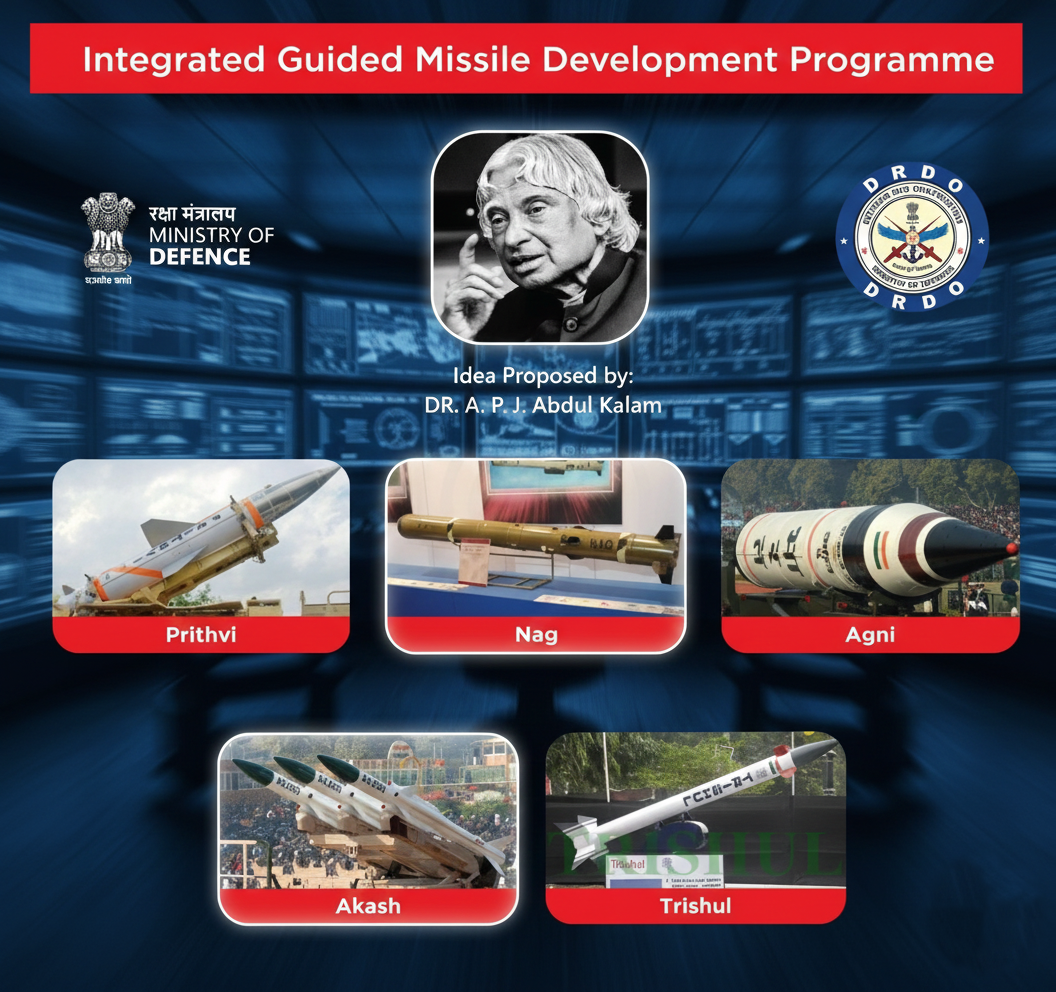
DRDO spearheads missile R&D through specialised laboratories. The **Integrated Guided Missile Development Programme (IGMDP)** launched in 1983 enabled structured development of core missile families, laying the groundwork for self-sustained missile technology growth.
Contribution of Other Agencies
Strategic Forces Command, Indian Armed Forces, and Defence Public Sector Units support testing, production, and deployment. Their coordinated roles ensure missile systems transition from prototypes to reliable **operational assets** across services.
3.1 Ballistic Missiles
Ballistic missiles follow a preset trajectory and form India’s strategic backbone. The **Agni series**—ranging from short to intercontinental ranges—enhances nuclear deterrence, while Prithvi variants support tactical battlefield roles with improved accuracy and mobility.
3.2 Cruise Missiles
Cruise missiles fly at low altitudes with guided precision. **BrahMos**, a joint Indo-Russian project, is India’s flagship supersonic cruise missile known for versatility. Nirbhay adds long-range subsonic capability for deep-strike and strategic missions.
3.3 Surface-to-Air Missiles (SAMs)
SAM systems strengthen air defence. **Akash** provides area defence against aircraft and UAVs. **Medium-Range SAMs (MRSAM)** developed with Israel offer enhanced interception, while QRSAM supports rapid-response protection for mobile formations.
3.4 Anti-Tank Guided Missiles (ATGMs)
ATGMs support infantry and armoured units. **Nag** offers fire-and-forget capability, while HELINA and MPATGM expand precision anti-armour options. Indigenous systems reduce import dependence and improve battlefield flexibility.
3.5 Submarine-Launched and Air-Launched Missiles
**K-series submarine-launched ballistic missiles** strengthen second-strike capability under the nuclear triad. Air-launched weapons such as **BrahMos-A** enhance deep-strike missions, extending IAF’s long-range strategic reach.
4.1 Propulsion and Materials
Advances in **solid-fuel motors**, **composite airframes**, and thrust-vectoring have increased missile speed, range, and manoeuvrability. Indigenous materials support lighter structures and improved survivability against interception.
4.2 Guidance and Navigation Systems
India’s use of **ring-laser gyros**, satellite navigation, and advanced seekers has improved accuracy. Homegrown technologies minimise reliance on foreign components, ensuring operational autonomy during conflict situations.
5.1 Deterrence and National Security
Missile systems ensure **credible deterrence**, particularly in a challenging neighbourhood. Long-range platforms strengthen India’s stance against strategic threats and maintain a stable security environment.
5.2 Defence Modernisation and Atmanirbhar Bharat
**Indigenisation drives** under Atmanirbhar Bharat promote self-reliance in advanced weapon systems. Expanding production capabilities enhance export potential and strengthen India’s position as an emerging defence technology hub.
India’s missile development reflects a blend of **strategic necessity, technological innovation, and institutional commitment**. The growing missile ecosystem ensures preparedness, strengthens deterrence, and contributes to long-term national security objectives.
Integrated Missile Development Programme (IMDP)
The Integrated Missile Development Programme (IMDP) was launched in 1983 to achieve self-reliance in strategic and tactical missile systems. It aimed to build indigenous capability across design, testing, propulsion, guidance, and production, reducing dependence on foreign technology.
Before IMDP, India relied heavily on external suppliers and faced restrictions after key defence crises.
The programme emerged from DRDO’s growing competence in propulsion and electronics, combined with national security needs after regional conflicts and technological barriers.
IMDP focused on developing a family of missiles suited for diverse military needs. Core objectives included strengthening deterrence and improving stand-off strike abilities.
It also aimed at creating systems covering land, air, and sea domains, alongside achieving long-term technology accumulation and domestic industrial capacity.
The programme was spearheaded by Dr. A.P.J. Abdul Kalam, then Director of DRDL.
DRDO laboratories, public sector units, and industries worked under a coordinated mission-mode structure, producing India's first integrated approach to missile development.
IMDP included five key systems: Prithvi (SRBM), Agni (ballistic missile family), Trishul (SAM), Akash (SAM), and Nag (anti-tank missile).
Each missile addressed specific battlefield requirements and contributed foundational technologies for later developments.
Prithvi Missile System
Prithvi was India’s first indigenously developed ballistic missile. Designed for short-range battlefield roles, it used liquid propulsion and high payload flexibility. Its variants enhanced accuracy and established early confidence in India’s design ecosystem.
Agni Missile Series
Agni began as a technology demonstrator but evolved into India’s strategic backbone. Using solid propulsion and advanced guidance, Agni missiles expanded to intercontinental ranges, strengthening credible minimum deterrence under nuclear policy frameworks.
Akash Surface-to-Air Missile
Akash provided medium-range air defence with command guidance and multi-target capability. Its indigenous radar-missile integration improved India’s layered air defence architecture.
Trishul Short-Range Air Defence
Trishul aimed to support quick-reaction air defence roles. Though it faced technological hurdles, its research contributed to seeker technology and future missile programmes like QRSAM.
Nag Anti-Tank Missile
Nag was designed to destroy armoured targets using fire-and-forget capability. Its imaging infrared seeker was advanced for its time. Helina and Dhruvastra variants later enhanced airborne deployment options.
IMDP strengthened indigenous expertise in propulsion, composites, navigation, seekers, and warhead design.
It established test ranges, production lines, and quality-assurance frameworks, laying the foundation for later systems like BrahMos, Astra, and hypersonic programmes.
The programme faced technology denial regimes such as MTCR and sanctions after nuclear tests. Limited industrial capacities and funding constraints also slowed progress.
Despite external pressures, mission-mode execution ensured steady advancements through indigenous innovation and strategic focus.
IMDP formally ended in 2008 after achieving core objectives, signifying its success.
Its completion marked India's entry into the league of nations with independent missile capabilities, enabling advanced strategic and tactical systems beyond the original mission.
Arsenals with the Indian Army: An Overview
The Indian Army’s arsenals comprise weapons, platforms, support systems, and technologies that enable land warfare capability. These arsenals are essential for deterrence, rapid response, and multi-domain operations across diverse terrains such as mountains, deserts, plains, and high-altitude regions.
2. Armoured Fighting Vehicles (AFVs)
The Army fields a mix of main battle tanks like T-90 Bhishma, T-72 Ajeya, and Arjun MBT. These platforms provide decisive strike capability, high mobility, and battlefield endurance, especially crucial for plains and desert warfare.
3. Infantry Combat and Support Vehicles
Infantry receives mobility and protection through BMP-2 Sarath and newer wheeled armored vehicles. These systems support mechanised infantry in rapid unit-level movement, troop protection, and integrated battlefield operations with tanks and artillery.
4. Artillery Guns and Rocket Systems
The Army operates diverse artillery, including Dhanush, M777 Ultra-Light Howitzers, and K9 Vajra-T. Rocket systems like Pinaka enhance deep-strike capability, providing long-range suppression and precision fire across varied operational theatres.
5. Missile Systems and Tactical Deterrence
Key tactical missiles include BrahMos, Pralay, and Nag. These support stand-off engagement, anti-armour roles, and precision targeting. Together, they strengthen offensive and defensive operational flexibility across multi-front environments.
6. Ground-Based Air Defence Systems
Systems such as Akash, QRSAM, and Spyder form layered air defence protection. They safeguard forward assets against aircraft, drones, missiles, and stand-off weapons, ensuring secure ground operations during conflict.
7. Radar and Surveillance Assets
Modern radars like Swathi Weapon Locating Radar and battlefield surveillance systems enhance early warning. They enable quick detection, tracking, and neutralisation of hostile aerial or ground threats, supporting proactive battlefield control.
8. Small Arms and Close-Combat Weapons
The infantry arsenal includes INSAS replacements, SIG-716 rifles, AK-203, light machine guns, and advanced sights. These weapons improve accuracy, lethality, and reliability under extreme weather and counter-insurgency conditions.
9. Battlefield Mobility and Protection
Modern soldier gear includes body armour, night-vision devices, communication sets, and situational-awareness tools. These upgrades enhance survivability, coordination, and fighting effectiveness during high-intensity or prolonged operations.
10. Engineering and Mobility Equipment
Bridges, mine-ploughs, bulldozers, and route-opening tools help forces operate in diverse terrains. They ensure safe troop movement, battlefield access, and quick restoration of damaged infrastructure under combat stress.
11. Electronic Warfare and Cyber Capabilities
EW systems enable interception, jamming, and protection of communication networks. Increasing cyber-integration strengthens electronic dominance, essential for modern hybrid and multi-domain warfare scenarios.
12. Indigenous Defence Ecosystem
Initiatives like Make in India, iDEX, and DPP reforms accelerate indigenous production. Systems like Pinaka, Dhanush, Arjun, and drone technologies reflect growing self-reliance, reducing import dependency and enhancing strategic resilience.
13. Future-Ready Combat Technologies
Focus areas include AI-enabled systems, loitering munitions, robotics, and integrated battlefield networks. These technologies aim to create a more agile, precise, and network-centric Army for future warfare demands.
Arsenals – Indian Navy (Overview)
The Indian Navy’s arsenals represent the structured system of weapon storage, maintenance, logistics, and readiness facilities that support naval operations. These arsenals ensure that ships, submarines, aircraft, and coastal units receive timely, safe, and reliable ammunition support across peacetime and conflict scenarios.
Naval arsenals function as dedicated hubs for ammunition storage, inspection, repair, and distribution. Their central role is to sustain operational preparedness by ensuring optimal availability of missiles, torpedoes, naval guns, underwater weapons, and aviation armaments.
3. Directorate of Ordnance (Navy)
The Directorate of Ordnance oversees policy, standardisation, safety protocols, and lifecycle management for naval ammunition. It coordinates planning, procurement, quality control, and interaction with DRDO, DPSUs, and private industry to strengthen indigenous capability.
4. Material Organisation (MO) Setup
Material Organisations at major naval commands handle logistics coordination for arsenals. They link operational units with supply chains, ensuring that warships and aircraft receive timely weapons replenishment during deployments and harbour maintenance cycles.
Naval Armament Depots are the core storage and handling establishments across coastal regions. They manage receipt, safe storage, technical evaluation, and issue of ammunition to operational platforms under strict environmental and safety standards.
Each command hosts major depots:
* Western Naval Command – Mumbai, Karwar
* Eastern Naval Command – Visakhapatnam
* Southern Naval Command – Kochi
Their geographically distributed design ensures quick response and dispersal during contingencies.
7. Storage and Safety Management
Arsenals maintain specialised storage environments including magazines, humidity-controlled cells, segregated explosive areas, and blast-proof enclosures. Regular safety audits, risk mitigation drills, and adherence to explosive handling manuals preserve operational reliability.
8. Inspection and Quality Assurance
Weapons undergo routine performance checks, defect investigation, shelf-life analysis, and refurbishment. Quality teams collaborate with DRDO labs and production agencies to maintain the effectiveness of missiles, torpedoes, depth charges, and naval gun ammunition.
Arsenals assist in integrating weapons with warships, submarines, and aircraft. They provide calibration services, software updates for smart munitions, and technical guidance during harbour acceptance trials and operational readiness inspections.
10. Supply Chain and Fleet Replenishment
Arsenals coordinate ammunition movement through secure transport channels, replenishment at sea arrangements, and forward logistics points. This ensures uninterrupted availability during exercises, patrols, and high-intensity operational deployments.
11. Indigenous Manufacturing Linkages
Arsenals work closely with domestic industry to support Atmanirbhar Bharat. Collaboration includes joint testing, documentation, feedback mechanisms, and absorption of new technologies like precision weapons, underwater sensors, and ship-borne missile systems.
The Navy is introducing digital inventory tools, automated magazines, predictive maintenance systems, and improved explosive surveillance technologies. These upgrades enhance traceability, safety, and rapid mobilisation during operational demands.
Indian Navy arsenals form the backbone of maritime combat readiness by ensuring secure storage, reliable maintenance, and timely supply of weapons. Their expanding infrastructure and modernisation reflect India’s broader goals of capability enhancement and self-reliant defence preparedness.
Arsenals of the Indian Air Force – Overview
The Indian Air Force (IAF) maintains a diverse arsenal designed to ensure air superiority, strategic reach, and precision strike capability. Its inventory includes fighter aircraft, transport fleets, helicopters, unmanned systems, missiles, and emerging indigenous platforms.
Overview
IAF’s fighter fleet integrates multirole combat aircraft capable of air-to-air, air-to-ground, and reconnaissance roles. Platforms differ in range, payload, radar strength, and avionics, helping maintain layered offensive and defensive air power.
Su-30MKI
The Su-30MKI is the backbone of the IAF, offering long-range strike capability, heavy payload capacity, and advanced maneuverability. It supports precision weapons and can conduct air dominance, maritime strike, and deep interdiction missions.
Rafale
Rafale enhances India’s deterrence with advanced AESA radar, superior electronic warfare, and long-range Meteor missiles. Its multirole capability strengthens quick-reaction combat readiness and improves India’s ability to counter modern aerial threats.
LCA Tejas
Tejas marks a major step in indigenous fighter development. It offers high agility, modern avionics, and compatibility with precision munitions. Its deployment improves self-reliance and supports future upgrades under the LCA Mk-1A programme.
Overview
IAF’s transport fleet ensures rapid mobility, disaster relief, and logistics support. It ranges from heavy-lift aircraft for strategic missions to medium and light transporters for routine troop and equipment movement.
C-17 Globemaster III
C-17 enables heavy-lift operations, capable of transporting tanks, troops, and humanitarian cargo. Its long-range and short-runway performance make it crucial for military operations, international deployments, and emergency missions.
C-130J Super Hercules
C-130J offers versatile tactical airlift, including special operations, medical evacuation, and night-time missions. Its advanced sensors and ability to operate from semi-prepared airstrips enhance India’s rapid response capability.
Overview
IAF helicopters support combat, logistics, and high-altitude missions. Their utility ranges from attack operations to search-and-rescue and battlefield mobility in challenging terrains.
Apache AH-64E
Apache provides precision attack capability with advanced sensors, anti-tank missiles, and battlefield survivability. It strengthens close air support roles and enhances joint operations with the Army.
Chinook CH-47F
Chinook supports heavy-lift needs in mountains, transporting artillery, equipment, and troops. Its tandem-rotor configuration enables stable operations in extreme altitudes like the Himalayas.
Overview
IAF’s missile inventory combines indigenous and foreign systems for layered defence. These weapons provide ability to intercept enemy aircraft, drones, and ballistic threats.
Akash Missile System
Akash is an indigenous SAM offering medium-range air defence with high mobility and multi-target engagement capability. It strengthens base protection and complements higher-tier defence systems.
S-400 Triumf
The S-400 offers long-range detection and interception against aircraft, cruise missiles, and ballistic threats. It enhances India’s strategic air defence envelope and deters high-end aerial intrusions.
IAF employs drones for surveillance, target acquisition, and limited strike roles. Expansion into indigenous UCAVs and high-altitude long-endurance platforms is underway under programmes like Ghatak and TAPAS.
The IAF arsenal reflects a balanced mix of firepower, mobility, and surveillance capability. Its ongoing modernisation through indigenous platforms and global partnerships aims at enhancing readiness, strategic autonomy, and capability for future multi-domain warfare.
Arsenals – India’s Strategic Hubs of Defence R&D (Overview)
Overview
India’s defence arsenals act as the backbone of national security, integrating research, manufacturing, testing, and upgradation capacities. They combine traditional platforms with modern technologies to ensure self-reliance, preparedness, and rapid response to emerging military threats.
Historical Shift
India’s defence R&D ecosystem evolved from basic ordnance workshops to a coordinated network under DRDO, DPSUs, and strategic partnerships. This expansion reflects the shift from import-dependence towards an indigenized, technology-driven defence capability aimed at long-term strategic autonomy.
Function
DRDO functions as India’s key scientific hub, developing systems in missiles, avionics, sensors, combat vehicles, and cyber technologies.
Impact
Its multi-lab structure supports mission-mode projects, enabling coordinated breakthroughs essential for modern battlefield readiness and technological deterrence.
Role
Ordnance factories and DPSUs manufacture ammunition, armored systems, naval platforms, and aerospace components.
Reform
Their restructuring into corporatized entities enhanced accountability, competitiveness, and integration with private industry, improving production efficiency while maintaining strategic supply assurance.
Missile Programmes
Missile complexes across APJ Abdul Kalam Missile City, Hyderabad, and other hubs drive development of ballistic, cruise, and tactical missiles. These centres integrate propulsion, guidance, and materials research, sustaining India’s credible deterrence and strengthening the strategic forces architecture.
Aviation Platforms
Hubs led by HAL, ADA, and NAL focus on fighter aircraft, UAVs, helicopters, and stealth technologies. Their collaborative programs, including LCA-Tejas and upcoming AMCA, highlight India’s shift towards designing indigenous platforms tailored for future air-combat environments.
Shipbuilding
Naval design bureaux and shipyards such as MDL, GRSE, and CSL develop submarines, destroyers, and maritime sensors.
Indigenous Systems
These hubs support blue-water ambitions by integrating indigenous sonar, propulsion, and combat-management systems that enhance coastal and deep-sea operational capabilities.
Specialized Areas
Specialized centres work on composites, lightweight armour, radars, semiconductors, AI systems, robotics, and electronic warfare.
Next-Gen Impact
These technologies shape next-generation arsenals by improving survivability, accuracy, and autonomous decision-making across all domains of warfare.
Ecosystem Integration
The iDEX initiative opens defence R&D to startups and private innovators, accelerating rapid prototyping and dual-use technologies. This diversified ecosystem reduces procurement delays, promotes competition, and aligns India’s arsenals with global innovation trends in defence preparedness.
Key Hurdles
Key challenges include long development cycles, technology gaps, limited testing infrastructure, and reliance on certain foreign components.
Requirements
Overcoming these requires stable funding, skilled manpower, joint ventures, and faster integration of battlefield feedback into ongoing R&D programs.
Future Strategy
India must promote deeper inter-agency coordination, expand indigenous semiconductor and propulsion capacities, and enhance exports. Strengthened quality control, digital manufacturing, and sustained innovation culture can transform arsenals into globally competitive centres of strategic capability.
Nuclear Triad & India’s Evolution as a Nuclear Triad State
A nuclear triad refers to a nation’s ability to deliver nuclear weapons through land-based missiles, airborne platforms, and submarine-launched systems. This three-pronged structure strengthens deterrence by ensuring nuclear retaliation even if one leg is neutralised in a conflict scenario.
The triad enhances survivability, credibility, and flexibility of a state’s nuclear arsenal.
It supports the doctrine of No First Use (NFU) by guaranteeing assured retaliation and discouraging adversaries from attempting pre-emptive strikes or coercive military strategies.
Each leg of the triad plays a specific role. Land systems provide prompt response, air systems offer mobility and signalling value, while sea-based systems provide stealth and second-strike capability essential for stable deterrence.
Land-Based Leg
India’s land leg comprises Agni-series ballistic missiles with varying ranges, mobility, and accuracy. These systems form the backbone of India’s immediate response capability and allow deep-strike roles against strategic targets in the region.
Air-Based Leg
Air-delivered capability is maintained through aircraft like Mirage-2000, Jaguar IS, and Su-30 MKI modified for nuclear roles. Air platforms provide high visibility signalling and allow flexible mission planning in escalating conflict situations.
Sea-Based Leg
The sea leg is anchored by Arihant-class nuclear-powered ballistic missile submarines (SSBNs) equipped with K-series SLBMs. SSBNs remain hidden underwater for long durations, ensuring survivable second-strike capability crucial for credible deterrence.
Adopted in 2003, the doctrine emphasises No First Use, credible minimum deterrence, and massive retaliation. These principles guide force development, posture, and operational readiness while ensuring nuclear weapons serve defensive, not aggressive, purposes.
India moved towards a triad after the 1998 tests, recognising the need for multi-dimensional delivery systems. Development gained momentum with integrated missile programmes, strategic command structures, and the commissioning of indigenous nuclear submarines.
Key Milestones
Major milestones include induction of Agni-V for long-range deterrence, operationalisation of strategic air assets, and sea trials of INS Arihant. These achievements collectively established India’s credible triad around the mid-2010s.
Present Status
India today maintains an operational but evolving triad. Focus is on enhancing SLBM ranges, improving missile accuracy, expanding SSBN fleet size, and strengthening command-and-control networks for secure, real-time strategic decision-making.
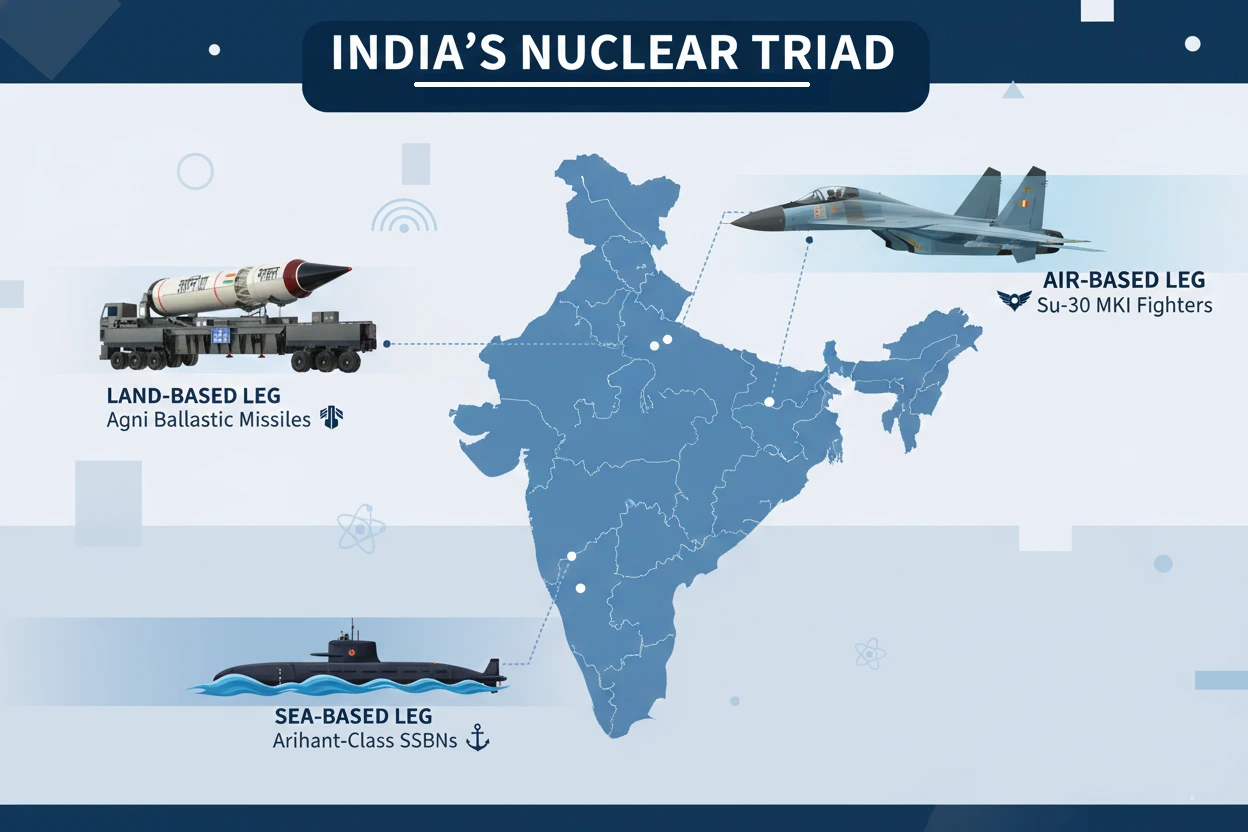
A functional triad strengthens India’s position in a complex neighbourhood marked by nuclear-armed adversaries. It supports strategic autonomy, deters coercion, and contributes to stable regional deterrence dynamics under India’s responsible nuclear posture.
Future priorities include longer-range SLBMs, advanced SSBNs, MIRV-enabled missiles, and enhanced survivability measures.
These steps will consolidate India’s transition from a developing to a fully mature nuclear triad power.
Anti-Satellite (ASAT) Weapons & India’s Mission Shakti
Anti-Satellite (ASAT) weapons are systems designed to disable, destroy, or temporarily impair satellites in space. They reflect a nation’s capability in space warfare, strategic deterrence, and securing critical space-based assets essential for communication, navigation, and surveillance.
Modern militaries depend heavily on satellites for real-time intelligence, missile tracking, secure communication, and navigation support. Any threat to these systems can cripple strategic operations, making ASAT capability a crucial component of national security and technological autonomy.
ASAT systems function through diverse methods such as kinetic kill vehicles, co-orbital interceptors, directed-energy lasers, and electronic jamming. Each technology aims to neutralise hostile satellites either through physical destruction or temporary disruption of onboard functions.
Note: This content section ensures the text layout is vertically aligned with the adjacent image, maintaining a neat two-column structure.
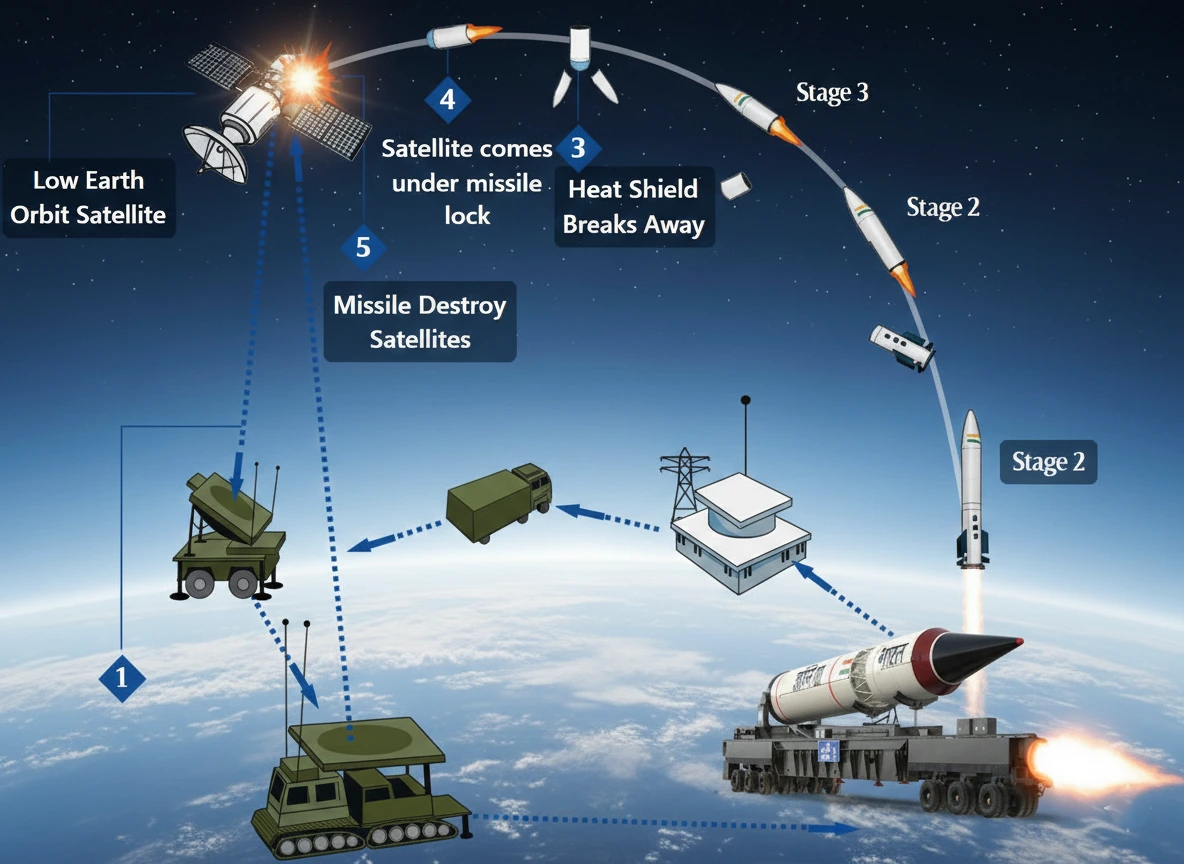
India’s growing reliance on satellite assets for civilian and military applications increased the need for credible protection. Rising global ASAT developments, especially by major powers, pushed India to demonstrate an indigenous deterrent aligned with strategic stability doctrines.
Overview
Mission Shakti was India’s first successful ASAT test conducted on 27 March 2019. It showcased India’s ability to intercept and destroy a satellite in Low Earth Orbit (LEO), placing India among a select group possessing operational ASAT capability.
Context
The mission was a demonstration of indigenous ASAT technology and was conducted by the Defence Research and Development Organisation (DRDO), proving India's capability in space defence and strategic space command and control.
Interceptor Used
The test used a modified PDV-MK II ballistic missile interceptor equipped with advanced sensors, guidance algorithms, and kinetic kill technology.
Engagement Type
The system performed a precise hit-to-kill engagement, ensuring direct destruction through sheer impact rather than explosive payloads, which minimises collateral damage.
Target Type
India targeted a pre-identified, live satellite (a decommissioned Indian satellite) serving as a representative target for the test.
Altitude
The satellite was located around 300 kilometres above Earth. The low altitude was deliberately chosen to ensure debris decayed rapidly, minimising long-term risks to other space assets.
Deterrence
Mission Shakti strengthened India’s deterrence posture by signalling capability to protect critical space infrastructure. ASAT capacity is a credible threat against potential space attacks.
Strategic Counter-Measure
The ASAT capacity acts as a strategic counter-measure against adversarial attempts to disrupt India’s communication, surveillance, and navigation networks during conflict scenarios.
Debris Management
Though kinetic tests create debris, India’s choice of low altitude ensured most fragments re-entered Earth’s atmosphere quickly, burning up due to atmospheric drag.
Responsible Conduct
India emphasised responsible conduct, transparency, and minimal environmental impact, aligning the test with global space sustainability principles and mitigating risks to the International Space Station (ISS).
Global Acknowledgment
Global responses acknowledged India’s transparency but raised concerns over the increasing militarisation of space as more nations gain counter-space capabilities.
India's Stance
India reiterated its commitment to peaceful space use while asserting the right to safeguard national interests amidst evolving geopolitical challenges in the space domain.
Technological Priority
India must prioritise space situational awareness (SSA), satellite shielding, and the development of non-kinetic counterspace technologies (like jammers or lasers) to stay ahead.
Policy & Synergy
Strengthening policy frameworks, enhancing DRDO-ISRO synergy, and supporting global norms for space security will consolidate India’s long-term strategic preparedness in the space domain.
International Organisations & Treaties (Defence)
International organisations and defence-related treaties play a crucial role in maintaining global stability, coordinating security responses, and shaping India’s strategic environment. Understanding their structure, mandates, and relevance helps aspirants link global shifts with India’s defence and foreign policy.
2.1 UN Security Council (UNSC)
The UNSC is responsible for international peace and security. It authorises sanctions, peacekeeping missions, and conflict-resolution mandates. Its decisions influence India’s security environment, especially regarding terrorism, regional conflicts, and global arms control frameworks.
2.2 UN Peacekeeping Operations (UNPKO)
UNPKO deploys multinational forces to conflict zones to maintain ceasefires and support political transitions. India is among the largest troop contributors, highlighting its commitment to global security and enhancing its visibility in international diplomacy.
3.1 Organisation Overview
The North Atlantic Treaty Organization (NATO) is a military alliance ensuring collective defence under Article 5. It shapes global security norms, technological standards, and strategic coordination among Western powers, indirectly influencing India’s defence partnerships.
3.2 Relevance for India
Though not a member, India engages with NATO countries on counter-terrorism, maritime security, and strategic technology. NATO’s evolving Indo-Pacific approach also impacts India’s security calculations with China and regional coalitions.
4.1 Purpose and Mandate
The Quadrilateral Security Dialogue (QUAD) includes India, the US, Japan, and Australia. It focuses on a free, open, and rules-based Indo-Pacific, addressing maritime security, resilient supply chains, emerging technologies, and humanitarian assistance.
4.2 Importance for India
QUAD strengthens India’s maritime posture, enables technology access, and counterbalances China’s assertiveness. It also supports naval interoperability and enhances India’s role in shaping Indo-Pacific governance.
5.1 ASEAN Defence Ministers’ Meeting-Plus (ADMM-Plus)
ADMM-Plus promotes practical cooperation among 18 countries, including India, on counter-terrorism, maritime security, cyber defence, and peacekeeping. It strengthens India’s regional engagement and supports capacity building.
5.2 Significance for India
ASEAN’s centrality in Indo-Pacific architecture aligns with India’s “Act East Policy.” Participation helps India expand naval partnerships, enhance strategic trust, and maintain regional balance.
6.1 Nuclear Non-Proliferation Treaty (NPT)
The NPT aims to prevent nuclear weapons spread, promote disarmament, and support peaceful nuclear energy. India is a non-signatory due to concerns over discriminatory provisions but supports responsible nuclear norms.
6.2 Comprehensive Nuclear-Test-Ban Treaty (CTBT)
CTBT bans all nuclear test explosions. India has not signed it, citing issues related to sovereignty and incomplete universal acceptance, but maintains a voluntary testing moratorium.
6.3 Missile Technology Control Regime (MTCR)
MTCR limits proliferation of unmanned delivery systems capable of carrying WMDs. India’s membership boosts access to high-end missile technology and enhances indigenous defence production.
Defence-related international organisations and treaties shape global power dynamics, technological standards, and India’s strategic space. A clear understanding enables aspirants to connect global developments with India’s evolving defence strategy and exam-relevant analysis.
Status of Defence Development in India
India’s defence sector has undergone a transformative shift over the past decade. Driven by Aatmanirbharta and sustained policy support, the country is moving from import-dependence to becoming a major global defence manufacturer, exporter, and technology creator.
India’s indigenous defence production touched ₹1,27,434 crore in FY 2023–24, marking a 174% jump from ₹46,429 crore in 2014–15. This growth reflects increased budget allocations, long-term reforms, and a decisive shift towards self-reliance in defence manufacturing.
Budgetary Push
The defence budget rose from ₹2.53 lakh crore (2013–14) to ₹6.81 lakh crore (2025–26). This sustained expansion highlights the government’s commitment to strengthening military capability, infrastructure, and domestic industrial capacity.
Growing Industrial Participation
Both public and private sectors have shown steady growth. DPSUs and PSUs contributed 77%, while the private sector’s share increased from 21% to 23% between FY 2023–24 and FY 2024–25. This signals a maturing, competitive ecosystem across defence manufacturing.
India now exports defence equipment to 100+ countries, including the US, France, and Armenia. Exports grew by ₹2,539 crore (12.04%) over FY 2023–24. The government targets ₹3 lakh crore manufacturing and ₹50,000 crore exports by 2029, positioning India as a global defence hub.
Before the reforms of the last decade, India’s defence sector struggled with slow procurement, restricted private participation, and heavy import dependence. Defence exports were only ₹686 crore (2013–14), and capability gaps persisted due to rigid procedures and limited R&D support.
Defence Production & Export Promotion Policy (DPEPP)
The DPEPP provides a comprehensive roadmap by boosting R&D, encouraging IP creation, supporting MSMEs, enhancing industry–academia linkages, and setting export-led goals to build a globally competitive defence industry.
Strategic Focus
DPEPP’s focus is on creating a self-reliant ecosystem by facilitating technology transfer, standardizing procedures, and providing a stable policy environment for both public and private sector investment in advanced defence manufacturing.
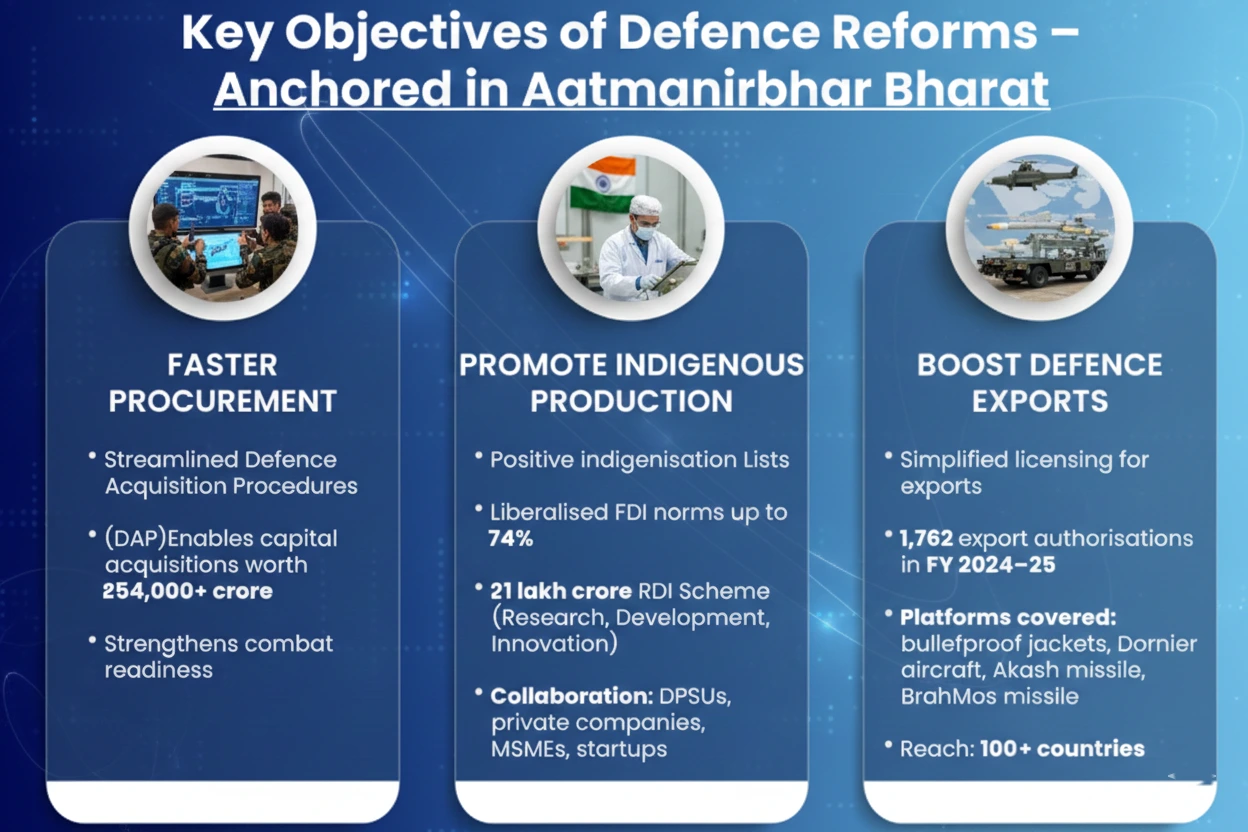
Reforms launched under Aatmanirbhar Bharat aim to accelerate procurement, promote domestic manufacturing, and integrate industry with modern technology.
Faster Procurement
Streamlined Defence Acquisition Procedures and DAC-driven approvals.
Indigenisation Drive
Positive Indigenisation Lists and liberalised FDI up to 74% automatic, 100% via government route.
Innovation Push
The ₹1 lakh crore RDI Scheme encourages collaboration among DPSUs, private firms, MSMEs, and startups.
The DAP 2020 modernises procurement by prioritising self-reliance and technological advancement.
Indian First
Highest priority to Buy (Indian–IDDM) category.
Speed & Transparency
Digital workflows and simplified approvals reduce delays.
Tech of Tomorrow
Focus on AI, robotics, cyber, space, and advanced warfare systems.
Industry Partnership
Platforms like iDEX help startups and MSMEs innovate.
Ease of Approvals
Empowered structures ensure timely decision-making.
Launched in October 2025, DPM 2025 enhances revenue procurement worth nearly ₹1 lakh crore annually.
Ease of Doing Business
Standardised procedures across all services.
Support for Innovation
Promotes collaboration and reduces liquidated damages to 0.1% per week for indigenisation.
Industry-Friendly Norms
Guaranteed orders for five years and removal of obsolete NOC requirements.
Digital Integration
Advanced e-procurement and data-driven monitoring for transparency.
Together, DAP 2020 and DPM 2025 form a unified procurement system blending capital and revenue purchases. This ensures faster delivery of strategic assets while empowering domestic industry to scale innovation, manufacturing, and exports—strengthening India’s march toward true Aatmanirbharta.
Ballistic Missiles
Ballistic Missiles: Key Features and Strategic Relevance
A ballistic missile follows a guided early phase and a free-fall later phase, travelling largely under gravity. Its design enables long-range, high-speed delivery of warheads, making it central to modern deterrence and strategic warfare doctrines.
Initial Thrust
Ballistic missiles rely on powerful rocket motors—solid, liquid, or hybrid fuels—to generate initial thrust. This propulsion phase determines the missile’s range, payload capacity, and acceleration, forming the critical foundation of its overall performance.
Fuel Systems
Solid-fuel systems offer quicker launch readiness and easier storage. Liquid-fuel systems enable greater control and higher energy output. Together, propulsion choices reflect strategic priorities such as mobility, survivability, and response time during conflict.
Boost Phase Guidance
In the boost phase, missiles use inertial navigation systems, gyroscopes, or satellite-based updates to maintain accuracy. This early guidance ensures the missile reaches the correct angle and velocity before entering its unpowered ballistic path.
Control Limitations
Advanced systems integrate GPS, ring-laser gyroscopes, and onboard computers to reduce errors. However, once the powered phase ends, control becomes minimal, making pre-launch guidance planning extremely important for mission success.
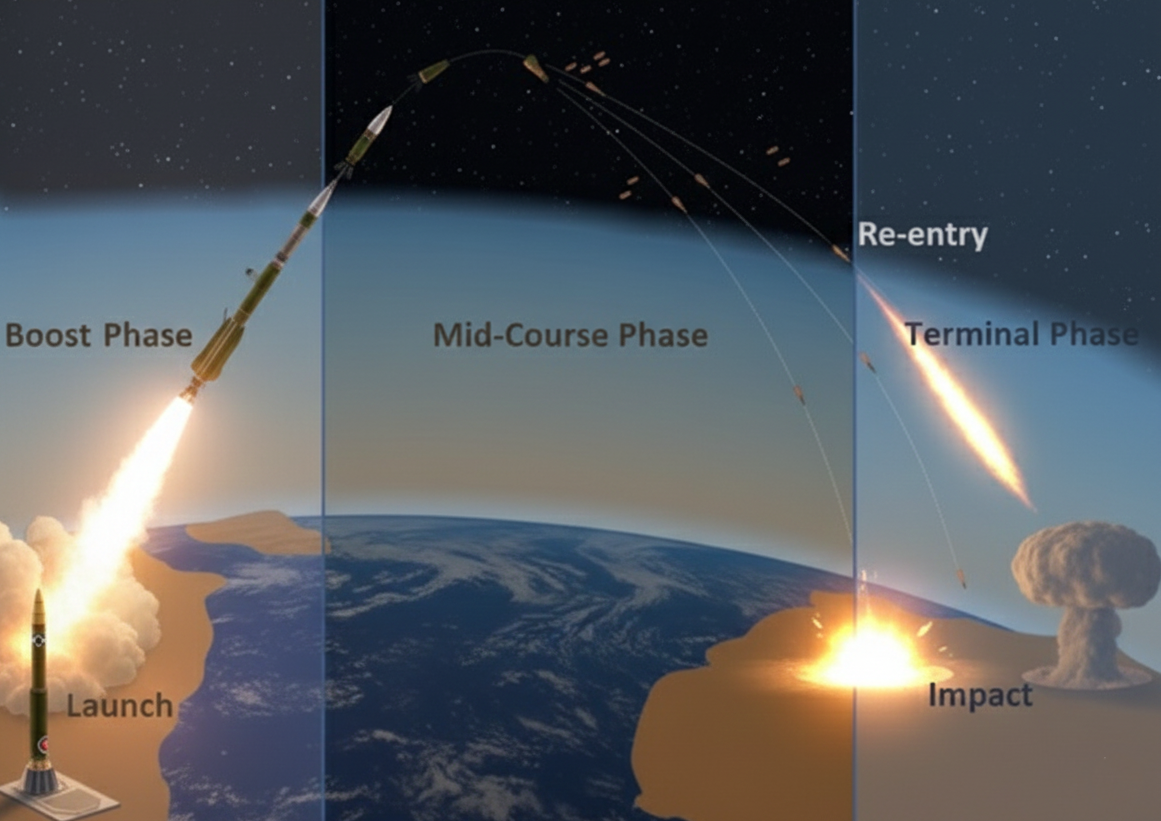
Ballistic missiles travel through the atmosphere and space, following a predictable arc shaped by gravity and momentum. This trajectory makes them fast-moving and difficult to intercept, especially during mid-course travel outside the dense atmosphere.
During re-entry, the missile faces intense heat, pressure, and drag. Re-entry vehicles are engineered with heat-resistant materials to maintain stability and protect the warhead while descending at extremely high velocities toward the target.
Warhead Types
Modern ballistic missiles carry diverse warheads—conventional high-explosive, nuclear, thermobaric, and penetration-oriented designs. The choice depends on strategic objectives, ranging from precise tactical strikes to large-scale strategic deterrence missions across regions or continents.
MIRV Technology
Some advanced systems use MIRVs (Multiple Independently Targetable Re-entry Vehicles), enabling one missile to hit several targets. This drastically increases deterrence value and complicates enemy missile defence planning and interception strategies.
Ballistic missile launches produce significant thermal signatures, making them detectable by space-based sensors. Despite high visibility, their extreme speeds, steep trajectories, and mid-course altitude make interception technologically challenging for most defence systems globally.
Even with visibility, the short decision time between launch detection and impact enhances the missile’s psychological and strategic influence. This makes ballistic systems powerful tools of deterrence and rapid-response warfare.
After the propulsion and mid-course phases, the missile’s final strike is driven purely by gravity and velocity. The re-entry vehicle descends at hypersonic speeds, giving minimal reaction time to defenders and delivering high kinetic impact alongside the warhead.
This gravity-assisted descent ensures deep penetration and high destructive potential. For strategic planners, the terminal phase’s speed and predictability shape both offensive targeting tactics and defensive interception strategies.
Cruise Missiles
Cruise Missiles: Key Features and Strategic Significance
Cruise missiles are precision-guided weapons that travel within the atmosphere for most of their flight. Designed for accuracy, stealth, and flexibility, they enhance deterrence, strategic strike capability, and stand-off attack potential for modern armed forces.
Jet-Engine Propulsion
Cruise missiles use small, efficient jet engines—usually turbofan or turbojet—to maintain sustained atmospheric flight. These engines allow stable speeds, long ranges, and flexible flight paths, making cruise missiles ideal for deep-strike and precision-target missions.
How Propulsion Affects Performance
Jet propulsion enables constant thrust, unlike ballistic missiles that rely on initial boost. This steady power supports terrain-hugging flight, evasive manoeuvres, and greater survivability against radar-guided air-defence networks.
Versatile Launch Platforms
Cruise missiles can be launched from land-based launchers, aircraft, warships, and submarines. This multi-platform ability allows armed forces to disperse firepower, enhance surprise, and conduct stand-off attacks far from the adversary’s defensive systems.
Operational Advantages
Air-launched variants provide long-range penetration without risking aircraft over hostile airspace. Sea-based and submarine-launched versions support second-strike capability, vital for strategic deterrence in modern conflict scenarios.
Prolonged Atmospheric Flight
Unlike ballistic missiles that arc into space, cruise missiles fly within the atmosphere throughout their mission. This allows predictable aerodynamic control, precise mid-course corrections, and sophisticated navigation using satellite, inertial, and terrain-matching systems.
Implications for Accuracy
Continuous atmospheric flight helps maintain high accuracy, often within a few metres. This precision makes cruise missiles ideal for targeting critical infrastructure while reducing collateral damage and avoiding unnecessary escalation.
Warhead Variety
Cruise missiles can carry diverse warheads—conventional, sub-munition, bunker-buster, or nuclear—depending on mission needs. This flexibility makes them effective for tactical battlefield use as well as strategic deterrence roles.
Mission Customisation
Warhead choice allows the same missile platform to perform roles from anti-ship operations to deep-strike missions against hardened or high-value targets, increasing overall operational versatility.
Low-Altitude Flight
Cruise missiles often fly at extremely low altitudes, sometimes below 100 metres. This “terrain-hugging” profile helps them exploit hills, forests, and ground clutter to avoid detection by long-range surveillance radars.
Benefits of Low-Level Approach
Low flight reduces radar cross-section and delays detection, giving defenders little reaction time. This is a major reason why cruise missiles remain a preferred choice for high-precision, high-survivability attack missions.
Modern cruise missiles incorporate stealth shaping, radar-absorbent materials, and reduced heat signatures. These features make them harder to track, identify, and intercept, increasing mission success during high-threat operations.
Cruise missiles combine propulsion efficiency, stealth, precision, and platform versatility, making them central to modern deterrence and warfare. Their ability to deliver accurate, low-observable strikes ensures increasing relevance in India’s evolving defence posture.
Comparison (Exam Ready)
Comparison of Ballistic and Cruise Missiles
Ballistic and cruise missiles form the backbone of modern strategic deterrence. Understanding their design, flight behaviour, accuracy, and mission roles is essential for analysing India’s evolving defence capabilities and global missile doctrines, especially for GS-III security topics.
Definition
Ballistic missiles are powered only during initial launch. After burnout, they follow a free-fall, gravity-driven trajectory similar to a projectile. Their high-speed, high-altitude flight makes them suitable for long-range, strategic roles.
Key Features
Ballistic missiles achieve extremely high velocities during mid-course flight. They generally arc through space before re-entering the atmosphere. While modern versions carry manoeuvrable re-entry vehicles (MARVs), traditional systems offer lower mid-course manoeuvrability.
Cruise missiles are powered throughout most of their flight using jet, turbofan, or rocket engines. They fly within the atmosphere at low or mid altitudes and resemble pilotless aircraft designed for precision strikes.
Sustained Flight
Cruise missiles maintain sustained propulsion, allowing them to fly low, hug terrain, and evade radar detection. Their guidance systems—GPS, terrain contour matching, and inertial navigation—enable high accuracy and selective target engagement.
Flight Path & Propulsion
Ballistic missiles depend on an initial boost phase and then coast. Their flight typically exits the atmosphere. Cruise missiles remain atmospheric, continuously powered, and adopt flexible paths, including sea-skimming and terrain-following routes for stealth.
Cruise missiles are generally more accurate due to continuous guidance and lower speeds that support precise adjustments. Ballistic missiles prioritise long-range delivery, high impact, and strategic deterrence, especially when armed with nuclear warheads.
Indian Context
India deploys ballistic missiles like Prithvi, Agni-I to Agni-V, and submarine-launched K-series systems for credible deterrence. Cruise missiles such as BrahMos and Nirbhay strengthen precision-strike options across land, air, and maritime domains.
| Feature | Ballistic Missiles | Cruise Missiles |
|---|---|---|
| Propulsion | Powered initially, then free-fall | Powered throughout flight |
| Flight Path | High-arc, space-based trajectory | Low-altitude, terrain-hugging flight |
| Speed | Very high (hypersonic ranges) | Subsonic to supersonic |
| Accuracy | Moderate to high (with MARVs) | Very high due to continuous guidance |
| Detectability | Easier to track due to predictable arc | Harder to detect; stealthy routes |
| Typical Range | Short to intercontinental | Short to long but usually lower than ballistic |
| Primary Role | Strategic deterrence, long-range strikes | Precision attack on specific targets |
| Examples (India) | Agni series, Prithvi, K-15/K-4 | BrahMos, Nirbhay |
Prithvi Missiles
Prithvi Missiles
The Prithvi missiles are India’s first indigenously developed ballistic missiles under the Integrated Guided Missile Development Programme (IGMDP). Designed for short-range roles, they strengthened India’s early strategic and tactical deterrence capabilities.
Prithvi missiles use liquid propulsion, high-accuracy guidance and can carry conventional or nuclear payloads.
Their ability to perform maneuvering re-entry improves strike precision and complicates enemy interception, making them significant for battlefield support.
The Prithvi family includes Prithvi-I (Army), Prithvi-II (Air Force) and Prithvi-III/Dhanush (Navy). Each variant differs in range, payload, and launch platform, enabling multi-service deployment across land and sea.
Prithvi-I (Army Variant)
Range of about 150 km, high payload capacity and mobile launch vehicles make Prithvi-I suitable for close-range battlefield targets, including logistics hubs and troop concentrations.
Prithvi-II (Air Force Variant)
Prithvi-II, with 250–350 km range, supports deeper strike missions. It is known for high accuracy, often used for training and strategic firing tests under India’s Strategic Forces Command (SFC).
Prithvi-III extends range up to 350–600 km. Its naval version, Dhanush, is ship-launched, offering sea-based strike capability that enhances second-strike and maritime deterrence.
Prithvi missiles demonstrate India’s early missile self-reliance, contribute to credible deterrence, and form a key case study in IGMDP.
They are critical to understanding India's strategic preparedness and evolving tri-service missile capability—all relevant for Prelims and Mains.
Trishul Missiles
Trishul Missiles
Overview
The Trishul missile is a short-range, quick-reaction, surface-to-air missile developed under India’s Integrated Guided Missile Development Programme (IGMDP). It was designed to provide low-level air-defence against aircraft, helicopters, and sea-skimming missiles.
Range and Role
Trishul has a range of around 9 km, suitable for point-defence roles. It was intended to protect vital installations and naval ships from sudden, low-altitude aerial threats.
Propulsion and Guidance
The missile uses a solid-fuel propulsion system. Its command-to-line-of-sight guidance and three-beam guidance ensure quick response against fast-moving targets, improving accuracy in close-range engagements.
Warhead and Control
It carries a pre-fragmented warhead designed for high lethality. Its automatic command control and quick launch capability enable effective interception in cluttered, low-altitude environments.
Part of IGMDP
Developed alongside Agni, Prithvi, Akash, and Nag, Trishul represented India’s early efforts to build indigenous, multi-role missile systems across different domains.
Trials and Challenges
Despite demonstrating successful low-flying target interception, the system faced issues with consistent guidance performance. These delays limited its induction prospects for Army and Air Force roles.
Outcome
The programme was eventually closed as a “technology demonstrator.” However, technologies from Trishul significantly benefited later systems, including improvements in sensors, guidance, and control technologies.
Akash Missiles
Akash Missiles
The Akash missile is India’s indigenously developed, medium-range surface-to-air missile (SAM) designed to counter aircraft, drones, and cruise missiles. Developed by DRDO, it forms a key part of India’s layered air-defence network, offering quick-reaction capability.
Propulsion and Engagement
Akash uses a solid-fuel rocket motor, ensuring high reliability and rapid launch readiness. It can engage targets at low, medium, and high altitudes.
Warhead and Guidance
The missile carries a high-explosive warhead and uses command guidance supported by powerful ground-based radar.
Akash has an operational range of about 25–30 km in its standard version. It can engage multiple targets simultaneously through networked fire-control systems.
Its ability to function in all-weather conditions significantly enhances India’s defensive readiness.
Akash-1S
The Akash-1S variant integrates an indigenous seeker for improved accuracy and precision.
Akash-NG (New Generation)
Akash-NG extends range to around 45 km, reduces reaction time, and uses a dual-pulse solid motor. These upgrades improve mobility, survivability, and engagement precision.
Akash strengthens India’s air-defence coverage along sensitive borders.
Its indigenous content reduces external dependence and supports the “Aatmanirbhar Bharat” vision (Self-Reliant India).
Deployment across the Army and Air Force demonstrates its operational credibility and strategic value.
Nag Missiles
Nag Missiles
Introduction
Nag is India’s third-generation, fire-and-forget Anti-Tank Guided Missile (ATGM). Designed by DRDO, it targets heavily armoured vehicles using an Imaging Infrared (IIR) seeker, ensuring high accuracy even in adverse battlefield conditions.
Guidance System
Nag uses lock-on-before-launch technology, enabling the IIR seeker to identify and lock onto targets prior to firing, which is a key feature of fire-and-forget missiles.
Warhead Capability
Its tandem High-Explosive Anti-Tank (HEAT) warhead is specifically designed to defeat Explosive Reactive Armour (ERA) commonly found on modern main battle tanks.
Platform Overview
NAMICA (Nag Missile Carrier) is a tracked, amphibious, BMP-2 based combat vehicle that serves as the launch platform for Nag missiles. It provides mobility, armoured protection, and real-time observation using thermal imagers and a stabilised launcher system.
Role Flexibility
NAMICA can carry multiple ready-to-launch missiles and execute both top-attack and direct-attack roles, offering versatility against different armoured threats.
Survivability
The vehicle operates day-night and its elevated sensor mast allows for target acquisition from a concealed position, which is crucial for increasing the crew's survivability in combat.
HELINA Variant
HELINA (Helicopter-Launched Nag) is the air-launched version of Nag, specifically designed for deployment from advanced helicopters like the ALH Rudra and LCH Prachand. It also employs an advanced IIR seeker and lock-on-before-launch capability.
Extended Range
HELINA has an operational range of around 7–10 km. This extended range enables the launching helicopter to strike armoured targets from standoff distances, remaining outside the immediate hostile air-defence envelope.
Strategic Importance
Nag, NAMICA, and HELINA significantly strengthen India’s indigenous anti-armour capability, reduce import dependence, and enhance readiness for high-intensity, armour-centric operations across diverse terrains.
Agni Missiles
Agni Missiles
Agni missiles are India’s long-range, nuclear-capable, surface-to-surface ballistic missiles developed under the Integrated Guided Missile Development Programme (IGMDP). They form the land-based leg of India’s nuclear triad, enhancing strategic deterrence and second-strike capability.
The Agni series began in the late 1980s, evolving from a technology demonstrator to a family of advanced, highly accurate ballistic missiles. Progressive upgrades in propulsion, materials, guidance, and mobility have strengthened India’s long-range strategic reach.
Propulsion & Guidance
Agni missiles use solid-fuel propulsion and high-accuracy guidance, ensuring quick readiness and precise targeting for both conventional and nuclear payloads.
Mobility & Readiness
They utilize road- or rail-mobile launch platforms. Their canisterisation enables quick launch, improved shelf-life, and all-weather readiness, enhancing survivability.

The Agni family strengthens credible minimum deterrence and ensures survivability through dispersed launchers and rapid mobility. Their extended range supports India’s security interests, enhances strategic stability, and projects a reliable second-strike posture.
Artillery Guns
Artillery Guns in India
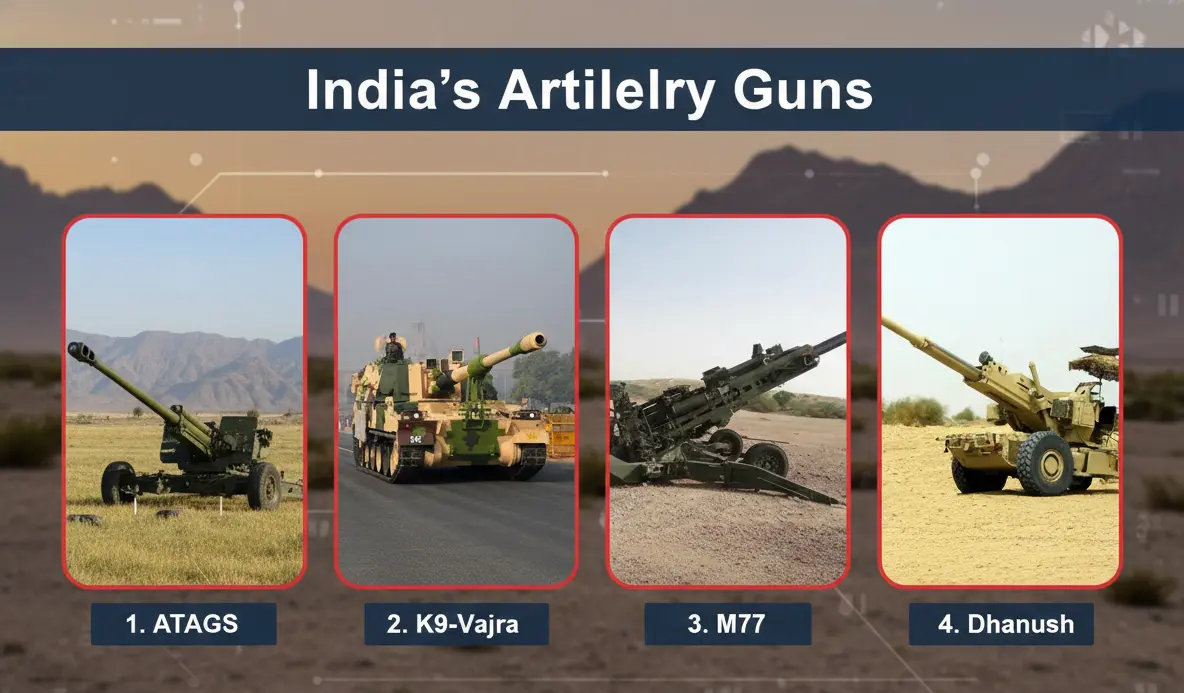
Modern artillery enhances long-range precision, mobility, and battlefield dominance. India’s recent acquisitions and indigenous systems strengthen deterrence, ensure rapid deployment, and support integrated battle groups for high-intensity and high-altitude warfare.
Overview
Dhanush is an indigenously upgraded 155mm/45-calibre gun based on the Bofors design. It improves range, accuracy, and digital fire-control features, making it highly effective in mountainous terrain.
Key Features
Its 38–40 km range, automated loading, and all-weather capability support sustained firepower. The gun strengthens Make-in-India goals and reduces long-term dependency on foreign platforms.
Overview
The M777 is a 155mm/39-calibre ultra-light gun made of titanium alloys. Its lightweight build allows swift air-lift and deployment in difficult high-altitude sectors.
Operational Value
Used by the U.S. and Indian armies, it suits rapid mobility and mountain warfare. Its precision-guided munition compatibility boosts accuracy against fortified targets.
Overview
The K9-Vajra is a 155mm/52-calibre tracked, self-propelled system built under technology transfer from South Korea.
Why It Matters
Its high mobility, quick shoot-and-scoot ability, and 40+ km range make it ideal for desert warfare and integrated mechanised operations.
Overview
ATAGS is India’s indigenous 155mm/52-calibre flagship system with world-leading range, modular design, and advanced electronics.
Strategic Relevance
With a 48+ km range and full electric drive, ATAGS boosts self-reliance and meets future battlefield requirements for accuracy, survivability, and mobility.
Multi Barrel Rocket Launcher
Multi Barrel Rocket Launcher: Pinaka
Pinaka is India’s indigenously developed Multi Barrel Rocket Launcher (MBRL), designed by DRDO to deliver quick, high-volume firepower across large areas. It enhances India’s artillery mobility, accuracy, and rapid-reaction capability during modern, high-tempo battlefield operations.
Range and Firepower
Pinaka launches a salvo of rockets within seconds, saturating targets up to 75 km (extended-range). This allows for quick, destructive strikes on enemy concentrations.
Mobility and Survivability
Its mobility, automated fire-control systems, and shoot-and-scoot ability reduce detection risk, improving survivability and response speed during hostile engagements.
Integrated Architecture
The system consists of a launcher vehicle, loader-cum-replenishment vehicle, command post, and fire-control computer.
Mission Capability
This integrated architecture allows rapid reloads, precise target engagement, and simultaneous strikes by multiple regiments in coordinated battlefield missions.
Evolution of Range
Pinaka has evolved from Mark-I (40 km) to Mark-II/ER (up to 75 km) and guided versions with navigation-aided precision.
Future Improvements
Upgrades focus on improved propellants, better warhead options, and enhanced accuracy comparable to global MBRL systems.
Core Function
Primarily used for area-denial, suppression of enemy positions, and deep-strike support, Pinaka strengthens India’s deterrence posture.
Deployment Capability
Its high mobility ensures rapid deployment across plains, deserts, and high-altitude theatres, making it a versatile weapon system.
Pinaka has attracted interest from Armenia, which signed major contracts with Indian firms. Its rising demand strengthens India’s defence exports, showcasing indigenous capability and improving strategic partnerships with friendly nations.
Tanks
Indian Battle Tanks
India’s tank fleet combines Russian-origin platforms and indigenous systems. The focus is on mobility, firepower, night-fighting capability, and survivability for both plains and high-altitude operations. Modernisation seeks lighter, faster, and network-centred tanks.
T-90 “Bhishma”
T-90 is India’s mainstay MBT with superior thermal sights, explosive reactive armour (ERA), and high mobility. It excels in desert warfare and offers reliable performance during day–night operations, making it central to India’s offensive armoured formations.
T-72 “Ajeya”
T-72 forms the backbone of older armoured regiments. Upgrades include night-fighting devices, communication systems, and improved protection. Despite ageing, its large numbers ensure continued operational relevance until complete modernisation is achieved.
Arjun Mk-1
Arjun Mk-1 is an indigenous MBT with a powerful gun, advanced fire-control system, and superior crew comfort. Its high weight limits deployment in all terrains, yet it demonstrates India’s capability for complex armoured manufacturing.
Future-Ready Combat Vehicles (FRCV)
FRCV aims to replace T-72 tanks with a modular, technology-ready platform. It focuses on enhanced protection, active defence systems, and integration with drones, sensors, and battlefield networks for high-intensity, multi-domain warfare.
Zorawar Light Tank
Zorawar is a strategic light tank designed for high-altitude areas. Its lightweight construction, mobility, and modern targeting systems provide India an advantage along mountainous borders where heavy MBTs face deployment challenges.
Aircraft Carriers
Aircraft Carriers: Classification & Indian Context
Aircraft carriers are large naval platforms capable of launching, recovering, and supporting aircraft at sea. They serve as mobile airbases, extend maritime reach, and enhance a nation's power-projection capability across the Indian Ocean and global commons.
Nuclear-Powered Carriers
Nuclear-powered carriers use onboard reactors, allowing virtually unlimited range, higher endurance, and larger air wings. They sustain continuous operations for months, making them central to blue-water navies like the United States.
Conventional-Powered Carriers
Conventional carriers rely on fossil fuels, requiring regular refuelling but remaining easier to construct and maintain. They provide flexible operational capability and are widely used by mid-sized navies, including India, the UK, and China.
STOBAR System
STOBAR (Short Take-Off But Arrested Recovery) combines a ski-jump for take-off with arrestor wires for landing. It is cost-effective, easier to operate, and suitable for fighter aircraft with high thrust-to-weight ratios.
CATOBAR System
CATOBAR (Catapult Assisted Take-Off But Arrested Recovery) uses steam or electromagnetic catapults for launch. It supports heavier aircraft, AEW platforms, and larger payloads, making it ideal for advanced naval aviation and extended-range missions.
EMALS Technology
EMALS (Electromagnetic Aircraft Launch System) is the modern CATOBAR variant used on next-generation carriers. It provides smoother acceleration, reduced stress on aircraft, and better launch control, enabling more efficient carrier flight operations.
INS Vikramaditya
INS Vikramaditya is a modified Kiev-class STOBAR carrier acquired from Russia. It operates MiG-29K fighters and supports key naval missions, enhancing India’s maritime deterrence across the Arabian Sea and Bay of Bengal.
INS Vikrant (IAC-1)
INS Vikrant, India’s first indigenous aircraft carrier, represents a major leap in naval capability. Using STOBAR operations, it deploys MiG-29K fighters and advanced helicopters, symbolising India’s growing shipbuilding and operational expertise.
Future Carrier Plans (IAC-2)
India’s proposed IAC-2 aims for a larger displacement, CATOBAR capability, and integration of EMALS. It seeks enhanced sortie rates, wider aircraft compatibility, and improved maritime strike and surveillance capacity in the Indo-Pacific region.
Shipbuilding Ecosystem
India’s indigenous carrier programme drives domestic industries, steel production, aviation components, and high-technology systems. It strengthens defence manufacturing under Make in India and reduces long-term dependence on foreign suppliers.
Strategic Significance
Aircraft carriers protect sea lanes, support humanitarian missions, and ensure presence in critical chokepoints. For India, they are vital for securing the Indian Ocean Region and balancing strategic competition involving China’s expanding naval footprint.
Aircraft carriers remain central to modern maritime power, combining technology, industry, and strategic foresight. India’s growing carrier fleet and indigenisation push reflect its ambition to evolve into a self-reliant, blue-water naval power.
Submarines: Classification, Indian Navy & Indigenisation
Submarines are underwater naval platforms designed for stealth operations, sea denial, surveillance and strategic deterrence. Their ability to remain hidden while striking targets at long ranges makes them central to modern maritime security and power projection.
Submarines are broadly classified based on their propulsion systems and operational roles. The two primary categories are nuclear-powered submarines (SSN/SSBN) and conventional diesel-electric submarines (SSK), each offering distinct endurance, stealth and mission profiles.
Nuclear submarines use onboard reactors for propulsion, allowing them to stay submerged for months. Their near-unlimited endurance and higher speeds make them suitable for long-range offensive operations and strategic deterrence missions across distant maritime spaces.
SSNs – Nuclear Attack Submarines
SSNs are fast, agile and designed for offensive roles such as hunting enemy vessels, escorting carrier groups and protecting sea lanes. Their sustained underwater speed gives them a tactical advantage in open oceans and contested maritime zones.
SSBNs – Nuclear Ballistic Missile Submarines
SSBNs carry long-range nuclear missiles and form the sea-based leg of a nuclear triad. Their primary function is assured retaliation through continuous at-sea deterrence, making them critical for national strategic security.
Conventional submarines use diesel engines on the surface and batteries underwater. They are quieter at low speeds, ideal for coastal defence. Air-Independent Propulsion (AIP) systems further enhance underwater endurance and reduce detectability.
India operates a mix of nuclear and conventional submarines across multiple classes. The fleet is being modernised to address Indo-Pacific challenges and enhance deterrence, sea-denial capability and readiness for multi-domain maritime operations.
Nuclear Submarines of India
India currently operates INS Arihant-class SSBNs, forming the core of sea-based nuclear deterrence. An indigenous SSN project is under development to strengthen deep-sea dominance and expand operational reach in the Indian Ocean Region.
Conventional Submarines of India
The Indian Navy operates Shishumar-class, Sindhughosh-class, and Kalvari-class (Scorpene) submarines. The Kalvari-class, built under Project-75, features modern sensors, advanced torpedoes and superior stealth for littoral and open-sea operations.
India’s submarine indigenisation aims to reduce import dependence and build a self-reliant underwater fleet. Key initiatives include domestic hull construction, combat systems, AIP development and planned Project-75(I) for next-generation submarines with advanced propulsion.
A strong submarine arm strengthens sea denial, safeguards maritime trade routes and enhances deterrence in the Indo-Pacific. As geopolitical competition rises, underwater capability becomes essential for securing national interests and achieving credible maritime power.
Destroyers: Classification, Indian Navy & Indigenisation
Destroyers are fast, heavily armed warships designed for multi-role operations such as anti-air, anti-submarine, anti-surface warfare, and escort duties. They combine high endurance, advanced sensors, and precision weapons, making them central to modern naval power projection.
Destroyers carry powerful radars, long-range missiles, torpedoes, and electronic warfare systems. Their versatility allows them to operate independently or as part of carrier battle groups, ensuring layered maritime security across India’s vast oceanic interests.
3. Based on Role
Destroyers may be classified into air-defence, anti-submarine, and multi-role types. Air-defence destroyers prioritise long-range surface-to-air missiles, while anti-submarine variants enhance sonar and torpedo capabilities. Modern navies prefer multi-role designs for flexibility.
4. Based on Displacement
Light destroyers range around 4,000–5,000 tonnes, while heavy destroyers exceed 7,000 tonnes. Higher displacement supports more weapons, sensors, and fuel, enabling longer missions and improved survivability in high-intensity maritime operations.
5. Based on Propulsion
Most destroyers use gas-turbine propulsion for speed and rapid manoeuvrability. Some use combined diesel-gas (CODAG) or combined gas-gas (COGAG) systems for fuel efficiency. Propulsion choice affects range, speed, and overall operational endurance.
6. Early Generations
India inducted its first destroyers in the 1950s and 1960s, mainly British-origin vessels. These platforms helped the Navy transition from coastal defence to a blue-water outlook by providing greater firepower, stronger hulls, and long-range patrol capability.
7. Delhi-Class (Project 15)
Commissioned between 1997–2001, the Delhi-class marked major technological progress. These 6,700-tonne destroyers integrated advanced Russian missiles, indigenous sonar, and modern command systems, enabling balanced multi-role operations.
8. Kolkata-Class (Project 15A)
The 7,400-tonne Kolkata-class introduced stealth shaping, BrahMos missiles, MF-STAR radar, and improved automation. These features enhanced situational awareness and strike capability, giving India a credible platform for network-centric warfare.
9. Visakhapatnam-Class (Project 15B)
Commissioned from 2021 onwards, these destroyers refine Project 15A design with upgraded stealth, better sensors, next-generation weapon integration, and superior damage control. Their advanced combat suites support precise engagements in multi-threat environments.
10. Evolution of Indigenous Design
India’s destroyer programme evolved from foreign imports to complex indigenous designs. Naval Design Bureau leads conceptualisation, while domestic shipyards manage construction. Indigenous development strengthens strategic autonomy and reduces dependence on external suppliers.
11. Indigenous Weapon Systems
Destroyers now carry indigenous weapons such as BrahMos, Shakti Electronic Warfare Suite, HUMSA-NG sonar, and AKASH-NG missile variants. This combination improves operational flexibility while promoting self-reliance under the Atmanirbhar Bharat framework.
12. Indigenous Shipbuilding Capacity
Mazagon Dock Shipbuilders Limited (MDL) and Garden Reach Shipbuilders and Engineers (GRSE) are key contributors. They incorporate modular construction, automation, and digital design tools, reducing costs and timelines for large destroyer projects.
13. Strategic Importance of Indigenisation
Indigenisation enhances supply-chain security, wartime readiness, and technology retention. It builds advanced industrial capabilities, supports export potential, and ensures that India’s destroyers remain future-ready in an evolving maritime security environment.
Frigates
Frigates: Classification, Indian Navy & Indigenisation
Frigates are versatile, medium-sized warships designed for multi-role maritime operations. They bridge the gap between larger destroyers and smaller corvettes, offering endurance, firepower, and flexibility.
Modern frigates handle surface warfare, anti-submarine missions, air defence, and maritime security tasks.
Frigates combine agility with long-range deployment capability. Their design focuses on endurance, advanced sensors, guided missiles, and stealth shaping.
These attributes make them crucial for blue-water navies like India seeking regional security and strategic reach.
a) Based on Role
Frigates are broadly classified into Anti-Submarine Warfare (ASW), Anti-Air Warfare (AAW), and General-Purpose (GP) types. ASW variants carry sonar suites, while AAW versions feature advanced radars and long-range missiles.
b) Based on Technology Level
Frigates evolved from conventional gun-based platforms to stealth frigates with reduced radar signatures. Current designs emphasise electronic warfare, network-centric operations, and modular weapon integration for rapid capability upgrades.
c) Based on Tonnes / Size
Modern frigates usually displace 3,500–7,000 tonnes. Heavier frigates approach destroyer capabilities. Lighter frigates prioritise speed, coastal defence, and rapid manoeuvrability.
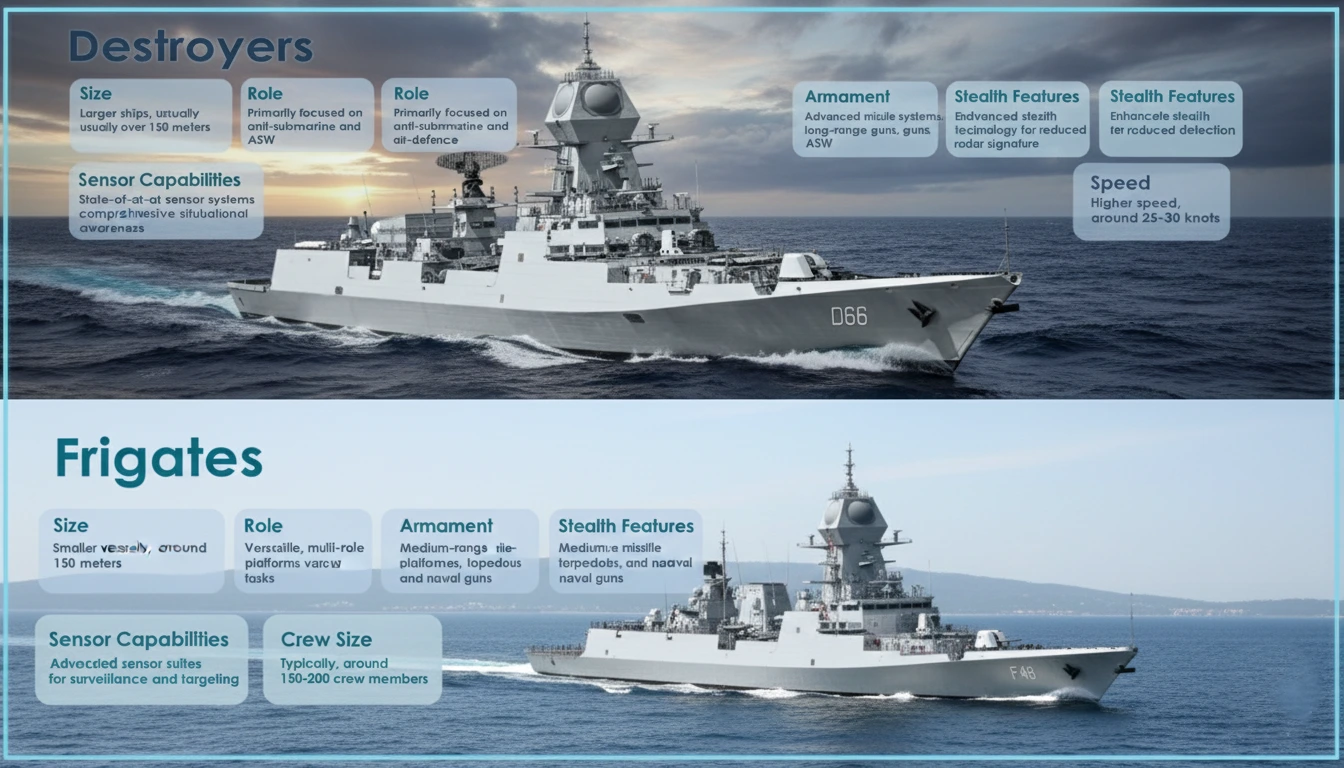
India operates in a vast maritime neighbourhood with complex security challenges. Frigates support deterrence, power projection, and sea-lane protection.
Their endurance enables sustained missions in the Indian Ocean Region (IOR) and beyond, including anti-submarine patrols.
a) Shivalik-Class (Project 17)
Shivalik-class frigates are India’s first indigenously built stealth frigates. They integrate advanced radar, BrahMos missiles, and ASW systems. Their multi-role design strengthens fleet versatility.
b) Nilgiri-Class (Project 17A)
Project 17A frigates feature improved stealth, larger displacement, and enhanced automation. They incorporate AESA radar, bow-mounted sonar, and vertical-launch systems. Modular construction accelerates delivery.
c) Talwar-Class
Talwar-class frigates, built with Russian collaboration, provide balanced firepower and reliability. They serve as key platforms for BrahMos deployment and fleet escort missions.
a) Shipbuilding
India has strengthened indigenous shipyards such as MDL and GRSE. Modular construction, digital ship design, and enhanced private-sector participation support faster, more cost-effective frigate production.
b) Indigenous Systems
Advanced systems like BrahMos, HUMSA sonar, and the Revathi radar reflect deepening self-reliance. Indigenous combat management systems and electronic warfare suites reduce dependency on foreign suppliers.
c) Make in India Push
Government initiatives prioritise defence manufacturing. Long-term procurement plans emphasise local content, technology transfer, and innovation. Frigates exemplify this shift, reflecting rising domestic capability.
India aims to expand its frigate fleet to meet evolving maritime challenges. Future priorities include AI-enabled combat systems, stronger ASW capabilities, and export-oriented production.
Sustained indigenisation will consolidate India’s position as a major maritime power.
Combat Aircrafts
Combat Aircrafts: Classification, Indian Air Force Fleet & Indigenisation
Combat aircrafts form the backbone of a nation’s air-power capability. They provide air superiority, ground-strike precision, reconnaissance, and deterrence.
For UPSC, understanding classification, technological generations, and India’s indigenisation roadmap is essential for defence preparedness perspectives.
Fighter Aircrafts
High-speed platforms designed for air combat. They deliver air superiority, interception, and escort missions. Modern fighters integrate radar, sensors, guided weapons, and network-centric warfare systems for precision and survivability.
Multirole Fighters
These aircrafts perform both air-to-air and air-to-surface operations. They combine flexibility, cost-effectiveness, and adaptable mission payloads, making them dominant in contemporary air warfare and strategic planning.
Strike Aircrafts
Optimised for deep-strike and ground-attack roles. They carry heavy payloads, precision weapons, and terrain-following radars. Their primary function is destroying enemy infrastructure, armour, and strategic assets.
Trainer Aircrafts
Two-seat platforms used for pilot training and combat-ready transition. They build operational proficiency in manoeuvres, avionics handling, and weapons systems before pilots fly frontline fighter jets.
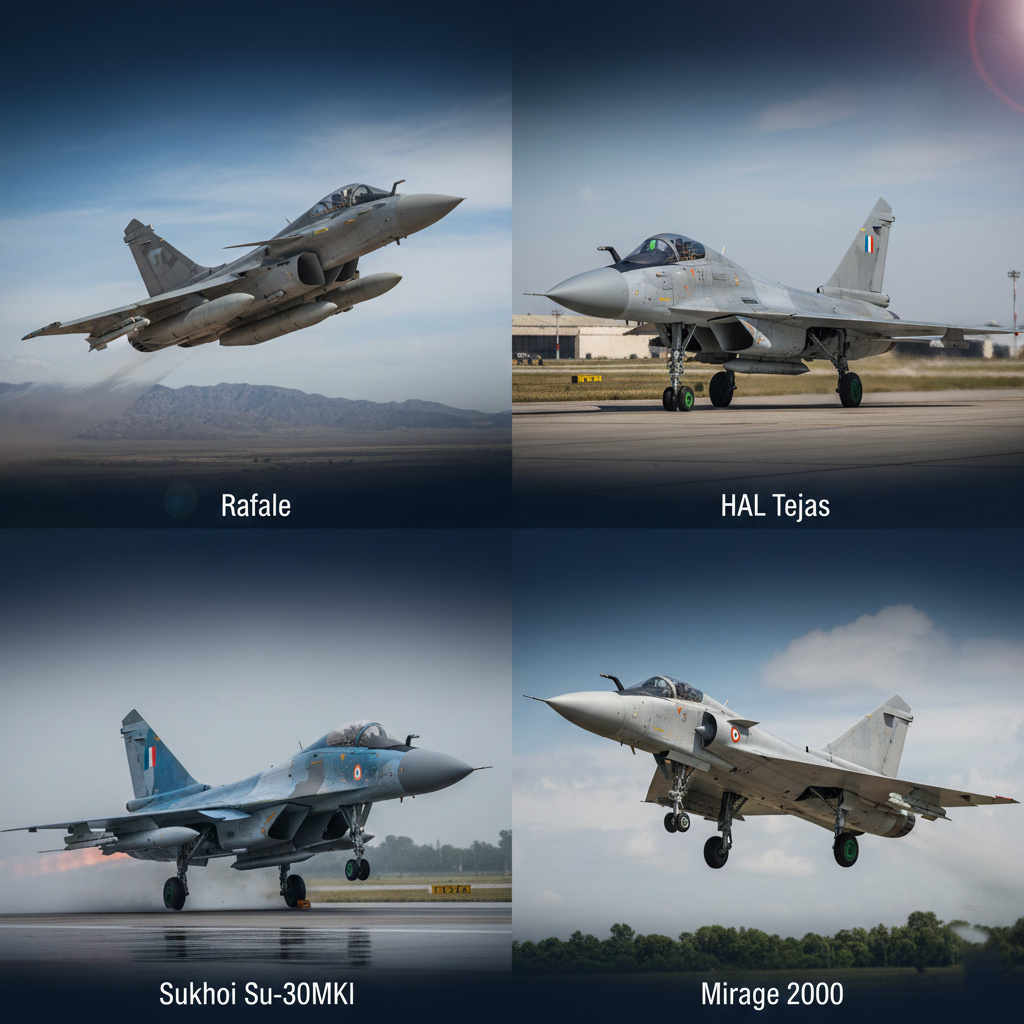
By Origin (OEM)
India operates a diversified fleet from France (Rafale, Mirage-2000), Russia (Su-30MKI, MiG-29), UK-origin Jaguars, and Indian-built Tejas. This ensures operational flexibility but increases logistics complexity.
By Generation
The IAF possesses 3.5-generation (Mirage-2000, MiG-29), 4-generation (Su-30MKI), and 4.5-generation (Rafale, Tejas Mk-1A) fighters. Future acquisition focuses on 5th-generation capabilities through AMCA development.
Role-Based
Air superiority (Su-30MKI), multirole (Rafale, Mirage-2000), and light combat roles (Tejas) form the operational spectrum. IAF combines heavy, medium, and light categories for strategic balance.
India’s push for defence self-reliance is centred on Tejas, AMCA, and upgraded indigenous avionics.
Focus areas include engines, AESA radars, advanced composites, and weapons. This enhances strategic autonomy and reduces import dependence.
| Feature | Rafale | Sukhoi Su-30MKI | HAL Tejas | Mirage-2000 |
|---|---|---|---|---|
| Origin (OEM) | France (Dassault) | Russia-India (Sukhoi + HAL) | India (HAL) | France (Dassault) |
| Generation | 4.5 Gen | 4 Gen | 4+/4.5 Gen (Mk-1A) | 3.5 Gen |
| Role | Multirole, nuclear-capable | Air superiority + strike | Light multirole | Multirole strike |
| Key Strength | High survivability, AESA, Meteor missile | Super-manoeuvrability | Indigenous design, high agility | Proven precision-strike record |
| Status in IAF | 36 in service | ~270+ | Mk-1 inducted, Mk-1A entering service | Upgraded fleet operational |
Military Transport Aircrafts
Military Transport Aircraft
Military transport aircraft enable rapid mobility of troops, weapons, and logistics across theatres. They form the backbone of airlift capability, humanitarian relief, and strategic reach—critical for India’s response during war, disaster management, and international commitments.
Strategic Transport Aircraft
Used for long-range, inter-continental airlift of heavy cargo and troops. They support out-of-area contingencies, evacuation missions, and strategic logistics in multi-domain operations.
Tactical Transport Aircraft
Used for short-range missions, battlefield resupply, and troop insertion. They operate from semi-prepared runways and support frontline formations in difficult terrain.
Heavy-Lift Aircraft
Carry large equipment like tanks, artillery, and armoured vehicles. Essential for rapid force projection and movement of high-weight military payloads.
Medium-Lift Aircraft
Used for troop transport, supply drops, and logistics support. Offer versatility, cost-effective operations, and wide deployment across routine missions.
Light-Lift Aircraft
Operate in remote and high-altitude airfields. Ideal for Siachen, NE border areas, and short-strip operations supporting small detachments.
Airlift (Cargo + Troops)
Dedicated to moving equipment, soldiers, and stores across theatre commands.
Aerial Refuelling & Multi-Role Transport
Provide fuel to fighters while also functioning as transport platforms, increasing flexibility.
Special-Mission Transports
Configured for signals intelligence, maritime surveillance, airborne early warning, or VVIP transport.
C-17 Globemaster III (USA, Boeing)
India’s primary strategic lifter with high payload and long range. Supports HADR, UN missions, and rapid mobilisation of heavy military equipment.
IL-76 ‘Gajraj’ (Russia, Ilyushin)
Backbone of medium strategic lift since the 1980s. Used for para-dropping, supply missions, and induction of special forces.
C-130J Super Hercules (USA, Lockheed Martin)
Special-operations capable. Operates from short and unprepared airstrips. Widely used in high-altitude and precision-airdrop missions.
AN-32 (Ukraine, Antonov)
Upgraded and adapted for high-altitude operations. Vital for Ladakh, North-East, and frontline logistics.
Do-228 (India, HAL)
Supports coastal surveillance, light transport, and short-haul connectivity. A major indigenisation success for regional operations.
C-295 Programme Details
IAF’s major upgrade replacing ageing Avro fleet. Manufactured jointly by Airbus and Tata in India, marking a landmark in domestic aerospace manufacturing with assembly, testing, and full ecosystem creation.
Domestic Push
HAL’s Do-228 and proposed Medium Transport Aircraft (MTA) highlight India’s push toward a robust domestic transport aviation sector.
Key Benefits
Reduces import dependence, ensures supply-chain security, and enhances operational availability. Supports Make in India, defence exports, and long-term technological self-reliance.
Transport aircraft form India’s core strategic mobility architecture. Their modernisation and indigenisation will enhance rapid deployment, jointness, and strategic autonomy—essential for future military preparedness and integrated theatre operations.
Aerial Refuelling Aircrafts
Aerial Refuelling Aircrafts
Aerial refuelling enables aircraft to transfer fuel mid-air, extending endurance, range, and mission flexibility. It is critical for strategic reach, persistent air operations, and force projection, making it a key capability for modern air forces, including India.
For India, aerial refuelling supports long-range patrols, rapid deployment, and maritime domain awareness. It enhances nuclear deterrence, increases sortie rates, and strengthens the IAF’s ability to respond to threats across extended borders and oceanic spaces.
3.1 Based on Refuelling Mechanism
Systems are classified by how fuel is physically transferred: the flexible Probe-and-Drogue system or the rigid, high-flow Flying Boom system.
(a) Probe-and-Drogue System
This method uses a flexible hose with a basket-like drogue. The receiving aircraft inserts its probe into the drogue. It is simple, widely used by fighters, and suited for operations requiring flexibility and quick hose deployment.
(b) Flying Boom System
A rigid, telescopic boom controlled by an operator delivers higher fuel flow. It is ideal for large aircraft requiring rapid transfer. Many strategic transport aircraft and heavy bombers rely on this system for quick refuelling cycles.
3.2 Based on Platform Type
Aircraft platforms are classified into those dedicated solely to refuelling and those capable of multiple roles.
(a) Dedicated Tankers
These are purpose-built aircraft such as KC-46 or Il-78, capable of carrying large fuel loads, multiple refuelling pods, and long-duration missions. They offer strategic capability and serve as "airborne fuel stations."
(b) Multi-Role Tanker Transport (MRTT)
MRTTs combine transport and tanker roles. They offer troop movement, medical evacuation, and cargo lift. This multi-utility approach reduces costs and increases adaptability for diverse peace-time and wartime operations.
4.1 Current Fleet
The IAF operates the Il-78MKI fleet acquired from Russia. These aircraft support fighters like Su-30MKI, Mirage-2000, LCA Tejas, and Rafale. They use the probe-and-drogue method and are central to India’s long-range missions.
4.2 OEM and Generation Aspects
The Il-78 series belongs to an older generation of tankers with limited availability and high maintenance needs. The IAF repeatedly evaluated the Airbus A330 MRTT and Boeing KC-46A, representing modern, fuel-efficient, and network-enabled tanker generations.
4.3 Operational Challenges
India faces issues such as ageing fleet, high downtime, and limited numbers. Tanker availability significantly impacts strategic missions. Modernisation is essential for supporting twin-theatre operations and extended Indo-Pacific outreach.
5.1 Airbus–Tata Conversion Proposal
India is exploring converting Airbus A330 commercial aircraft into MRTTs through Tata-Airbus collaboration. This model uses domestic MRO and conversion facilities, reducing costs and creating local aerospace capability.
5.2 DRDO Aerial Refuelling Pod Development
DRDO is developing indigenous refuelling pods compatible with transport aircraft. This reduces foreign dependence and enables future Indian-made tankers to equip fighters through probe-and-drogue systems.
5.3 Long-Term Indigenous Tanker Vision
Future options include adapting the C-295 or future wide-body platforms for tanker roles. Indigenous integration, digital avionics, and domestic pod systems can gradually create a fully Indian aerial refuelling ecosystem.
Aerial refuelling is essential for India’s strategic reach. Strengthening IAF tanker numbers, acquiring modern MRTTs, and promoting domestic conversion and pod development are vital steps toward a resilient and self-reliant refuelling capability.
Combat Helicopters
Combat Helicopters
Combat helicopters are specialised rotary-wing platforms designed for offensive operations, close air support, anti-armour roles, and high-altitude missions. Their agility, low-level manoeuvrability and precision weaponry make them essential in modern battlefield environments, especially against mobile ground targets.
Combat helicopters are broadly classified into Attack, Armed/Weaponised Utility, Recon-Attack, and Anti-Tank Helicopters. Each category differs in armour protection, payload, targeting systems and weapon sophistication, aligning with mission requirements ranging from close support to deep-strike operations.
Early generations focused on basic gun-rocket combinations, while later generations integrated night-fighting capability, digital avionics, anti-armour missiles, and network-centric features. The latest generation includes advanced stealth shaping, sensor fusion, and multi-role adaptability for high-intensity warfare environments.
IAF Fleet Composition
The IAF operates a mixed fleet comprising imported platforms like the AH-64E Apache and indigenously developed helicopters like HAL Rudra and HAL Prachand. This combination enhances strategic flexibility while supporting long-term technology absorption and defence industrial capability.
Key OEMs
Key OEMs include Boeing (AH-64E Apache), Mil Moscow Helicopter Plant for legacy Mi-series, and Hindustan Aeronautics Limited (HAL) for Rudra and Prachand. The shift toward HAL-led manufacturing aligns with India’s self-reliance and capability-based defence planning approach.
The Mi-25 and Mi-35, developed by Russia, served as India’s early attack helicopter backbone. These heavily armoured platforms provide troop insertion capability and anti-ground firepower, though their limitations in high-altitude warfare reduced frontline relevance in recent years.
Rudra is the weaponised variant of the ALH Dhruv featuring rockets, ATGMs, chin-mounted turret guns, and advanced electro-optical sensors. It performs multi-role missions including armed escort, reconnaissance, and limited attack roles, especially in mountainous terrain.
Prachand's Core Role
Prachand is India’s dedicated attack helicopter optimised for high-altitude operations. Equipped with anti-armour missiles, air-to-air capability, and superior manoeuvrability, it is uniquely capable of operating above 5,000 metres.
Strategic Importance
It is uniquely capable of operating above 5,000 metres, serving Ladakh and Siachen requirements effectively. It represents a major step towards indigenous capability in critical and challenging operational environments.
The AH-64E features advanced sensors, Longbow radar, precision missiles, and network-enabled combat systems. It is India’s most technologically advanced attack helicopter, offering all-weather lethality, autonomous targeting, and multi-domain operational support for offensive air operations.
HAL’s progression from Dhruv to Rudra and Prachand reflects maturing domestic aerospace capabilities. Indigenous engines, avionics, composite structures, and weapon integration are being prioritised to reduce import dependence and strengthen India’s long-term strategic autonomy.
Prelims Focus
Prelims focus areas include features of LCH, ALH-WSI, Apache systems, and OEM details. These test factual knowledge on the technical specifications and origin of platforms in the Indian inventory.
Mains Themes
In Mains, themes relate to defence self-reliance, high-altitude warfare capability, and technological adaptation under national security and strategic preparedness frameworks, requiring analytical and contextual understanding.
Military Transport Helicopters
Military Transport Helicopters
Military transport helicopters provide tactical and logistical mobility by lifting troops, equipment, and supplies across diverse terrains. They enable rapid deployment, humanitarian support, and high-altitude missions, making them a critical part of modern airpower and joint operations.
Light-Lift
Light-lift helicopters support quick troop movement, casualty evacuation, and limited cargo transport. Their smaller size allows agile operations in narrow valleys and forward posts, especially in mountainous border regions where landing zones are restricted.
Medium-Lift
Medium-lift platforms carry heavier troops, artillery parts, and logistics loads. They balance payload, range, and altitude performance, making them the backbone of most tactical airlift missions in counterinsurgency, disaster relief, and high-altitude supply chains.
Heavy-Lift
Heavy-lift helicopters transport bulky equipment, vehicles, and large troop groups. Their superior power and endurance support infrastructure build-up, high-altitude logistics, and strategic airlift roles in difficult terrains such as Ladakh and advanced landing grounds.
Mi-series (Mi-8/Mi-17)
The Russian-origin Mi-8 and Mi-17 families serve as IAF’s versatile medium-lift workhorses. Their strong engines, reliability, and all-weather capability make them crucial for troop lift, disaster relief, and supply missions in Himalayan theatres.
Chinook CH-47F(I)
The U.S.-origin Chinook is IAF’s heavy-lift asset with twin rotors, high agility, and excellent high-altitude performance. It transports artillery, engineering equipment, and troops, supporting rapid infrastructure mobilisation in border regions.
India focuses on indigenous transport helicopter development through HAL’s IMRH project, localisation of components, and technology partnerships. Future platforms aim to enhance self-reliance, reduce import dependence, and strengthen sustainable aerospace capability for long-term strategic needs.
Unmanned Aerial Vehicles (UAVs)
Unmanned Aerial Vehicles (UAVs)
Definition and Scope
Unmanned Aerial Vehicles (UAVs) are aircraft operated without an onboard pilot, used for surveillance, targeting, logistics, and increasingly for combat roles. They form a crucial part of modern warfare and national security due to low-risk, high-precision operations.
By Weight Class
UAVs are categorised into micro, mini, small, medium, and large platforms. The classification helps determine operational roles such as infantry-level surveillance, border monitoring, strategic reconnaissance, and long-endurance intelligence missions.
By Altitude & Range
Common categories include LoS (Line of Sight), Beyond Visual Line of Sight, Low/Medium/High Altitude Long Endurance (L/M/HALE) systems. These determine mission endurance, sensor payloads, and strategic versus tactical applications.
By Roles
Roles include ISR (Intelligence, Surveillance, Reconnaissance), combat/armed drones, target drones, logistics drones, and swarm drones. This functional classification increasingly guides defence procurement and indigenous R&D priorities.
Operational Fleet
The IAF employs Israeli-origin Heron, Searcher, and Harop systems, along with indigenous options. Generations now include MALE/HALE platforms, loitering munitions, and stealth-enabled autonomous systems under trials and procurement pathways.
OEM Landscape
Major suppliers include Israel Aerospace Industries, DRDO, HAL, and emerging private players. The ecosystem shows a shift from import dependence to co-development and Make-in-India-aligned manufacturing.
Indigenous Thrust
India’s indigenisation push centres on the Rustom series—Rustom-I for basic trials, Rustom-II (TAPAS-BH) as a MALE UAV with EO/IR sensors, SATCOM, and 24-hour endurance. These platforms aim to reduce imports and strengthen autonomous capabilities.
DRDO
Defence Research and Development Organisation (DRDO)
DRDO
DRDO is India’s premier defence R&D agency responsible for designing, developing, and integrating advanced military technologies. Established in 1958, it supports self-reliance by reducing external defence dependence and enabling indigenous strategic capabilities across land, air, sea, cyber, and space domains.
Organisational Position
DRDO functions under the Ministry of Defence (MoD). The Secretary, Department of Defence R&D, simultaneously serves as the DRDO Chairman, ensuring operational integration with national defence priorities and coordination with the Armed Forces and production agencies.
Major Clusters
DRDO operates 50+ laboratories grouped into clusters such as Aeronautical Systems, Naval Systems, Missile Systems, Armaments, Life Sciences, and Electronics. Each lab specialises in domain-specific research for faster innovation and targeted technology delivery.
Strategic Projects
Major programs include the Integrated Guided Missile Development Programme (IGMDP), Agni and Prithvi missile series, Ballistic Missile Defence (BMD), Advanced Medium Combat Aircraft (AMCA) technologies, UAVs, electronic warfare systems, and strategic materials development.
Emerging Capabilities
Recent achievements include Agni-V MIRV capabilities, extended-range BrahMos, Uttam AESA radar, ATAGS artillery gun, hypersonic test vehicle progress, quantum communication trials, and indigenous tech transfer to private industry through iDEX and production partners.
Defence PSUs
Defence PSUs, Dissolution of OFB & New Corporations
India’s Defence Public Sector Undertakings (DPSUs) form the backbone of indigenous defence manufacturing. They support strategic autonomy, promote domestic procurement, and bridge capability gaps through production of platforms, sensors, weapons, and advanced subsystems for the Armed Forces.
Major DPSUs
Major DPSUs include HAL, BEL, BEML, MDL, GRSE, GSL, and HSL. They specialize in aircraft, electronics, heavy engineering, naval platforms, and support systems.
Aatmanirbhar Bharat
Their expansion aligns with the “Aatmanirbhar Bharat” defence manufacturing roadmap, emphasizing self-reliance in military hardware and technologies.
The Ordnance Factory Board (OFB), previously a departmental setup under the Ministry of Defence, was criticized for issues like inefficiency, limited accountability, and low competitiveness.
The **2021 reform** aimed to modernize production, introduce flexibility, enhance accountability, and boost global export potential by corporatizing the OFB.
Seven New PSUs
OFB was dissolved into seven new DPSUs, each focusing on specialized, performance-driven manufacturing and corporate governance.
Key Companies
These include Munitions India Ltd., Armoured Vehicles Nigam Ltd., Advanced Weapons & Equipment India Ltd., Troop Comforts Ltd., Yantra India Ltd., Gliders India Ltd., and India Optel Ltd.
All new DPSUs function under the Department of Defence Production (DDP), Ministry of Defence, transitioning from a government department to a set of corporatized entities.
The restructuring aims for improved productivity through **corporate governance**, financial autonomy, professional management, and greater technology infusion.
R&D Collaboration
The DPSUs actively collaborate with DRDO labs for joint Research & Development to stay at the cutting edge of defence technology.
Focus Areas
Key development programs include advanced artillery, optical systems, armoured platforms, mobility vehicles, and **smart munitions**.
Reform Priorities
Priorities for the sector remain export-driven production and closer integration with the domestic private sector to build a robust defence industrial base.
Outer Space Treaty
Outer Space Treaty (OST)
The Outer Space Treaty (1967) forms the foundational global legal regime governing activities in outer space. It establishes principles ensuring peaceful exploration, non-appropriation of celestial bodies, and responsible behaviour by States. It remains the most widely accepted space governance treaty.
Context
During the Cold War, rapid technological advances increased military use of space. This created an urgent need for global rules to prevent an arms race beyond Earth's atmosphere.
Treaty Formulation
To avoid weaponisation and unilateral territorial claims, the UN formulated the OST, aiming to preserve outer space as a global commons for peaceful and cooperative use.
The treaty prohibits national appropriation of outer space, including the Moon and other celestial bodies, by claim of sovereignty, use, occupation, or any other means.
It bans the placement of nuclear weapons or any other weapons of mass destruction in Earth's orbit or on celestial bodies, promoting disarmament in space.
It obligates States to bear international responsibility for national activities in space, including those conducted by non-governmental entities (private sector).
The Treaty requires States to avoid harmful contamination of space and celestial bodies and adopt measures to prevent adverse changes in the environment of Earth resulting from space activities.
Preserve Peace
The main goal is preventing an arms race in space by prohibiting the stationing of WMDs and limiting military activities to peaceful purposes.
Benefit All
Ensuring that the exploration and use of outer space shall be carried out for the benefit and in the interests of all countries, promoting equitable access.
Cooperation and Trust
Facilitating international cooperation in scientific investigation and fostering global trust by preventing territorial claims or exclusive military deployment.
India is a signatory and actively supports the treaty’s principles. ISRO follows OST norms while undertaking missions like Chandrayaan and Gaganyaan, especially the mandate for non-appropriation and peaceful use. India emphasises space as a developmental domain, advocating responsible behaviour and opposing the weaponisation of outer space.
Emerging Concerns
Growing private sector activity (e.g., SpaceX) and debates on commercial resource extraction (space mining) raise questions about the adequacy of the treaty's non-appropriation clause.
Governance Gap
Rising ASAT capabilities (anti-satellite weapons) and the proliferation of space debris reflect emerging gaps in the current regime, requiring updated global governance protocols.
New Accords
New agreements, such as the Artemis Accords led by the USA, reflect attempts to create a modern framework for lunar exploration, often interpreted as competing with the original spirit of the OST.
Missile Technology Control Regime
Missile Technology Control Regime (MTCR)
The Missile Technology Control Regime (MTCR) is a voluntary export-control partnership among major countries to limit the spread of unmanned delivery systems capable of carrying nuclear, chemical, or biological weapons. It strengthens global non-proliferation by restricting sensitive technologies.
Created in 1987 by G7 countries, MTCR originally focused on nuclear-capable ballistic missiles. Over time, it expanded to include drones, cruise missiles, and related propulsion technologies. The regime evolved to address emerging dual-use components and growing unmanned systems.
3. Key Features
MTCR categorizes systems into two groups. Category-I includes missiles capable of delivering a 500-kg payload to 300 km or more. Category-II covers less sensitive items. Members follow common guidelines while deciding export permissions.
4. Working Mechanism
The regime operates through national implementation. Decisions are consensual and non-binding. Members share intelligence, monitor transfers, and deny exports posing proliferation risks. The regime acts as a coordinated restraint system, not an enforcement body.
5. Core Objectives
The primary objective is preventing the proliferation of WMD delivery systems. It aims to regulate critical technologies, encourage responsible defence transfers, and support global stability by discouraging destabilizing missile programmes.
6. Strategic Significance
By controlling high-end missile components, MTCR reduces threat escalation in volatile regions. It strengthens cooperative security and complements global instruments such as the Nuclear Non-Proliferation Treaty and Hague Code of Conduct.
India joined MTCR in 2016 after long negotiations. Membership enhanced its access to advanced missile and UAV technology while reinforcing India’s non-proliferation commitments and responsible global image.
MTCR membership allows India to acquire high-end technologies, export systems such as the BrahMos, and strengthen indigenous programmes. It also improves India’s bargaining power in other technology-control regimes.
9. Global Shifts
Growing drone proliferation, hypersonic systems, and dual-use components challenge MTCR’s traditional framework. Members increasingly discuss tightening norms to address autonomous platforms and AI-enabled guidance systems.
10. India-Specific Updates
India is expanding export prospects for systems like BrahMos and indigenous UAVs. Technological cooperation with MTCR partners has improved, though global restrictions still limit certain high-end propulsion and electronics transfers.
Wassenaar Arrangement
Wassenaar Arrangement
The Wassenaar Arrangement (WA), established in 1996, is a multilateral export control regime that promotes transparency and responsibility in the transfer of conventional weapons and dual-use goods.
It is not a treaty but a voluntary, consensus-based arrangement among participating states committed to implementing the arrangement through their own national laws and practices.
Preventing Destabilization
WA aims to prevent destabilising accumulation of advanced military and dual-use technologies, ensuring global security is not undermined by irresponsible transfers.
Harmonizing Policies
It helps members harmonise export policies, share information on sensitive transfers, and ensure that such items do not reach actors threatening regional or global security.
3. Strengthening Export Controls
A key objective is to help states maintain robust national export-control systems. Members exchange data on licence denials and significant transfers, creating checks against diversion of sensitive materials to prohibited end users.
4. Promoting International Security
WA contributes to global stability by ensuring responsible trade in high-end technologies, including cybersecurity tools, avionics, sensors, and advanced materials. It aligns members toward non-proliferation goals without restricting legitimate civilian technological progress.
5. India’s Membership
India became the 42nd member of the Wassenaar Arrangement in December 2017. Its entry recognised India’s strong export-control systems and its growing role in global technology governance and non-proliferation efforts.
6. Benefits for India
Membership improves India’s access to advanced dual-use technologies, strengthens defence modernisation, and enhances credibility for future entries into other export-control regimes like the Nuclear Suppliers Group (NSG).
7. Updated Control Lists
WA frequently updates its Control Lists to cover emerging technologies such as advanced semiconductors, quantum-related items, and cybersecurity tools. These revisions shape India’s domestic export policies and industrial licensing frameworks.
8. India’s Policy Alignment
India is increasingly aligning SCOMET lists with WA guidelines, improving transparency and compliance. Enhanced industry outreach and digital licensing systems have strengthened India’s export-control architecture in line with evolving global standards.
Australia Group
Australia Group (AG)
The Australia Group (AG) is a voluntary, export-control regime formed in 1985 to prevent the spread of chemical and biological weapons. It harmonises export controls among member countries, ensuring dangerous materials and technologies do not aid weapons development.
AG emerged after the extensive use of chemical weapons in the Iran–Iraq war. The initiative began as coordinated chemical-weapon export controls but gradually expanded to include biological agents, equipment, and technologies related to dual-use research.
The AG aims to strengthen global non-proliferation norms by standardising export controls, improving information sharing, and supporting effective implementation of the Chemical Weapons Convention (CWC) and Biological Weapons Convention (BWC).
It seeks to reduce proliferation risks without hindering legitimate scientific trade.
Membership Structure
The group includes 43 members plus the European Union. Decisions are consensus-based and non-binding.
Mechanism
Members share intelligence, update control lists, and adjust guidelines to match emerging threats. Annual plenary sessions drive policy alignment.
India became a member in 2018, marking its third entry into major export-control regimes after MTCR (Missile Technology Control Regime) and Wassenaar Arrangement. Membership boosts India’s global non-proliferation credibility and facilitates high-technology trade in sensitive chemical and biological sectors.
Membership enables smoother access to advanced dual-use technologies.
Strengthens biodefence preparedness and aligns India with global counter-proliferation norms.
Enhances India’s case for entry into the Nuclear Suppliers Group (NSG).
AG has recently updated control lists to cover synthetic biology tools, emerging gene-editing equipment, and precursors used in new-age chemical agents. Members are increasingly focusing on biosecurity challenges linked to rapid biotechnology advancements.
No comments:
Post a Comment